
The speed of the fire as it spread, the engulfing of much of the exterior surface, the materials used in resurfacing the tower, and a history of inadequate fire safety technology on site, all contributed to the high mortality. Residents living in upper floors had little opportunity to escape. With no balconies and no external fire escape, Grenfell was an accident that its residents feared would happen. But Pearson found when he went online a fireproof escape chute that could be extended as high as 100 meters (330 feet) using a skylift crane or if attached to a balcony, external ledge or window. The Grenfell Tower stood 70 meters (220 feet) in height. So if London’s firefighters had this type of technology on hand it may have come into play to help save more lives.
Pearson decided to see if a technology existed that could have helped save the lives of Grenfell residents. He did a Google search and found both a permanent and portable external fireproof escape chute. The portable one which can be extended to 61 meters (200 feet) could have been used to rescue people from the upper floors of the Grenfell Tower which stood 70 meters (220 feet) in height.
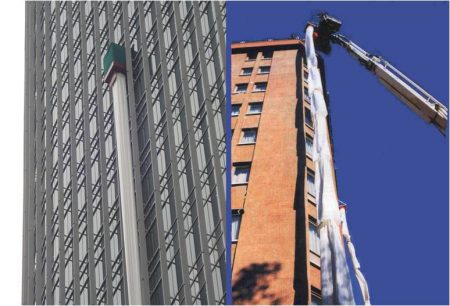
Called the Ingstrom Escape Chute (R), the technology has been developed by Mobiltex Evacuation Systems, a Swedish company. Is the technology new? No. On its website, Mobiltex describes it as “standard rescue equipment used by fire brigades worldwide for high rise rescue operations.”
What is its composition? It consists of three material layers. The outer containing fiberglass is fire resistant. The middle layer is Spuncell elastic and designed to allow those in the chute to manage a safe rate of descent. The innermost layer is Kevlar and designed to support the weight of the entire apparatus. Once inside the chute, evacuees are shielded from the fire, heat, and smoke. The chute can also be accessorized to include emergency lighting, exit light, walky-talky, and escape smoke hood.
How do people move through the chute? The illustration below shows how the chute conforms to the person descending and allows them to use their arms and legs to slow the rate of descent.

The chute can be installed permanently externally to a building with access from a balcony, ledge or window. Multiple chutes which would lie flat when not in use could give a building many escape routes.
The chute also comes with an internal multiple-escape system which if installed in a vertical building shaft could provide an effective escape route for many floors in case of fire.
A summary of the chute’s benefits follows:
I have no idea the price but it would seem to be an invaluable accessory to any firefighting operation in an urban setting. Too bad it was not available at Grenfell Tower.
]]>But ideas like this are worth sharing and I invite readers to get engaged in the conversation about the feasibility of this type of renewable energy solution, one that addresses many of the outstanding issues and concerns with present wind turbine technology, and a solution that with price reductions as it scales, could make wind attractive to Developing World countries.
Ian entitles his blog entry New Type of Wind Harvester.
If we must use wind power to appease renewable fans, then at least we should do it in ways that are less irritating to humans and wildlife and a little imagination can go a long way with today’s technology compared to the primitive, almost Victorian heavy engineering used for conventional turbines. This method should be a lot quieter, less visually intrusive, about the same efficiency but unlike wind turbines, potentially able to reduce in cost with Moore’s Law. Initial cost would be similar (the costings I mention are based just on their sample prices, which obviously are usually far higher than finished large scale production), so still nowhere near as good as using shale gas, but it could be. Even then, we’d still need backup generation for when the wind isn’t blowing.
Conventional wind energy harvesting uses turbines on a grand scale, connected to a central motor. The whole thing needs heavy engineering, complex control systems and expensive and scarce materials such as neodymium for the motors. It is possible to build a system that is far more elegant, resource-efficient and less intrusive. Perhaps even much cheaper.

Some time ago a Danish company Danfoss, invented plastic capacitors, that generate electrical energy directly when they are bent. Wind pressure could be used to bend small vanes made of this material by pushing it around a spindle. As it rotates, one side goes through extended, the other side is forced to bend on the way back through the gap. By repeated bending and extending every time it rotates, each vane would generate electricity from the wind. These could be arranged in long strings, and many strings made up into a large sail.
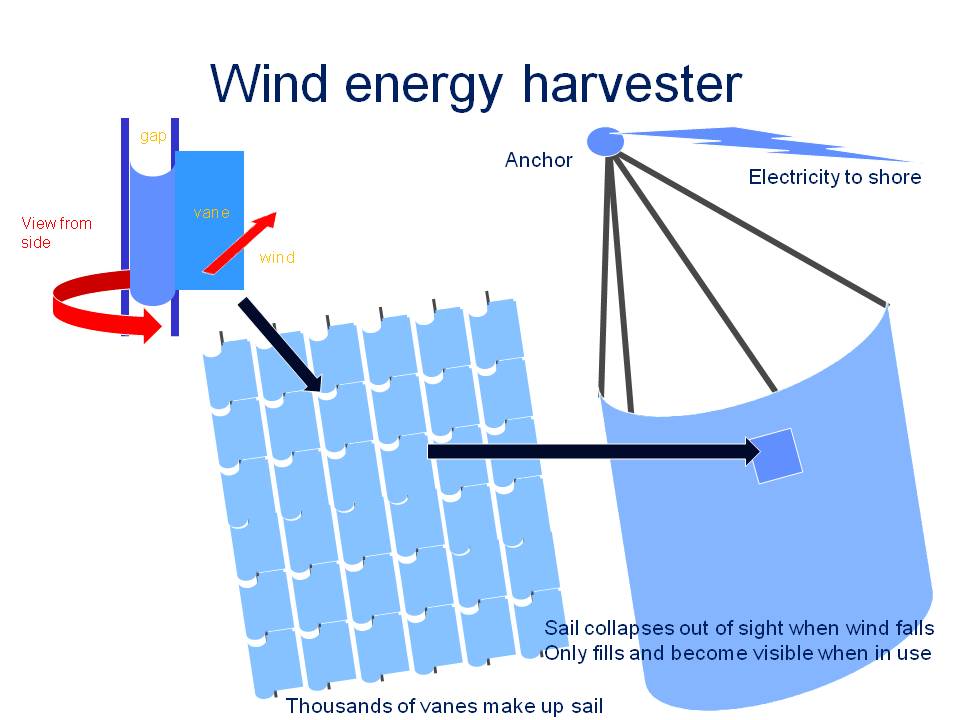
The sail would be tethered to an anchor using ropes, and when the wind blows, it would fill up, the vanes would rotate, and energy would be harvested, with no need for a central motor or any heavy engineering. When the wind dies down, the sail would collapse so that it is less visible. Because the vanes individually would be small, just 5-10 centimetres across, no motion would be visible from any distance away, so they would not be as distracting as conventional turbines. Nor would they kill birds. Plastic capacitor sail generators would therefore have a few advantages over conventional approaches.
The disadvantage is that at the moment the material is fairly expensive, but there are excellent prospects for large cost reductions, and these could make it a far cheaper, as well as a greener, way of harvesting wind power.
]]>