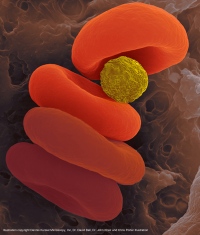
Researchers at Boston Children’s Hospital, however, have been experimenting with a new way of delivering oxygen to the blood using microscopic nanobubbles of oxygen encased in a foamy lipid suspension that releases the gas directly when injected like a vaccine. In the image below you can see one of the microscopic nanobubbles in yellow, adjacent to some red blood cells.
So far the test subjects, rabbits with obstructed airways, have remained alive and stable without taking a breath for 15 minutes. The results of this research have been published in the journal, Science Translational Medicine. What does this mean for victims suffering from pneumonia, a heart attack, stroke, asthma, drowning or airway injuries? When administered the microscopic bubble infusion temporarily stops the hypoxemia, which can give a medical trauma team the opportunity to restore airway or lung function. From rabbits to larger animal trials and finally human clinical trials, we may soon see this discovery become a regular part of CPR and emergency medical procedures, saving countless lives.
The current maximum time of use for microscopic nanobubble injections is 30 minutes with serum volume being the limiting factor. The researchers, however, are working on increasing the ratio of microscopic bubbles to fluid to extend the therapy.
]]>