The aviation industry has been described as laggards when it comes to developing alternative power sources for its jet and turboprop fleets. But it is already in the process of developing electric-powered, and hybrid aircraft designed to provide short-distance service of 1,600 kilometers (1,000 miles) or less. This type of distance is, unfortunately, much more costly to fly than transcontinental and transocean flights. How much more so? By a 3X to 5X factor. But in terms of practicality based on the limits of power from batteries, that appears to be the electric aircraft sweet spot. And then there are the power-to-weight ratio requirements for airplanes during takeoff and at various moments during a flight that, at the moment don’t square with the energy derived from current battery technology.
So with all these constraints, it shouldn’t be a surprise that the two largest aircraft manufacturers in the world, Boeing and Airbus, are both tinkering with prototypes. At the Paris Air Show, Airbus General Manager in charge of electrification, Glenn Llwewllyn describes why the company is looking at electric power describing carbon dioxide emission reductions as the primary motive. The company has two projects underway working with Rolls Royce and Siemens on both pure electric and hybrid-electric airplanes, the latter which it hopes to test fly by 2021. Boeing has been working with Zunum Aero, with hopes to have its 12-passenger hybrid-electric jet flying by 2022. Other Boeing projects are looking at electric-powered vertical-takeoff-and-landing (VTOL) projects such as the Nexus, more akin to a helicopter than a commercial aircraft.
How close, then are we to seeing electric-powered commercial flight? Airbus estimates at least ten more years before electric flight will be an offering in airline operations around the globe. But at present rates of development from the Big Two, it more than likely will be 20 years before we see electric and hybrid-powered airplanes flying regularly in and out of airports.
If Airbus and Boeing aren’t the players to bring electric and hybrid-powered aircraft to the market, then who is?
Currently, there are 57 other companies, universities and agencies trying to make electric and hybrid-powered flight a reality. But most of these projects aimed at short commuter operations, and some even looking more like flying cars than airplanes.
Despite the current reality, when faced with concerns about climate change tipping points in the near future, reporters and the public are asking why progress on non-fossil-fuel powered aircraft is not proceeding at a faster rate. The threat of a warming planet has taken on some urgency of late with CO2 and methane levels accelerating. States Andrew Murphy, Aviation Manager at Transport & Environment, a European Union (EU) organization set up to monitor environmental progress in transportation, “We have a pretty small timeframe to cut emissions … Either you don’t fly or you replace the fuel with something less carbon-intensive.” The EU’s Aviation Safety Agency has indicated its intentions to label aircraft by carbon contribution. And Sweden and Norway have both committed to short-haul flights to be exclusively powered by electric airplanes in 2040.
Some engineers argue that aircraft could better contribute to lowering GHG levels through the perfecting of fossil-fuel powered jet flight by dramatically improving efficiencies. Today’s jets, although far more efficient than the original Boeing 707s of the 1960s, remain inefficient in terms of performance versus amount of fuel burned.
This is where a hybrid-electric powered aircraft could prove to be a short to mid-term answer. With a hybrid drivetrain, the fossil-fuel powered jet engine could overcome the power-to-weight ratio issue on takeoff and during ascent, with the aircraft switching to pure electric power at cruise elevation.
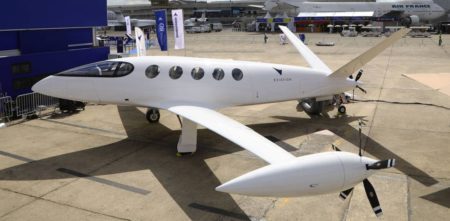
At the Paris Air Show, an Israeli company, Eviation, is showing an all-electric prototype called Alice. A nine-passenger commuter aircraft, Alice runs solely on electric power using motors developed by Siemens.
And then there is NASA whose scientists and engineers are developing hybrid gas-electric propulsion systems that could power an existing Boeing 737, and the X-57, an all-electric aircraft. In NASA’s planning, it sees the year 2035 and beyond as when sustainable alternatives to fossil-fuel powered aircraft will become mainstream.
The 4-stroke gasoline engine and electric motor are coupled together to spin the propeller. Both are engaged during takeoff and initial ascent. Once at cruising height of approximately 500 meters (1,500 feet), the electric motor begins recharging the airplanes 16 lithium-polymer batteries stored in the wings.
The airframe is a modified ultralight. So we are not talking about commercial passenger aircraft as of yet. That requires even more significant weight to energy performance improvements in batteries.
When asked about the potential of using hybrid-electric in future airplanes, the engineering team indicated that the aircraft they have created is a good test bed for demonstrating multiple-sources of powered flight. It requires much more research to make the technology leap to a commercial fleet of such airplanes.
Based on the current state of technology, modern commercial jet aircraft if flown using just battery power, would stay aloft for approximately ten minutes. So we have a long way to go before we can produce a viable electric-powered airplane. But a hybrid sounds far more doable and can provide a margin of safety beyond what is currently available in fossil-fuel powered aircraft whether prop or jet-based.


