In the 21st century, one would think we had made sufficient social progress collectively to not exhibit the behaviours described in this tale. But it seems, whether, from political expedience or our engendered and continuous fear of strangers as a social norm, these behaviours remain with us. There is no doubt that the human experience in encountering family, friends, or strangers is consistent. It is part of human self-awareness and our social construct that we live within a community based on kinship, family, and friends. In our modern industrial world that social construct extends to co-workers, to religious associations, to health and golf club relationships, and more. Through social media, we even have extended the network of kinship and community to include global ties.
But one aspect of our humanity has remained. We continue to define ourselves by our differences whether it be skin pigment, religion, or place of origin. These differences breed fear, hostility and a lack of compassion and empathy. And it appears to be hard-wired within us going back to our prehistoric origins. Self-identity very much comes from social groupings. That is the glue that keeps us comfortable in our place, within our family, our religion, our neighbourhood, our village, town, city, or nation.
For those who believe in the narrative of religion whether it be the Torah (the Pentateuch), Old Testament, New Testament, Koran, or other sacred text, there are many descriptions and parables to describe interaction with strangers, not all of them kind. Religious narratives sometimes command us to love strangers and at other times to reject them even to the point of drawing a sword against them.
My parents were Jews. They passed away nearly two decades ago. I was raised as a Jew, had a bar mitzvah, and sang in the synagogue choir. But at some point I became a non-believer. If I were to put a label on me I would say I am an atheist. Having studied religion from a historical and anthropological perspective in university, I see in it the contradictions that reinforce fear of strangers.
I have vivid memories of being the stranger from my youth to more recently. Where I grew up in Montreal, Catholics and Jews lived side-by-side. There was a convent school just around the corner from our brownstone apartment. Every year between Christmas and Easter, I witnessed incidents of antisemitism. Younger Jewish children were victims of beatings or thefts from older Catholic children in the neighbourhood.
It was no different when my family moved to Toronto where I was beaten by older Christian children while in Grade One. It is no wonder that such things happened since the abusers were subject to the messaging of religious leaders like the reverend who came to my Grade One class and told my fellow students that the Jews killed Jesus. When I stood up and called him a liar I got sent to the principal’s office where I was told I couldn’t say such things to my elders even if what they were spouting was possibly untrue. Years later as a teenager, when swastikas were painted on a synagogue around the corner from where we lived, that sense of being a stranger within the larger community was reinforced. And then again when I got my first full-time job, and my boss talked about “jewing” people out of money, an offensive expression of hate.
The events of this past weekend, the previous week in the United States, and the messages of fear and hate spouted by America’s current president, Donald Trump, illustrate how little has been our social progress since humans first evolved. Today’s strangers are people who dress differently, and who look different. They are people from outside the community, beyond borders, seeking a better life for their families.
The messages of hate the stranger have become a norm in our political discourse. Even here in Canada it is becoming apparent. In our most recent Toronto municipal election, a person spouting antisemitic vitriol finished third on the ballot to become mayor. And in the province of Quebec, a newly elected centre-right government plans to enact legislation to ban religious headwear for those providing public services. The expression of being different in dress invokes fear of the stranger.
Is there a cure for this human behaviour? If we are to look at this purely through our genetic past, humans remain hard-wired to small-group thinking. Our evolution happened within these types of environments containing closely interrelated families. From time to time, the interactions with outsiders were often violent and sometimes added new genes to our small groups. That lead to offspring that sometimes looked different. Sometimes we killed these “aliens” among us, but other times our empathy and better nature overcame our fear. The diversifying of the gene pool through stranger interactions probably saved our species from extinction, but it didn’t alter our social instincts which remained committed to cooperating small groups and the natural fear of strangers, snakes, spiders, and things that go bump in the night.
Today, then, it is no surprise that humans continue to fear strangers, seeing them as threats, as foreign and alien. Whether migrants trekking to our borders in search of asylum and a better life, or those living within our communities that observe different traditions by wearing distinctive garb, or by practicing faith differently, or by eating different foods with different aromas, we feel threatened.
Cooperation and contact, the social conventions and behaviours that break down our fear are summarily rejected by many of us. In the minds of those who are fearful it is better to build walls and keep the strangers out. And in some of these minds, it is better to walk into a place of worship and spray bullets and murder whether the stranger is darker skinned, or wearing a prayer shawl, or praying to different manifestation of a god. In the minds of these fearful, it is equally better to listen to invective spread by political leaders who exploit the fear, than to reach out to the unknown and embrace the stranger.
This is the 21st century, not the 12th or even the first half of the 20th. We have witnessed the Crusades, Jihad, the Holocaust, Apartheid, Rwanda, Bosnia, the Rohingya, and other examples of fear-driven ethnic cleansing that comes with hatred bound to us by our biological roots. We have collective knowledge and wisdom that should allow us to move past our biology but nonetheless, from time to time, we continue to exhibit the worst in our nature.

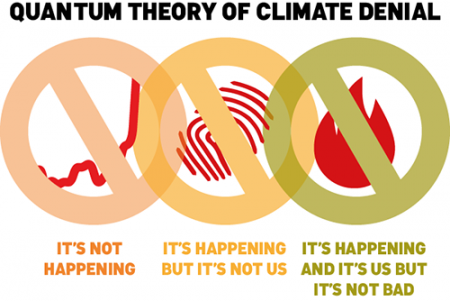
As an observing and reasoning species, the range of our reactions is highly variable. Many who look at climate change are utter skeptics. Some question any evidence that contradicts their beliefs. Some are unsettled by academic authority and see climate change as a conspiracy by elitists. Some, in acknowledging climate change, see a potential loss of their livelihood and lifestyle. This mindset is called identity-protective cognition and is all about self-preservation. System justifiers are all about keeping the status quo and any action to change this is seen as inappropriate. And then there are some traumatized by the notion making it easier to be in denial rather than face the evidence they often can see around them. And finally, you have those who defer to deniers seen as authority figures. This is called social dominance orientation. In a hierarchical society such as ours, when a leader calls climate change a Chinese hoax, if you succumb to social dominance orientation, you are compelled to believe him.
There is no doubt today that climate change has been politicized by figures like Trump. As a result, we are distracted from the science and the mounting evidence. We divide into camps. If conservative, despite the implied “conservation” in our name, we generally associate with deniers and skeptics. And if liberal, we line up with environmentalists and advocates for active climate intervention.
What has caused climate change?
A subset of humanity is the answer. The correlations we see in different data sets, rising carbon dioxide, methane, nitrous oxides, and other greenhouse gases in the atmosphere, and the mean global temperature rise almost in lockstep provides us with the evidence of what our lifestyle choices are doing to the planet. That’s not the lifestyle of the vast majority of us, but rather, that of a minority, largely located in the Western Hemisphere, or in locales with descendants of European origin. For those not identified within this lifestyle and geography, we see climate change victims, both present, and future.
Can climate change alter human behaviour?
Whether we accept that Hurricanes Harvey, Irma, and Maria are associated with climate change, or just three coincident extreme weather events happening within a 30-day window, it is our larger actions after that will give us an indication of our willingness to change.
Harvey’s disruptive impact in Texas, where flooding of a major American city has revealed poor decision making and lifestyle choices, should elicit policies and actions that mitigate against a future similar catastrophe. Will Houston and Texas institute better urban planning that acknowledges the increasing frequency and intensity of extreme weather events? Or will the city and state revert to the status quo?
For the Caribbean islands decimated by Irma and Maria, will the governments and citizens rebuild as before, or will they harden the infrastructure to withstand multiple 500-year storm events happening in less than 500-year increments? And will Florida re-examine its gung-ho shoreline development practices that continue to expose more of its citizens to climate risk?
What are the changes climate will bring this century?
Last year Scientific American, working with NASA Ames Research Center, compiled data for nearly every part of the planet and then applied a range of climate models to determine what our world will be like in 2100. From Alaska to Tuvalu, from Lagos to Cape Town, and from the Middle East to Melbourne, they created a picture of the conditions in these locales as the century turns.
It is not a pretty picture. Here are just a few projections:
Identity-protective cognition will not save us from these and similar outcomes. Clinging to the status quo, and continuing to live our Western lifestyle, will not stop what we more than suspect will unfold. Are we prepared to commit to the behaviour change that climate change necessitates?