Figuring out the expansion rate led to the discovery of what is known as the Hubble Constant (no relation to the telescope that goes by that name other than the same guy is being honoured in the nomenclature). The Hubble Constant preceded our launching of the Hubble Space Telescope by NASA. And today, because of measurements recently made through it by astronomers at John Hopkins University and the Space Telescope Institute, we are finding out that the Constant as currently calculated is, in fact, wrong by 9%. That means galaxies are moving away from each other even faster than previously thought.
The difference from previous observations is simply this. Galaxies are moving away from us here in The Milky Way at a rate of 73 kilometers per second per megaparsec. Megaparsecs are a unit measure used by astronomers. A parsec equals a light year. A megaparsec equals a million light years.
This doesn’t impact us in any way here on Earth but it is interesting science that confounds astronomers and cosmologists. Some hypothesize that the increased acceleration may be caused by the strengthening of dark energy, already the culprit scientists theorize explains the Universe’s accelerating expansion. Others have proposed a new subatomic particle, potentially a particle similar to a neutrino, that travels at close to the speed of light and is affected only by gravity. The accumulation of these supposed particles is referred to as dark radiation. And then there is the ever-present reference to dark matter, invisible and yet present like a shadow of visible matter that interacts in such a way with the Universe to explain accelerated values.
The paper can be accessed here for those of you sufficiently intrigued to learn more about Parallaxes of Galactic Cepheids as observed through the Hubble Space Telescope and what the implications are for the Hubble Constant.
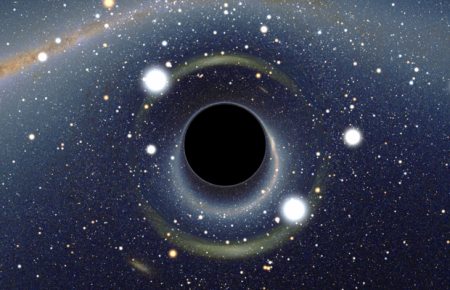
And then there is work by a UC Berkeley postdoctoral fellow, Peter Hintz, who hypothesizes that the laws of space and time break down in “benign black holes.” What is a benign black hole? It’s a black hole that is so large, the acceleration of objects close to the event horizon does not rip them apart. Fall into a benign black hole and theoretically, you can survive.
Hintz points out that his hypothesis is a thought experiment, a mathematical construct similar to that created by Einstein leading to general relativity. Einstein predicted the existence of black holes. Hintz now takes us inside one to find out what’s there.
In Hintz’ black hole the past no longer determines the future. As the traveler approaches the event horizon time would slow down. Light, gravitational waves and anything else falling into the black hole would stop time. Hintz doesn’t claim that benign black holes exist. In fact, he describes his thought experiment as conjecture plus mathemtatical formulas.
But he does reference Alice in Wonderland and asks what it would be like to drop into a black hole stating “She will not be able to say what is going to happen.” What it means is Alice will permanently live at a moment in time with no past or future.
Put that in your pipe and smoke it!
Now to the business at hand. In the movie, 2001: A Space Odyssey, based on an Arthur C. Clarke science fiction novel, the words appearing in this posting’s title are quoted near the film’s end. How Clarke could guess that Europa might be the likeliest place to find life in the Solar System other than here on Earth remains a mystery to me. The technology to glean such information from Earth-based observation was insufficient to draw such conclusions. So yesterday when NASA announced findings from pictures and video images taken by the Hubble Space Telescope of Jupiter’s moon, you had to expect that the media would pull out Clarke’s novel and quote those words.
What did NASA share with us?
Strong evidence of the existence of water vapour erupting from Europa’s surface. States Geoff Yoder, Acting Associate Administrator for NASA’s Science Mission Directorate, “Europa’s ocean is considered to be one of the most promising places that could potentially harbor life in the solar system.”
What ocean is he talking about?
Europa is covered by an icy crust under which astronomers have suspected the existence of an ocean of salty water greater in volume than all the oceans here on Earth. And where Jupiter’s gravitational pull causes fissures to occur in the icy Europan crust, water appears to be escaping to the surface.
Observations by a team from the Space Telescope Sciences Institute (STSci) in Baltimore announced they have observed plumes of water rising 200 kilometers (125 miles) above the moon’s surface.
How could they see these plumes?
States William Sparks of STSci “The atmosphere of an extrasolar planet blocks some of the starlight that is behind it….if there is a thin atmosphere around Europa, it has the potential to block some of the light of Jupiter, and we could see it as a silhouette. And so were were looking for absorption features around the limb of Europa as it transited the smooth face of Jupiter.”
What does this all mean?
Over 15 months on 10 separate occasions scientists at STSci observed 3 incidents of plume eruptions (see the image below and note the suspected plumes in the bottom part of the picture).
These new observations confirm those made in 2012 by the Southwest Research Institute in San Antonio, which detected water vapour eruptions in Europa’s south polar region. Those eruptions were estimated to reach 160 kilometers (100 miles) in height.
The latest results will be published in the September 29th issue of the Astrophysical Journal.

When the James Webb Space Telescope is launched in 2018, one of its immediate tasks will be to confirm the Hubble’s observations. But NASA scientists are seemingly convinced that the discovery of water vapour plumes justifies seeking funding for an orbital mission to Europa in the 2020s to observe the moon close up. No landing is planned and not because of Arthur C. Clarke’s prescient words, but because the orbital mission should be able to sample the ocean by flying through the plumes. What it may find could tell us that indeed, we are not the only place in the Universe where life exists.

For NASA, an unexpected increase in its budget has livened up the agency for 2016. The increase amounts to $1.3 billion U.S. In the past that would have been swallowed up by a little more than two Space Shuttle missions. But with the ending of that program, the money can be used for many interesting and exciting projects. One of them is the building of a deep space habitat for human occupancy, a home for crews not only in transit beyond the Moon but a technology that could serve as a base on the surface of Mars. The American Congress specifically directed the agency to take $55 million from that budget and build a prototype by 2018.
I have written here in the past about the steps needed for human exploration of outer space beyond low-Earth orbit (LEO). Since the Apollo Moon landings no human has ventured far from LEO which provides the protection of Earth’s tenuous upper atmosphere and the planet’s bulk and magnetic fields to shelter crews from solar flares and cosmic rays. In fact, the furthest out we have gone after 1972 is the repair missions (see picture below) to the Hubble Space Telescope, approximately 550 kilometers (340 miles) above the Earth.

Some engineers and scientists point out that LEO isn’t really outer space and until we address the challenges that Deep Space will throw at us we remain planet bound. Putting money into a program that perfects space habitat technology, therefore, should be financing well spent. And it will come in at 1/10th the cost of past Space Shuttle missions.
NASA, to execute its Asteroid Redirect Mission, needs this type of technology. A habitat adaptable for use in space for that mission, or for longer missions beyond the Moon to Mars, is a prerequisite. Any habitat designed for space would be equally useful on the lunar or Martian surface.
In Building 4649 tucked away at NASA’s Marshall Space Flight Center, a mock up of a proposed deep space habitat sits, far from being a finished design. Pictured below from a photograph taken in 2010, it appears to be a project orphan, long forgotten.

What will it take besides money from Congress to get NASA where it needs to go? A solution exists in seeking private-public partnerships with commercial aerospace companies. Such initiatives have always been part of NASA’s mandate from the early days of human space flight. The most recent success stories have cleared for flight two commercial carriers, SpaceX and Boeing, to provide crew replacement flights to the International Space Station (ISS).
Similarly NASA habitation partners are already in place. In a November 2015 Human Exploration and Operations Mission Directorate report, it references a number of commercial partners. Of the 72 milestones established by NASA related to human space flight for the year, the report states that 56 were met, a 78% success rate. Some of these successes covered habitation system requirements for living in Deep Space with a focus was on life-support systems, radiation protection, fire safety and durability. The objective for the last requirement specifically references achieving a habitation capable of enduring an 1,100 day mission. Contributors to these milestones included Bigelow Aerospace, the company that is scheduled to install one of its expandable habitable BEAM modules on ISS this year.

In addition to Bigelow, the report references Lockheed Martin, Boeing, Orbital ATK and Thales Alenia, the latter a principal contractor for ESA’s ATV cargo capsules used to resupply ISS. Not mentioned is SpaceX but I wouldn’t be surprised to find them involved in the near future. After all, Elon Musk, SpaceX founder, has stated in no uncertain terms that he founded his company to develop the technology to establish a permanent human presence on Mars.
In the short term NASA, in accepting the added $55 million, is required to provide the U.S. Congress with a report on its deep space habitation plans within the next 180 days.


This is a first. Up until now astronomers had speculated that many asteroids were icy bodies or contained large amounts of water ice. Now this speculation is confirmed.
The Dawn mission, NASA’s multi-asteroid robotic voyage that orbited Vesta for more than a year, is on its way now to Ceres to make much closer observations. It should arrive in the spring of next year.
Ceres is 950 kilometers in diameter. When first discovered in 1801 it was named a planet. But that was before many more asteroids were spotted orbiting between Jupiter and Mars. Today it is classified as a dwarf planet along with Pluto and other recently discovered objects within the Oort Cloud that surrounds our Sun beyond Neptune.
Scientists believe Ceres combines a rocky core with a thick ice mantle. The reason water vapor has been detected is believed to be a function of the dwarf planet’s orbit with it currently closer to the Sun. At this position its icy surface is warm enough to allow water vapor to plume from the surface. The scientists have even been able to detect where on its surface the water is coming from. Two dark spots detected by the Hubble Space Telescope are believed to be the source of the water.
Icy plumes have previously been detected on Europa and Enceladus, the former a moon of Jupiter, the latter of Saturn. And icy plumes jetting off comet surfaces have been known for years. Now, for the first time however, we are observing the same phenomenon from an asteroid or dwarf planet.
What this tells us is that, in our Solar System, water is abundant. And where there is water we may find the building blocks of life similar to here on Earth.
The colour image below taken by the Hubble Space Telescope in January 2004, shows both light and darker surface features on Ceres. When Dawn arrives we will learn so much more about this giant of the Asteroid Belt.


