
How does LEIA work? The images are created using conventional liquid crystal displays (LCDs). In regular LCD imaging the you have a light source and a light guide. The guide directs light from the source to specific pixels in the display to create the images you see. The LCD controllers vary the amount and type of light to create colour and definition.
LEIA replaces the standard light guide with a more sophisticated version containing nanoscale grid technology (see image below) that has greater control over the direction light emissions travel. Instead of single ray of light the LEIA light guide splits the light into 64 different rays before encountering the LCD pixel array. This breaking up of the single image into 64ths creates the holographic representation perceived by the viewer.

Currently LEIA works only with small displays. The first prototype is 5.6 centimeter (2.2 inch). At that size it can be integrated into a smart watch. The next iteration at 14 centimeters (5.5 inches) is approaching the size where it could be used in smartphones.
The company is talking to appliance and automobile makers where it believes its technology will have direct application.
Is it close to producing a windshield-sized 3D display?
Not yet. In breaking images into 64ths resolution gets lost. This is not apparent in smaller form factors where the holographic imaging appears sharp.
Look for the first LEIA displays in handheld devices and maybe even in display screens for new car models as early as 2017.

Back in June Meta started a Kickstarter campaign that soon exceeded its $100,000 goal by almost double. Now the company is ready to take advance orders for its production prototype which should be available by June 2014.
Priced at $3,000 U.S. it features a 1280 x 720 pixel display with 40 degrees field of view. The optics provide enhanced 3D depth delivered by twin full RGB colour cameras, supported by accelerometers, gyroscope and compass.
A consumer version is slated to follow but no date has yet to be announced for its release. It will be priced at $667 U.S.
Meta’s immediate competitor is the well publicized Google Glass, priced anywhere from $500 to $1,500 U.S. but expected eventually to drop to around $299.
How does Meta compare? According to its inventors MetaPro will provide 15 times the display, not 2D but full 3D, and finally full hand gesture recognition. Sort of a Google Glass+.
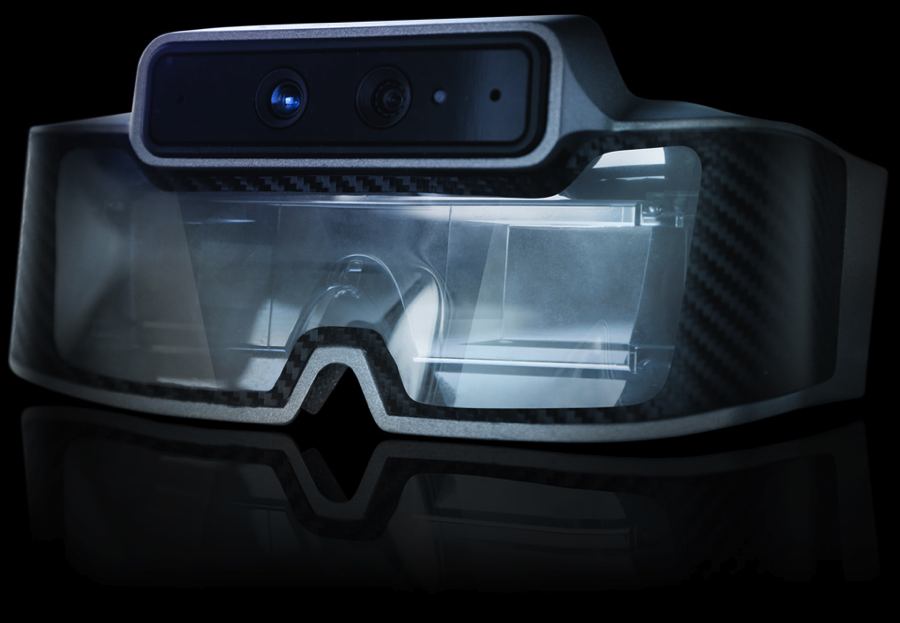
For a demonstration of what MetaPro can do watch the YouTube video.

