
The Hindenburg was the world’s largest airship, as big as RMS Titanic, the “unsinkable” ship that made the world aware of the potent danger of icebergs back in 1911. But like Titanic, the Hindenburg succumbed to nature. What happened at Lakehurst took a mere 40 seconds, probably ignited by a build-up of static electricity in the air after a passing thunderstorm. That combined with inflammable paint coating the sealed hydrogen storage cells within the airship’s structure ignited a spark that started the fire. Of course, if Hindenburg had used helium rather than hydrogen there never would have been that all-consuming fire that caused 36 people to die that day.
To this day when presented with hydrogen as an alternative clean fuel to replace gasoline and diesel, there is general consumer resistance. Today Toyota, Hyundai, and Honda are building hydrogen-fuelled cars. But who is buying? Not many. In an April 14, Wheel24 Motoring News article it states, “Honda, Toyota, and Hyundai have leased a few hundred fuel cell vehicles over the past three years, and expect to lease well over 1,000 in 2017.” The article continues describing General Motors supplying the U.S. Army with fuel-cell pickup trucks. But not much more is happening with hydrogen. When you compare purchases in the U.S. of electric to hydrogen-powered vehicles, the ratio is 80:1 in favour of the former over the latter in 2016.
But not much more is happening with hydrogen. And when you compare purchases of electric to hydrogen-powered vehicles in the U.S. in 2016, the ratio is 80:1 in favour of the former over the latter.
Hydrogen is clearly not catching on with consumers or the fueling network needed to deliver the gas to consumers. Here are what I believe are the most likely reasons for hydrogen’s virtual invisibility to American consumers today:
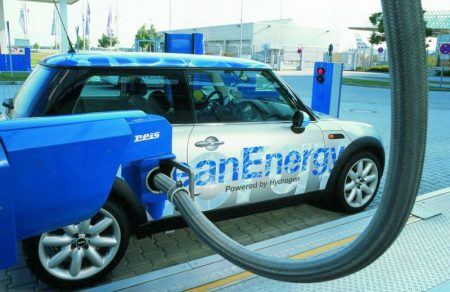

The memoru of the Hindenburg disaster is long in the past and hydrogen and Germany are once more crossing paths in two interesting projects.
Creating a Hydrogen Fueling Infrastructure
Germany is building a network of hydrogen fueling stations with Royal Dutch Shell the primary contractor. The goal is to have 400 across the country by 2023. Shell is betting on hydrogen to be a common energy source for fuel cell cars and trucks in the next decade. Germany is planning to eventually build 700 sites, considered optimal for maximizing the operation of hydrogen-fueled vehicles.
To top up a hydrogen car takes about the same amount of time as traditional gasoline and diesel. Cost is about the same as well. And hydrogen has no range anxiety issues because fuel cell cars go just as far as gasoline and diesel.

Shell opened its first hydrogen station in Germany in 2011. Today it operates less than 20 across the country. Hydrogen is sourced from natural gas using steam-methane reformation. Shell is experimenting using water as the source, applying an electrolytic process as an alternative. That would make hydrogen a zero-carbon fuel. Storage requires cryogenic liquid compression and insulated tanks. These are triple-layered and made from woven carbon fibers.
Building a Hydrail
Germany’s second project is the building of a hydrogen-powered train network. Alstom, the French rail transport company is finishing the first one called the Coradia iLint. This 300-passenger train can run on any existing rail line within Germany, electrified or not. The train is quiet and emission free. The power source is fuel cells which generate electricity to drive traction motors. The hydrogen for Coradia iLint will be sourced from waste products produced by Germany’s chemical industry. The byproducts of these new trains are zero carbon, just condensed water and steam. The first is scheduled to start operations next December. Germany eventually plans to have 40 hydrail trains in operation with a target date of 2020.

Will a hydrogen fueling infrastructure and fuel cell passenger trains put German citizens at risk? Is there a chance the use of hydrogen will spawn “little Hindenburgs” blowing up from time to time?
Not according to Toyota who is building hydrogen fuel cell cars. Its Mirai, will be available in California and Japan this year. Toyota describes hydrogen as far less a fire hazard than gasoline or diesel even though the gas is 90% more volatile than those fuels. The reason why, hydrogen is 16 times lighter than normal air. On the Mirai the gas gets compressed to 69,000 kilo-Pascals (10,000 pounds per square inch). Stored in a carbon-fiber tank, if it springs a leak, hydrogen will immediately dissipate into the surrounding air. Not so with gasoline which in liquid or vapour can instantly become a fire hazard.
]]>When we started talking about transportation we briefly introduced how humans made the initial breakthrough to conquer the air in the 20th century using heavier-than-air technology. The 21st century will feature a wide range of technologies for air passenger travel and transport. These technologies will include alternatives to the airplane to address energy conservation and the need to reduce carbon emissions. One of these technologies, the airship, is the subject of this blog.
Airships: What Are They and Where Are They Today?
In North America at every major sporting event we see a descendant of airships hovering over the venue giving us a bird’s eye view of the playing field. These lighter-than-air blimps, as they are called, are powered balloons. They are not airships in the true sense because they contain none of the rigid framework that characterizes that technology. To understand the difference between blimps and airships, let’s look at the history.
For a period in the 20th century Germany and Great Britain turned to airships to cross the Atlantic Ocean. This was before passenger airplane technology had the capability to make a non-stop flight across several thousand kilometers of open ocean. What were these airships?
They were aluminum alloy frameworks covered by a weatherproof cloth with vertical and horizontal fins attached at the tail. Vertical fins acted as rudders. Horizontal fins allowed the airship to climb or descend. Internally airships contained impermeable bladders called gas cells. These were filled with lighter than air gases, either hydrogen or helium. Crew and passengers were accommodated either within the structure or in a suspended cabin attached to the bottom of the frame. Internal combustion engines turned rear-facing propellers that pushed airships at speeds of 130 kilometers (80 miles) per hour.
The name most associated with airships, Zeppelin, appeared in 1900 with the launch of a series of airships in Germany. Count Ferdinand von Zeppelin perfected the airship and during World War I manufactured a fleet of them for the German military to use in bombing raids over Great Britain. Zeppelins, as they were called, proved to be impractical weapons of war because they provided British flyers and antiaircraft batteries with enormous, slow-moving targets.
After the war the Zeppelin and other commercial manufacturers found a peaceful purpose for their airships, offering passenger service between major European and North American cities. The Graf Zeppelin, an airship built in 1928, flew around the world in 1929. In 1936, the Hindenburg, the largest airship of its time, began a regular transatlantic passenger service between Germany and New York City.
The cause of the Hindenburg disasterremains unknown but the use of hydrogen gas made fire inevitable as a consequence of whatever accident occurred at Lakehurst, New Jersey on May 6, 1937. Germany lacked helium. The United States was the world’s largest producer at the time and restricted export to what was then Nazi Germany. The combustible nature of hydrogen gas made the airship particularly vulnerable to almost any accident that could cause a spark. Whether it was a snapped cable, or static electricity, the hydrogen gas in the Hindenburg ignited and the craft crashed to the ground killing and injuring dozens of passengers and onlookers. The Hindenburg’s demise sounded the end of passenger airships although the Graf Zeppelin continued to fly until 1940 just after the outbreak of World War II.

Blimps survived the demise of airships, largely serving as flying billboards, or sky-mounted camera platforms. Unlike airships blimps lack the structured aluminium framework. Instead the engine, fins and crew cabin are attached to the blimp’s outer skin which remains rigid because of the helium gas contained within it. Goodyear is the brand most associated with blimps. But the technology that Goodyear is using today may soon be replaced by new designs that incorporate new materials and engine capability.
One of the pioneers in delivering this new type of airship is Aeros, operating out of Montebello, California. The Aeroscraft is a rigid variable buoyancy airship with vertical takeoff and landing capabilities. Unlike blimps and airships of old, Aeros technology uses dynamic buoyancy management and not water ballast to keep afloat and on an even keel. More aerodynamic in shape than traditional blimps and airships, the Aeroscraft contains helium cells that hold up to 400,000 cubic meters (14 million cubic feet) of the gas, negating 65% of the aircraft’s weight. The forward and aft fins, called canards and empennages respectively, create additional lift.
Almost 2oo meters in length and as tall as a 14-storey building, Aeroscraft has a cruising range of close to 10,000 kilometers (6,000 miles) and a top speed of 280 kilometers (174 miles) per hour. Aeroscraft can be used as a flying hotel, or as a payload carrier capable of delivering materials to remote areas inaccessible because of terrain or lack of roads. Aeroscraft requires no ballast and can handle payloads of up to 400 tons or 250 passengers in a hotel-like cruise ship setting.

Pelican is a Pentagon funded smaller airship being built by Aeros to deliver payloads of 60 tons to remote locations. Like its larger cousin, Aeroscraft, Pelican uses a rigid-aeroshell,variable-buoyancy from pressure-stored helium, an impermeable helium cell, and a load-bearing internal frame made of carbon-fiber. The Pentagon sees it as a quick deployment, strategic aircraft for delivering soldiers or equipment to staging areas with greater load capacity than helicopters and vertical-take-off and landing capability.
Future Uses of Airship Technology
Aeroscraft and its successors may find themselves being used for a variety of applications as this technology matures. Here are just a few that take us past the flying billboards of present day: