How does it work?
Ambient air when cooled sufficiently to temperatures of -196 Celsius (-320 Fahrenheit) degrees, turns into a liquid that can then be stored in low-pressure, insulated vessels. When the liquid air is then exposed to room temperature its rapid expansion as it becomes a gas can be utilized to generate a sufficient force to drive a turbine.
Just how much does the air expand when going from a liquid back to a gas? 700 times the volume, yielding a significant amount of force.
The patented technology was launched in 2018 and is already drawing interest from energy utility companies and engineers from Finland to Spain, South Africa, and the Middle East.
Highview recently partnered with Citec, a Finnish company, to turn its proof of concept battery into a modularized system that grows from 50 to 500 Megawatts. This is the technology the company intends to sell globally.
What makes the CRYOBattery unique?
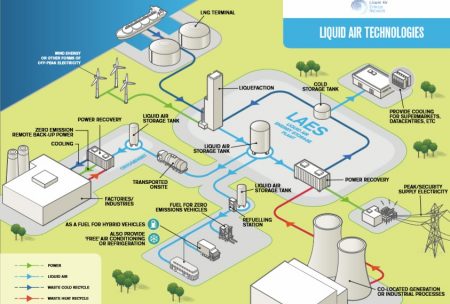
The CRYOBattery combines three processes that form a complete thermodynamic cycle including charging, energy storage, and power recovery. The schematic displayed below shows how it works.

CRYOBattery can be collocated with an existing facility such as a thermal-power plant, a liquid-natural-gas regasification plant, peaking plants, and manufacturing plants such as steel mills where it can use the waste heat and cold from their processes to power its thermodynamic cycle.
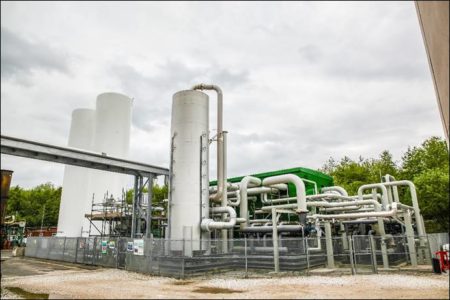
First tested at Slough Heat and Power, a Greater London utility, over a three year period from 2011 to 2014, the technology continues to be tweaked at the University of Birmingham Centre for Cryogenic Energy Storage. In April 2018, the first fully operational demonstration plant was constructed at the Pilsworth Landfill site in Greater Manchester (see image below) where it captured the waste heat for kickstarting cryoconversion of the air.
The CRYOBattery is capable of operating in standalone mode as well. But at Pilsworth it is coupled to the landfill gas and heat recovery system. It similarly can be coupled with other power generation facilities.
The CRYOBattery can be easily fabricated and run anywhere and has a rated lifespan of 30 plus years producing power from thin air. And even better it is a zero-emission technology that is 60% energy conversion efficient in standalone and 70% efficient attached to an existing facility.
The company estimates the market size for energy storage by 2040 to be as much as $1.1 trillion with forecasted cryogenic energy storage contributing just under $300 billion in revenue for operators while generating 208 GigaWatts of power for lighting, and heating.
Alex Eller, a Senior Analyst with Navigant Research, states, “Long-duration technologies such as cryogenic energy storage will become increasingly necessary for an electricity system to transition from a primary reliance on conventional fossil fuel generation to a grid dominated by variable renewable generation from solar and wind.”
The CRYOBattery was recently named the winner of the 2019 Ashden Award for Energy Innovation, an award given annually for achievements in increasing access to sustainable energy.
I’ve written about a variety of these types of options from pumped storage that pushes water uphill to a reservoir and then releases it flow down to power turbines and generators, to compressed air stored in sealed buildings or underground impermeable reservoirs. But this new facility near Manchester is something new.
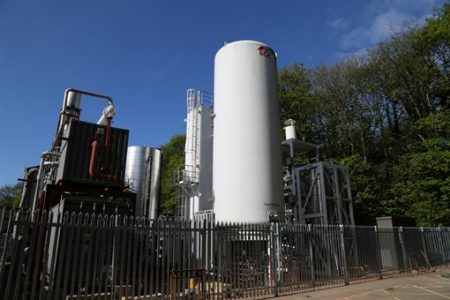
The Pilsworth Liquid Air Energy Storage (LAES) plant opens today. Developed in conjunction with The Birmingham Centre for Cryogenic Energy Storage, University of Birmingham, LAES is owned and operated by Highview Power and has a capacity of 15 Megawatts or enough electricity to serve 5,000 homes continuously for three hours. The Pilsworth facility is a pilot project. A larger plant is planned with a capacity of 50 Megawatts.
So how does LAES work?
The plant uses coolants to decrease air it takes into the system to -196 Celsius (-321 Fahrenheit) degrees. At that temperature, the air liquefies making it easy to store as a cryogenic fluid. In fluid form the air volume is dramatically decreased which makes the change of state from liquid back to air a means to exert sufficient force to drive turbines which then generate electricity.
The plant which has been built on a landfill site outside Manchester is a finalist in the United Kingdom for being the BusinessGreen Renewable Energy Project of the Year. The award is to be presented June 27, 2018.
The process is similar to that used for liquefying natural gas which involves super cooling and compressing the fossil fuel into liquid form. But instead of natural gas the fuel is ambient air. The energy sources to operate LAES can be waste heat from landfill or industrial plants, or can be off-peak period electricity generated from any power source. Regardless the energy derived is used to power conventional air conditioning absorption chillers which cool the ambient air drawn into an industrial air separation unit. For every 700 liters of ambient air, LAES creates 1 liter of liquid air which gets stored in an insulated, unpressurized tank. When heated the liquid air boils and gets converted back to 700 liters of air. The pressure exerted by this phase change from liquid to gas is used to drive a turbine connected to a generator.
The University of Birmingham is also experimenting with liquid nitrogen rather than ambient air largely because there is are existing commercial industrial sources for that gas with a transportation infrastructure to make it readily available. And because nitrogen is the most significant gas in our atmosphere (four times greater than oxygen), using it for LAES as opposed to ambient air, seems doable on a commercial operating scale.
The University of Birmingham has prepared a report which can be downloaded from its site entitled “Doing Cold Smarter.” In the report, it proposes an emerging “Cold Economy.” An illustration of the various ways it believes liquid air technologies could be deployed can be seen below. It is noteworthy that the technology would produce net-zero emissions which makes it attractive in the effort to combat global climate change. To learn more watch this YouTube posted video.