Genetically modified seeds were first produced As background the study provides the following statistics.
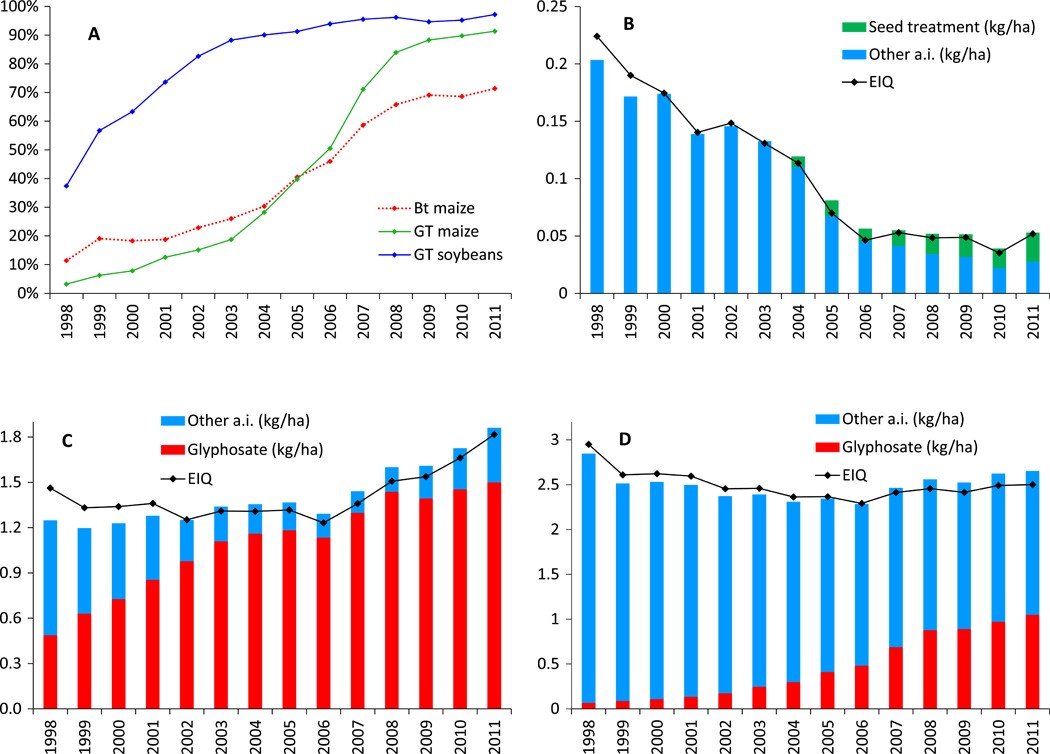
The four graphs appearing above appear in the study. The top left graph illustrates adoptions of GT soybeans, corn and a third genetically modified corn containing genes from Bacillus thuringiensis, hence BT. The top right graph shows the amount of insecticide used on corn plantings over the duration of the study. The lower left graph displays herbicide use on soybeans and the lower right herbicide use on corn.
Striking trends noted in the study:
University of Virginia economist, Federico Ciliberto, who led the study states in reference to the last trend described above, “In the beginning, there was a reduction in herbicide use, but over time the use of chemicals increased because farmers were having to add new chemicals as weeds developed a resistance to glyphosate…Evidence suggests that weeds are becoming more resistant and farmers are having to use additional chemicals, and more of them.”
The challenge of humans attempting to fight biological adaptation is well illustrated by Ciliberto’s comment. For every genetic modification made to a crop to improve yields the natural world learns to adapt and eventually evolution yields a resistant solution. The downside to all of this is the escalating war has unintended consequences such as negative impacts on useful insects and biota that help farmers as well as increased air and water pollution from application of herbicides and insecticides.
Can agricultural science find a better way to ensure increasing crop yields and stave off the impacts of climate change both present and future while minimizing unintended consequences? The chemical companies like Bayer (Monsanto’s purchaser), Dupont, BASF and others may be reaching their technological limits in helping plants adapt to what nature can throw at them. So what next?

If you eat cereal out of a box, then you are consuming GMO food. If you use margarine then you are a GMO junkie. If you eat dairy then the cows that produce it are eating GMO crops to produce that milk, butter, cottage cheese and yogurt that you so much like. If you eat beef, pork, or lamb then you are taking in protein raised on GMO crops. But if you eat bread made from wheat flour then you are in the clear. No GMO wheat on the market as of yet.
What is Involved
What plants are GMO today?
What are the plants that will be GMO tomorrow? The foods listed below are those being tested by various bio pharmaceutical and chemical companies and are in addition to the ones named above. They come in four major groups and include:
Fruits: apples, cherries, cranberries, grapefruit, kiwi, melons, pears, persimmons, pineapple, plum, and strawberries.
Vegetables: bell and chili peppers, cabbage, carrots, cauliflower, cucumber, lettuce, mustard, olives, onions, peas, radicchio, radish, squash, sweet potato, cherry tomatoes, watercress, and zucchini.
Grains, Seeds and Beans: barley, coffee, popcorn, lentils, oats, rice, sugar cane, and wheat.
Nuts and Seeds: peanuts, walnuts, flax, and sunflower.
Who Is Involved
There are three major stakeholders involved in the business of GMO.
So consider this. If you live in North America, Europe, China, and Russia today the cereals, meats and cheeses you eat probably contain GMO content. The soda pop your kids drink and the beer you consume have GMO content. Many of the fresh foods you buy from grocery chains are GM foods. Corn, soybeans, potatoes, to name just a few, are all GMO. And cooking oils, butter and margarine have lots of GMO content as well. Is there a risk to consumers? Is there a correlation between diseases like cancer and GMO? In altering plants with exotic genes can we be encouraging the evolution of new bacteria, viruses, fungi and moulds that will lead to unforeseen consequences?
GMO – Cornucopia or Pandora’s Box
How do you weigh the benefits of GMO against these unknowns? If you don’t know what the benefits are to help you in forming an opinion here is a short yet incomplete list:
Two opposite quotes worth pondering on the GMO question whether we should or shouldn’t:
In his book, The Biotech Century: Harnessing the Gene and Remaking the World, Jeremy Rifkin writes:
“The Biotech Century promises a cornucopia of genetically engineered plants and animals to feed a hungry world ; genetically derived sources of energy and fiber to propel commerce and build a “renewable” society……But with every step we take into this brave new world, the nagging question will haunt us : “At what cost ?” …..Ecologists are unsure of the impacts of bypassing natural species boundaries. Consider, for example, the ambitious plans to engineer transgenic plants to serve as pharmaceutical factories for the production of chemicals and drugs. Foraging animals, seed-eating birds, and soil insects will be exposed to a range of genetically engineered drugs, vaccines, industrial enzymes, plastics, and hundreds of other foreign substances for the first time, with untold consequences.”
Or this comment from Dr. Ray Bressan, Professor of Horticulture and The Director of the Center for Plant Environmental Stress Physiology at Purdue University when he writes:
“We’ll soon be able to produce more crops with less pesticide, less fuel, less fertilizer, fewer trips over the field. We’ll produce much more with much less….A couple of years ago I wouldn’t have predicted this. But I now think that within a decade it will be possible to have crops that can withstand the stresses of early spring and late fall to such an extent that farmers could plant two crops of corn, soybeans, or wheat each year.”
So which is it? Is GMO the lady or the tiger in Frank Stockton’s epic tale? We shall soon see!

]]>
1. The cost of energy and the transportation of agricultural products
The rising cost of fuel and energy impacts agriculture many ways. Industrial farms in North America and Europe need to find ways to reduce hydrocarbon energy dependency. The grow local movement is reinventing the very definition of what is a farm.
2. Our changing view on chemicals, fertilizers, herbicides and pesticides.
We have created both a revolution in agriculture and a potential monster in making our crop yields so chemical dependent. In saturating the soil with herbicides and pesticides we have created new varieties of resistant weeds and insects. This ongoing accelerating arms race between our technical fixes and the evolution of pests is one that we could inevitably lose with catastrophic consequences.
3. Bioengineering of crops and livestock
Bioengineering is changing the very nature of what we grow and eat. We have always been in the business of bioengineering ever since humans first changed food sourcing from being hunter-gatherers to farmers. The difference today is our bioengineering is in the laboratory and not through selective fertilization in the fields. We are now inserting genes into the DNA of plants and animals to fundamentally alter the end products. We are growing meat in the laboratory rather than on hoof. We are farming bioengineered fish rather than catching wild varieties in the open seas largely because we have overfished and exhausted natural population regeneration.
4. Climate change
Our fossil fuel dependency is altering the climate raising temperatures, causing prolonged droughts and more severe weather events. The impact on agriculture from environmental change cannot be underestimated.
5. Fresh water availability
Whether we draw water from lakes and rivers or aquifers, cities compete with agriculture for what is becoming a very precious resource. What can we do when we start reaching the limits of fresh water accessibility?
6. Human population growth
Can we continue to grow enough to feed a burgeoning human population let alone our livestock? At 7 billion today and with predictions of 9 billion by mid-century, will agricultural intensification meet our food needs. Considering today that over 1 billion people on this planet are underfed or malnourished, what will that number be at the end of the 21st century?
7. Implication of biofuels on growing food
Do we grow crops to feed our engines or are stomachs? This is a basic dilemma in countries like the United States and Brazil where corn in the former and sugar cane in the latter are both food and fuel crops. Part of the challenge lies with the practicality of moving food from where it’s grown to where it’s needed. The United States has had huge corn surpluses for years. Farmers have been paid to not grow it. A food industry has grown up built around corn byproducts just to suck up the surplus yield. Now the surplus is being used for biofuel rather than being shipped to where it can feed the hungry.
If I have missed any issue please feel free to comment. The subsequent blogs on agriculture will explore each of these topics in greater detail.
]]>
