Helium-3 availability on Earth is a trickle. On the Moon, however, it is a flood because in the absence of an atmosphere, the solar wind has been depositing Helium-3 on the lunar surface for billions of years. The estimates of Helium-3 reserves on the Moon vary between 650,000 and 3 million tons. Current Helium-3 reserves here on Earth amount to less than 25 tons. Theoretically, 25 to 30 tons of lunar Helium-3 could fuel nuclear fusion power plants that would provide all the energy the United States consumes in a year.
Mining on the Moon contravenes United Nations treaties. Back in 1967 and again in 1976, led by the United States and the Soviet Union, a treaty outlawed the exploitation of nonterrestrial resources, describing the Moon as a sanctuary of development. A 1979 treaty further reinforced the notion of leaving the Moon in its pristine state, much like international treaties involving Antarctica. Outer space would be reserved for scientific exploration and study, and human activity would be restricted to exploration, and our hands would be clean in the event of an encounter with extraterrestrial intelligent life that is more environmentally conscious.
Have things changed since 1979? Yep! The proliferation of non-scientific satellites in low-Earth and geostationary orbit space today counters the intentions of those who drafted these early outer space treaties. Space is now seen as a place to make profits with constellations of telecommunication satellites circling the globe, and the mining of asteroids, the exploitation of cislunar space and the Moon itself as the next phase in our commercial conquest.
A Seattle-based company, Interlune, founded by a former head at Blue Origin, Rob Meyerson, is one organization that intends to exploit lunar resources for profit. It has recently made several announcements, including:
On the company’s website, Meyerson states :
“For the first time in history, harvesting natural resources from the Moon is technologically and economically feasible. Now we embark on a new era of lunar exploration to create an in-space economy that will sustain humanity for millennia.”
The mining of the Moon won’t stop with Helium-3. The Moon is seen as a vital source of materials, including water, oxygen, metals, rare earth elements, and volatiles. The lunar soil, called regolith, is also being simulated here on Earth to see if it can be used in basic construction to replace Earthly concrete.
One reason to land America’s return-to-the-Moon Artemis Mission near the lunar south pole is to place the landings close to where these material resources are easily obtained. The shadowed craters of the polar region are believed to house ice, which can be turned into water. Water can be used for radiation shielding, drinking, and when split into breathable oxygen and hydrogen fuel.
The regolith, in addition to being a good building material for habitat, road and landing pad construction, is a rich source of essential materials including oxides (breathable air and rocket fuel), iron, titanium, aluminum, rare earth elements, ammonia, methane, carbon dioxide and carbon monoxide.
Where Meyerson wants to harvest Helium-3 and export it from the Moon to Earth, these other valuable materials would be assigned for In Situ Resource Utilization (ISRU). ISRU is front and centre for NASA in its plans to establish a permanent human presence on the Moon and later on Mars.
ISRU means that critical materials launched by rockets from Earth would no longer be required. Drawing on in-situ lunar resources for life support, energy production, propellant, and construction, however, replaces all those good intentions described in the outer space treaties of the late 20th century. We are no longer interested in preserving the pristine nature of the “off-worlds” humans encounter, but rather, in their exploitation and profits.
]]>The last time Americans visited the Moon was 1972. At the time they came “in peace for all mankind.” They explored, took pictures, picked and packed some rocks, left scientific instruments on the surface, and then left. For a long time, the attitude of the United States about the Moon was “been there, done that.” But now President Trump has his latest hot notion to create an American Space Force. Suddenly the Moon has become a strategic military and natural resource asset that must be protected by the United States. What doesn’t matter is that the creation of the Space Force would be a contravention of the Outer Space Treaty of 1967 to which the United States is a signatory.
The American Space program, it seems, is returning to its roots which began as a military exercise in response to the launching of Sputnik 1 by the Soviet Union in 1957. The first American attempts to put satellites into space came on military rockets. America saw Sputnik in military terms. The Soviets would hold the high ground of space and would spy on everything the United States was doing. Eventually, Americans saw the Soviets as weaponizing satellites to fire missiles on American cities and military installations. That threat remained on the mind of the American military throughout the 1960s.
The beginning of the thaw came when the United States civilian space program under NASA beat the Soviets to the Moon in a series of lunar landings with astronauts aboard. The Soviets waved the white flag in the Space Race. Soon to follow was a thawing of the Cold War first in space and then on the ground. In both nations, Soviet and American space programs became more civilian in nature. That cooperation continued leading to today’s International Space Station.
Military activity in space hasn’t gone away. Spy satellites have been launched by both countries over the years to check each other out. But no weapons have ever made it into space, the notable exception, a Soviet rifle which was brought along by cosmonauts just in case when they landed on Earth and opened their Soyuz capsule, they weren’t going to be staring at a hungry bear. Today, outer space is dominated more by satellites studying land use, Earth resources, and weather, and delivering telecommunications services to billions on the planet below, than by payloads sent aloft to spy.
The Moon through all this post-Apollo time has remained sacred, unspoiled ground, equivalent to Antarctica here on Earth. Antarctica, if you are not aware, is collectively shared by all the nations of the world. Its resources are not to be exploited. The few humans living there carry on scientific research. The 1967 outer space treaty used Antarctica as its model. If the Moon was to receive human explorers it would be for scientific purposes. No country could make a land claim. No country could mine there.
But it seems that is changing. Why?
Because satellites sent to orbit the Moon have discovered valuable resources for use by humans here on Earth. The most important is Helium-3 which can only be produced in nuclear fission reactors down here on Earth. But on the Moon Helium-3 can be scraped off the surface and shipped back to Earth. There is enough Helium-3 for the next great energy revolution to happen, the dawning of the nuclear fusion age providing unlimited power for at least 500 years. In addition, the Moon has revealed that it has water stored as ice at the lunar poles where it lies in the shadowy bottoms of craters. And there is a lot of it. So suddenly the Moon is no longer a scientific curiosity, but rather a resource to be exploited by the first nation to plant its flag. The purpose of the Apollo missions with flag raising ceremonies at each landing looks pretty suspicious in that light.
But there’s more. Something else was discovered by satellites orbiting the Moon. When they look back at Earth they have a bird’s-eye view of everything in low-Earth and geocentric orbit, as well as human activity on the surface of the planet and in the oceans. Talk about the high ground of space, the Moon now looks like the ultimate military outpost. With a satellite in lunar orbit or at a fixed point of cislunar space, it becomes possible to keep an eye on everything going on below.
With a Space Force deployed on the Moon or in its environs, it would mean world dominance. And that doesn’t even count exploiting the resource potential of the surface. Helium 3 would accelerate development of nuclear fusion on Earth. It would become an important resource in the development of next-generation nuclear propulsion systems allowing humans to get to Mars and beyond far faster than the chemical rocket propulsion systems in use today. And the use of the Moon’s water resources would ensure the sustainability of human presence on the surface.
In light of the above, it becomes awfully tempting for Americans to buy into President Trump’s Space Force. One can only hope that the other spacefaring nations of our planet aren’t equally inclined to proceed the same way. An arms race in space would have unintended consequences.
Here on Earth, the nuclear arms race between the Soviet Union and the United States led to MAD, a condition of agreed to mutual assured destruction should these weapons be used. Thus the world has avoided the Doomsday scenario of Hiroshima and Nagasaki being repeated on a global scale.
But in the name of defending space resources, what would stop space force adversaries from deploying and using nuclear weapons on or near the Moon? Without the equivalent danger of MAD in the vacuum of space what is there to stop a wrong-headed general or president from using a nuclear weapon to protect assets there? The consequence of such an action could then trigger the unintended scenario of MAD back here on Earth?

This will not be ISRO’s first lunar landing mission. Chandrayaan-1, launched in 2008, included an orbiter and probe which descended to the surface to detect the presence of water molecules. The October mission, Chandrayaan-2, is to include an orbiter, lander, and solar-powered rover. The plan is for a surface mission lasting 14 days with the rover covering a 400-meter (1,300 feet) radius. The rover will gather evidence of existing surface deposits of Helium-3 which naturally collects on the Moon’s surface as the solar wind strikes it.
Helium-3 today is being used in experimental fusion reactors. The isotope is not radioactive. And the moon NASA estimates has in excess of 1 million tons of the stuff valued at $5 billion per ton. If India and other space operations can harvest even a quarter of the Moon’s Helium-3 it could help provide clean nuclear fusion power to the entire Earth for up to the next five centuries.
India hopes to be the first into this lucrative opportunity. There are many obstacles to be overcome on the way to making this commercially viable. Mining Helium-3 is just one step in a very complex logistical supply chain. ISRO will have to develop a space infrastructure that can get the Helium-3 from the lunar surface to Earth. As of yet, no country or commercial space venture has put together such an operation.
Although the nations of the world have been governed since the 1960s by an international treaty that prohibits the commercial exploitation of space, it appears that keeping to this promise is getting harder to do. Two nations, the United States, and Luxembourg have both legislated the right of commercial entities to mine asteroids and other space bodies. India will probably soon enact legislation of its own to give legality to its ambitious plans.
Rakesh Sharma, who flew on board a Russian spacecraft back in 1984, is quoted in an article in The Times of India, stating: “You can’t go to the Moon and draw boundaries…..I want India to show that we’re capable of utilizing space technology for the good of people.”
Doing space missions on a small budget is turning out to be India’s thing. The country spends about $1.7 billion annually on national space projects which include two made-in-India rockets launching numerous satellites including telecommunications, global positioning systems, and scientific payloads. India is even competing with SpaceX in the space launch business these days. The country sent an orbiter to Mars on the first try (something the Soviet Union couldn’t do) and did it on the cheap. The upcoming lunar mission is expected to cost $125 million.

The Ever Increasingly Expensive ITER Project
Europe is home to ITER, the reactor that is one of the test beds for commercial fusion energy. ITER is a design where a vessel, called a tokamak, is designed to contain an enormous magnetic field that traps hot plasma in a continuous state to produce a controlled fusion reaction. ITER has proven to be very expensive to build and its start up has been delayed many times. The current best guess date for the reactor start up is 2025. ITER’s goal is to achieve a 10-times increase in energy output over input. If successful, EUROfusion hopes to then build a commercail version called DEMO, a smaller reactor capable of generating several hundred megawatts of electricity. But the road from ITER to DEMO remains a long one according to Cartlidge. The ITER project will only run for minutes at a time. DEMO will have to run continuously. The design is not there yet. Hence long timelines between the test and commercial product.

Stellarator May Win the Fusion Reactor Race
ITER isn’t the only fusion reactor in the race. A different design called a stellarator has been built and tested in Germany. It is the Wendelstein 7-X (W7-X) and is not a tokamak. More a cross between donut and Mobius band, W7-X is smaller. And rather than creating a single steady-state plasma, it produces many smaller ones using a number of magnetic fields generated by the ring. It doesn’t have ITER’s symmetry but in performance appears to be on a faster track to achieve sustained commercial fusion. W7-X began operation in December of 2015 with experiments continuing to March of the following year before operators decided upgrades were in order to increase energy output. Those upgrades are now done and the fusion reactor, a cross between a donut and a Mobius band, appears to confine plasma and hold better than ITER.
W7-X began operation in December of 2015 with experiments continuing to March of the following year before operators decided upgrades were in order to increase energy output. Those upgrades are now done and the fusion reactor appears to confine plasma and hold with few discernible issues.
So W7-X may change Cartlidge’s pessimistic forecast.

MIT’s Alcator C-Mod Gets a Fuel Boost
But wait, another breakthrough may speed commercial fusion’s onset. Work being done at MIT, with assistance from laboratories in Brussels and the UK, have almost by accident discovered a new nuclear fusion fuel that appears to be containable in either tokamak or stellarator designs.
MIT is using its own tokamak in experiments called the Alcator C-Mod. It is purely a passive machine so not intended for commercial production. In September 2016, using the Alcator in a fusion experiment, researchers discovered that adding trace amounts of helium-3 to the normal fuel of 95% deuterium ions and 5% hydrogen, produced energy output increases of 1,000%. This would have been hard to discover in the much larger ITER or W7-X because the amount of helium-3 is minute. The “three ion” fuel discovery was published on June 19, 2017, in an issue of Nature Physics.
It should be interesting to see results when the fuel gets introduced into ITER and W7-X. With a potential of a 1,000% energy output boost, this enhanced fuel may speed up commercial fusion’s launch date to 2030 rather than after 2050.
And it should be noted, that going back to the Moon to mine its resources now may make even more sense than ever since helium-3, only available in small quantities here on Earth, has been detected in significant amounts lying right on the lunar surface.

This is one of several Russian proposals for a permanent human presence on the Moon. Lin Industrial, a private Russian-based company, has published a draft plan to carry out 13 heavy-lift missions to build a lunar base using existing technology and new enhancements produced in the next half-decade. The Lin plan is also looking at a South Pole landing site, Malapert, a mountain plateau that receives continuous sunlight 89% of the time with night cycles of 3.6 days occurring only a few times a year. Lin’s plans are to provide much of the sites’ power using solar and battery technology.
The Russians are talking about “nationalizing” the lunar South Pole, a violation of International Space Law as agreed to by treaty.
Russia and ESA are not alone in their plans to establish a permanent human-occupied lunar base. China is equally interested with plans for human missions to the Moon in the 2020s and exploration of the Moon’s Dark Side following. Even the Japanese are getting into the act with speculative plans to build the first operating space elevator on the lunar surface.
What’s the attraction other than exploration and bragging rights? Two things.

The Apollo Program developed technology to send two humans to the surface of the Moon for short stays. The technology included temporary habitation and wheels to move around and explore. All the resources needed, from air, water, food and energy had to be transported from the gravity well that is Earth. Flush with funds from Cold War budgets, the U.S. space program headed by NASA, expended the capital to achieve within one decade this amazing feat. But Apollo was unsustainable. So when we return to the Moon in this and the next decade economics will determine how we do it. And we will begin with robotic landers and rovers similar to those we have successfully used on Venus and Mars. And we will be going because the Moon possesses “stuff” we need in pursuing our outward urge to explore the Solar System and beyond. But what we won’t be doing is the “picnic” approach of the Apollo Program. We will need bio-regenerative technology capable of supporting autonomous lunar settlement.
10 Reasons to Go Back to the Moon

Could much of what is described above be done using artificial intelligence and robots? Yes.
Would it make more sense to dehumanize our lunar presence? Yes and No. Yes in the sense that there would be no human risk, just an investment in technology and the spinoffs that we would derive from innovation. No in that the experience would not be ours. Some argue that virtual presence is almost the same as being there. But there are those being born today who will jump at the chance to become members of lunar colonies in the 21st century.
How Humans Will Live on the Moon
It is important to acknowledge that any permanent human presence on the Moon requires developing closed loop bio-regenerative systems that work autonomously without intervention and resupply from Earth. If this cannot be achieved lunar colonization will fail. To be successful lunar colonies will have to develop:
Bio-regenerative Earth-based experiments have not been all that successful. Remember Biosphere 2, the self-contained environment built in Oracle, Arizona, that attempted to create a closed-loop system modeled on Earth. Once built, Biospherians entered the complex and sealed themselves off from the outside. Two missions, one in 1991 and the other in 1994, illustrated the difficulties in getting the balance right. But unlike Biosphere 2, rescuing the inhabitants of a failed closed-loop system on the Moon is not a simple question of unsealing the habitat and walking out the door. Getting it right will be critical.

So how much edible biomass is required to support one human on the Moon? In terms of plant growing capacity, scientists estimate approximately 50 square meters (540 square feet). Think of an area about the size of large room (27′ x 2o’) and you get the idea. So any habitation we build on the lunar surface will have to accommodate a significant greenhouse for growing edible and non-edible plants. Why the latter? Because some plants may serve a symbiotic purpose to create more healthy edible plants, or be useful in purifying water, or better in absorbing CO2 and generating oxygen. Greenhouses can be tiered to save space with plants on rotational belts to move them for maximizing lighting conditions. And the growing medium for plants will largely be hydroponic. So on the lunar surface farmers will be invaluable.
Waste management will be a science and technology enterprise almost equal in significance to farming. Waste managers in a bio-regenerative environment will look after balancing the recycling of solid and liquid waste, composting and aquaculture to create freshwater and fish as a food source.
In addition lunar habitation will need to be designed to withstand the high radiation hazards of the lunar surface. The Apollo astronauts in their space suits, and the Lunar Excursion Module (LEM) were exposed to cosmic rays throughout each mission. But these missions were picnics – short term outings. Lunar inhabitants will need shielding against cosmic rays, solar storms and the solar wind.
And finally lunar habitations will need to deal with the potential of bacterial and viral pathogens evolving in the new environment of the Moon. So getting a good handle on microbial ecology will be an important job for lunar medical personnel.
So many of the jobs created for lunar colonization will be focused on supporting life in an autonomous bio-regenerative habitat.
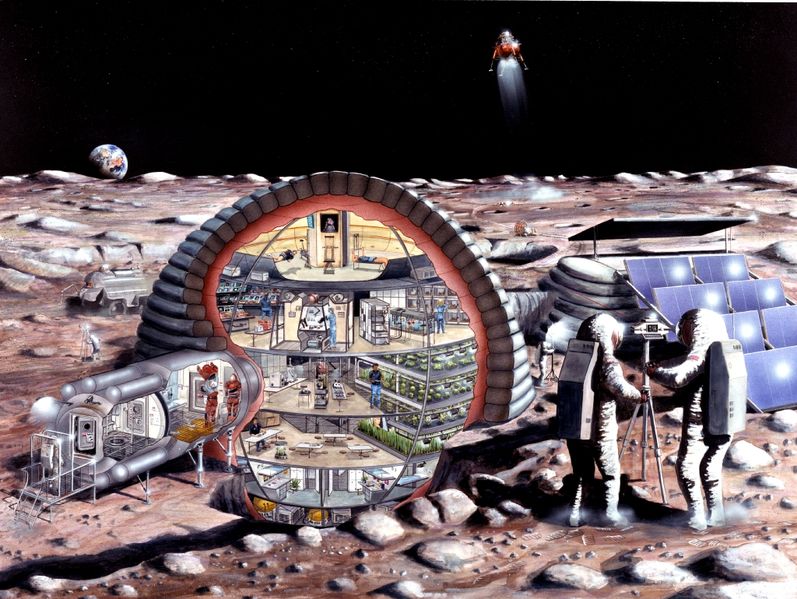
Inhabiting the moon won’t be easy. No frontier can compare to the challenges humans will face in overcoming the lunar environment. By 2100 we will see several lunar settlements. The sites won’t be anywhere near where Apollo astronauts landed. The sites will be large because growing food crops will require a considerable amount of space. Fortunately there is no lack of real estate in which to expand. All sites will be modular and individually bio-regenerative so that each can stand alone.
Polar and near polar regions will be the ideal choices for habitation. The South Pole is particularly attractive because of the recent discovery of water ice in deep craters. The presence of water meets key criteria for lunar self sufficiency. Polar locations will also be more easily sheltered from solar storms and the solar wind. Most of the habitation materials including photovoltaics for energy generation could be manufactured at the site and assembled into solar arrays to provide power to the colony. Such a site would be ideal for communication with Earth as well since the signaling system would never disappear behind the Moon during the monthly lunar cycle.
The lunar census of 2100 will have a head count approaching 100,000. Every day as the lunar colonists go about their daily lives they will look up at the inky blackness above them and see Earth. That view will inspire them as it has the generations that followed Apollo.

The “Space Race” of the 20th century wasn’t about profit. It was a war for ideological dominance. The United States versus the Soviet Union, Capitalism versus Communism, Freedom versus state control.
With the Apollo landings on the Moon that race to the high ground of space came to an end. The competition vanished. Both countries moved towards cooperation in space and the sharing of technology. Today there is a renewal of national competition. But this time it is not the United States versus the Soviet Union’s successor, Russia, but a new emerging global giant, China. China, however, remains at least a decade behind in building its space technology. So the nationalistic drive to the high ground of space is no longer all that urgent. Not only that current economics have made the cost of space an issue.
Having said that more countries have space programs than ever before. Many of these programs are in the Developing World. Many programs are a reflection of the competition between neighbouring states in the same way the United States and Soviet Union fought to hold the high ground. But most of countries going into space are building launch capability to deliver satellites into low-Earth or geosynchronous orbit above the planet to gain the benefits of telecommunications and remote sensing. They are not focused on human space flight.
Companies have been in space for some time. They have put satellites in orbit for profit. Telecommunications providers, resource and mining companies, all have either launched or bought time or data from Earth-orbiting satellites. But none of these companies are in the human space flight business.
The military remains engaged in space. The high ground of space provides unprecedented views of what’s unfolding on Earth below. So that makes sense.
And of course the global scientific community continues to go into space to view, sense and collect data about Earth from above and to study other parts of our Solar System, and star systems beyond. The military and the scientists are happy to use robotic spacecraft for these missions.
And finally science is conducted on the International Space Station in the interest of multi-nation cooperation and discovery. Some companies, universities and of course governments fund the activities on the station.
So what do for-profit businesses hope to attain more than they have already by getting involved with the sending of humans into near-Earth space and then to asteroids, the Moon and Mars?
The Lesson of Columbus
When Columbus departed from Spain in 1492, his motivation was to find new trade routes and establish commercial relationships with those who he met along the way. It wasn’t about discovery and exploration.

Columbus and his investment partners, the government and members of the Spanish court, were out to make money from the Spice Trade. They wanted to cut out the middlemen that drove up the price of spices sourced from East and South Asia. By establishing direct trade with Asia they would accomplish this goal. What they didn’t anticipate was running into the Americas but once they did and the route became charted and established they exploited America’s commercial value by seizing assets from its native population and eventually transporting citizens to manage the assets.
But the Spanish monopoly was short lived and the country soon found itself in competition with other European governments and government-sponsored private ventures from Portugal, France, England and the Netherlands who all had the same thing in mind, profit from trade and wealth from resource exploitation. For exploration of the Americas was funded by greed and the capital infusion Europe experienced led to its predominance on the planet for more than three centuries, and ultimately to the stormy upheavals of two world wars in the 20th century.
What European nations started once the high risk was taken out of the equation, European enterprises continued. Companies, not just governments established human colonies in the Americas. The ultimate superpower of the Americas, the United States, reflects this mix of business and government conjoined to push back and exploit the American frontier.
The Privatization of Space
Space is not unlike the discovery of the Americas by Columbus. Governments were the first to finance ventures in this “New World.” Once the risks were reduced private citizens and businesses established themselves. That is what is about to happen in low-Earth orbit in space.
The recent successful rendezvous and docking of the SpaceX, Dragon capsule with the International Space Station represents a first step towards private enterprise getting involved putting humans in space. Not that Dragon had any humans on board but the capsule’s clear intent, according to Space X’s founder, Elon Musk, is to do just that.
SpaceX is not alone in its goal. At last count 25 companies are developing technology for human spaceflight. A partial list includes companies such as:
Armadillo Aerospace – developing suborbital and orbital power ascent and descent capsules.
Bigelow Aerospace – building expandable space habitats for human occupancy.
Blue Origin – suborbital and orbital reusable launch vehicles capable of powered descent.
Copenhagen Suborbitals – a Danish company planning to built micro-sized spacecraft for individual suborbital human flight.
Excalibur Almaz – based on a Soviet technology that flew in the 1980s the company is building technology for human flight to low-Earth orbit, asteroids, the Moon and beyond.
Interorbital Systems – building a modular orbital launch vehicle called Neptune that can be configured for launching a crew of 6 into low-Earth orbit.
Orbital Technologies – a Russian company with plans to create a commercial space station as early as 2016 and place it within 100 kilometers of the International Space Station.
PlanetSpace – developers of the Silver Dart, a hypersonic glider designed to operate as an orbital vehicle.
Reaction Engines Ltd. – UK developer of a reusable space plane, the Skylon, suitable for launching satellites and human passengers.
Scaled Composites – developer of SpaceShipOne and SpaceShipTwo for human suborbital flights.
Space Adventures – since 1998 has been arranging for private citizens to fly in space with existing national space carriers and plans to send a private mission to circumnavigate the Moon.
Sierra Nevada Corporation – developers of Dream Chaser, a commercial orbiting glider with a 7-crew capacity, based on the NASA cancelled HL-20 that resembles a mini-Space Shuttle.
XCOR Aerospace – developer of human-manned, rocket-powered aircraft with 67 successful flights to-date, with plans to build a reusable launch vehicle, the Lynx, for suborbital and eventually low-Earth orbit flights.
Many of these companies will fail but some will succeed in their initial efforts, attract more investment, and expand their operations. That’s the way of risk-taking businesses and in low-Earth orbit, at least, the risks are low enough now to attract for-profit ventures. As Deep Space is explored by governments and proved to be doable, then private companies will follow.

There are many challenges that commercial space enterprises face going forward. Among these is the issue of ownership of what they find and exploit. For example if commercial space enterprises move beyond Earth orbit and mine asteroids or the surface of the Moon, what body or institution will govern who owns what?
In 1966 the United Nations agreed on a common set of principles governing outer space. Resolution 2222 of the General Assembly provided a framework for international law that stated:
This law was created in a geopolitical world far different from the one we live in today. Space activities are no longer just the actions of nations. If private companies start mining asteroids (Planetary Resources for one) or Mars One successfully begins colonizing that planet in 2023, or a major mining company sets up Helium 3 mining on the Moon, the rules established in 1966 will need revision.
]]>
Antimatter Engines
What is antimatter? The term comes up in so many episodes of Star Trek and other science fiction TV dramas that you may think it is fantasy rather than fact. But antimatter does exist in the form of subatomic particles with properties opposite to those particles that form matter. For example a positron is the antimatter equivalent to an electron. When the two meet they annihilate each other and release energy.
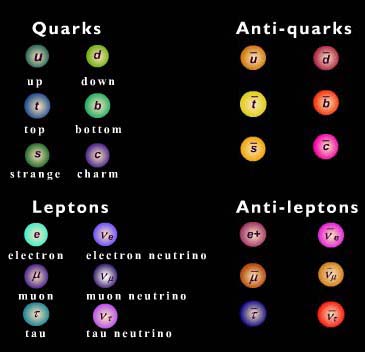
Where can you find antimatter on Earth?– in terrestrial gamma-ray flashes (TGF) associated with lightning strikes during thunderstorms. In fact, about 10% of particles erupting from lightning are positrons. NASA’s orbiting Fermi Gamma-Ray Space Telescope has detected in lightning antimatter that subsequently beamed into space using Earth’s magnetic field as a conduit.
How long does antimatter hang around? Not very. The Fermi telescope has recorded free positrons in the form of gamma ray bursts that survived 23 milliseconds before encountering electrons and their destruction. Most recently scientists at CERN in Switzerland set a new world record by capturing anti-hydrogen atoms and containing them for 16 minutes.
When a gram of antimatter encounters a gram of normal matter they experience mutual destruction and in the process generate as much energy as all of the energy stored in the liquid hydrogen fuel of 23 Space Shuttle external fuel tanks. A kilogram of the stuff would create energy equal to two billion kilograms of hydrocarbon, or more than one thousand times the energy from a kilogram of plutonium or uranium in a nuclear reactor.
CERN has demonstrated that antimatter can be contained using magnetic and electrical fields in a similar manner to the plasma technology containment used by the VASIMIR rocket engine. The big problem with antimatter, however, is how to make it in quantities sufficient to fuel a rocket. Today when we produce antimatter it is in minute amounts, a few nanograms. And those few nanograms cost a fortune.
Fortunately we don’t need a lot of antimatter to power a rocket to take us to the far reaches of the Solar System and beyond. As little as the equivalent of a grain of rice would be enough to fuel a rocket to Mars and back. With 17 grams of the stuff we could send a robotic spacecraft to our nearest neighbouring star, Alpha Centauri. The voyage would take 40 years travelling at 10% of the speed of light. To shorten the trip we would need 70 grams of the stuff.

So how do we harvest antimatter, the proverbial lightning in a bottle? Well short of milking lightning bolts for the antimatter they create, a somewhat difficult endeavour, we need to look elsewhere to where antimatter freely exists. And it appears to exist in orbit around the Earth. Recently discovered by PAMELA (Payload for Antimatter Matter Exploration and Light-Nuclei Astrophysics), a satellite launched in 2006, it seems our Earth is surrounded by a ring of antimatter particles contained by our magnetic field. And other planets that produce lightning storms and have magnetic fields are probably similarly surrounded by rings of antimatter. To harvest this antimatter resource researchers have proposed a magnetic trap that would orbit a planet to harvest and contain antiparticles (see image below).

Fusion Engines
We have yet to develop a nuclear fusion reactor but that hasn’t stopped scientists and engineers from looking at fusion as an energy source for interplanetary and interstellar travel. Fusion-powered rockets would use hydrogen as propellant and would harvest hydrogen while travelling through space using a large trap like scoop.
Fusion rocket engines would use magnetic field containment similar to VASIMIR but the reaction chamber in which the plasma is contained would be replaced by a Gas Dynamic Mirror (GDM). The GDM engine instead would be a long and thin magnetic bottle with mirror magnets at both ends to contain the fusion reaction and prevent the plasma from leaking in many directions rather than the intended one to generate thrust.
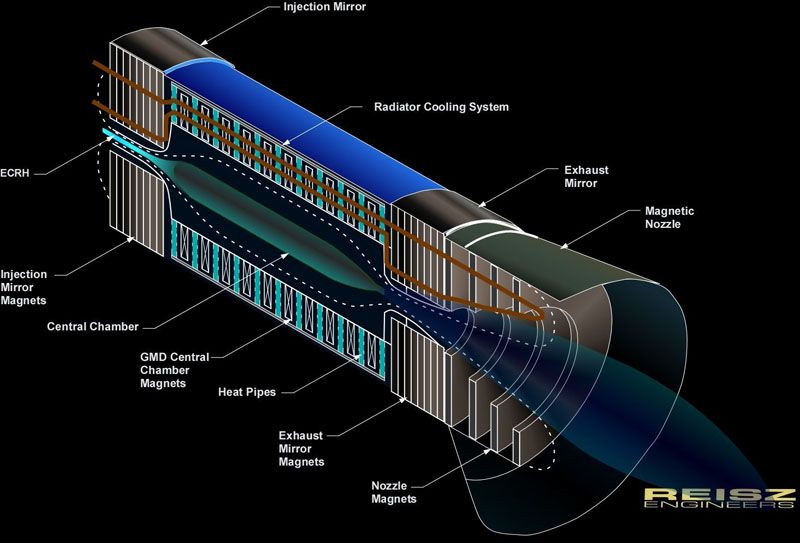
The proposed fuel for fusion rockets would be a combination of deuterium and Helium-3. While the latter is rare on Earth it is widely present in lunar surface soils and is one justification for humans returning to the Moon. Mining the Moon for Helium-3 and rare earths would provide the materials and fuel for fusion engines.
Warp Engines
Are warp engines for real? We have grown up with warp speed ever since Star Trek first aired on television in the 1960s. Warp 1 is the speed of light. Warp 2 is 10 times the speed of light. Is it even possible to travel at light speed or beyond it?
Warp technology defies the physical limit that nothing can travel faster than the speed of light. Yet didn’t we hear in February 2012 that CERN scientists had recorded neutrinos travelling faster than light speed, 299,792 kilometers (186, 282 miles) per second? Widely reported the CERN team performed the experiment twice getting similar results. Did this mean we could develop a technology like warp engines.
Unfortunately the scientists went over their data carefully and discovered the 60 nanosecond discrepancy recorded by the neutrinos early arrival at faster than light speed was really a faulty sensor reading and not the speed of the neutrinos themselves.
Light is truly a barrier because matter is made from the same stuff as light itself. But in Star Trek space ships achieve speeds hundreds of times light speed. They do this theoretically because a warp engine generates a bubble around it compressing the space time in front and expanding the space time behind. Inside the bubble the spaceship experiences stationary space time allowing it to go anywhere in the galaxy at faster than light speed.

The fuel of the warp drive is antimatter. But no antimatter-matter annihilation force can create a warp field. So for all intents and purposes warp engines remain purely theoretical until we can discover a new physics that unseats Einstein’s Theory of Relativity.
In our next blog on outer space we will look at the implications of the commercialization of space in the 21st century and how that change to profit-driven space enterprise will accelerate our outward urge.
]]>