But now I’m learning that not all sunblocks are equal. Those containing oxybenzone or octinoxate, two chemicals that are effective ultraviolet rays blockers, are proving to be dangerous to marine life, in particular, coral reefs. And if they are dangerous to other forms of life, could they not also be dangerous to the humans applying them to their skin?
Back in 2015, a study appeared in the journal Environmental Contamination Toxicology, describing the toxicological impact of chemicals in sunscreen. It described oxybenzone as a contaminant that is a genotoxicant to corals. In other words, it disrupts their DNA causing abnormal coral reef growth and bleaching. In mouse studies, the chemical causes reproductive changes, reduced body weight, unexplained mortality, and compromised immune systems. And what it does to fish is reduced egg production and hatching, as well as gender shifts in adult populations. It is equally disruptive to insect populations affecting reproductive processes.
That study appeared in 2015, So how come we are hearing about it now in the public airwaves some three years later? And why according to a CNN report are these chemical components in sunscreens going to be banned by 2021 in Hawaii, and who knows where else by what date?
This chemistry that we have been applying to our skin to save us from sun-induced cancer is unsafe for marine life, unsafe for mice, unsafe for fish, unsafe for insects, but not unsafe for us?
The U.S. Food and Drug Administration lists both oxybenzone and octinoxate as approved ingredients in sunscreens. And the American Academy of Dermatology describes the toxicity of these ingredients as not yet proven. I understand that one study published in 2015 might be considered insufficient evidence. But there have been a number of studies (just do a Google search using the phrase “sunscreens environmental toxicity studies”) going back to the early 2000s stating similar results and concerns about the potential toxicological impact of chemicals in sunscreens.
Hawaii has been treating the chemistry of sunscreens as a local concern encouraging users to buy “reef-safe” sunscreens. In Florida, scuba divers are being told not to use oxybenzone containing sunscreens when diving to protect offshore reefs.
Oxybenzone and octinoxate have been detected in seawater around the planet. Oxybenzone has a half-life of 2.4 years. So if you are applying sunscreen containing it whether away from the ocean or at the beach, runoff from showering can eventually find its way to the ocean.
The CNN report states that sunscreens with zinc oxide or titanium dioxide are not harmful to the environment and are effective ultraviolet rays blockers. Unfortunately, the majority of sunscreens commercially available contain oxybenzone and octinoxate. If you don’t see the ingredients in the content they can appear under two other names: benzophenone-3 and octyl methoxycinnamate.
A quick look at two popular brands of sunscreens my wife and I have used was edifying. For example, two of the Neutrogena products we have on our shelves contain oxybenzone and octinoxate. An Aveeno brand we have also used doesn’t but we didn’t like its consistency. We have a Vichy brand that contains none of the chemicals so we are going to look for it on the shelves.
If you too are seeking information about brands free of these chemicals you can go to your local drugstore and check out labels or try and find the information online (the latter a bit tougher).
A blog site I came across authored by Emily Rogan evaluates sunscreens from a medical risk perspective. It is worth a read for practical advice on sunscreen “do’s and don’t’s.”
A last word. Dermatologists qualify studies like the one I described in this posting, stating that we would have to apply the named chemicals daily for years to reach the levels of exposure in the mouse studies. So consider that but also ask yourself how the dermatologists would then describe the exposure levels in the wild indicated by damage from these chemicals to corals?

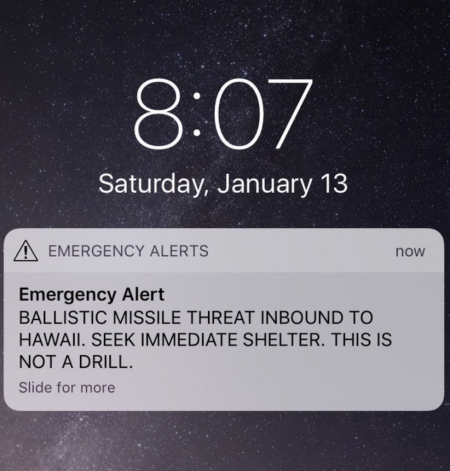
Just after sunrise, the message seen in the image above appeared on thousands of screens across the state, one that has a long memory of an attack arising from the Pacific Ocean to the west some 76 years ago. The message said in all caps, which is equivalent to shouting on the Internet, “SEEK IMMEDIATE SHELTER.” On one of the television networks, a college basketball game was interrupted by a series of ominous and continuous beeps followed by a ticker going across the screen stating “A missile may impact land or sea in minutes. This is not a drill.”
The TV announcement provided no advice. The Internet message said seek shelter.
For those on the receiving end, what in heaven’s name did “shelter” mean? How do you shelter yourself from a missile with an atomic warhead?
Remembering Pearl Harbor
The attack on Pearl Harbor on December 7, 1941, caught Hawaii by surprise. It was a weekend morning, a Sunday, not a Saturday. The sun rose on that Sunday in the same beautiful way it did last Saturday. But for the people of Oahu 76 years ago, the Pearl Harbor attack became reality when they looked up at the Japanese fighters and bombers overhead and recognized that these airplanes bore foreign insignia.
There was no warning. There was no advanced radar tracking, no NORAD command center, no telecommunications, computers, and television network to alert them to an impending strike. Few had the time to react, and few were prepared for what ensued.
Saturday’s False Alarm
That 76-year old reality was far different than the one Hawaiians and visitors to the islands faced on Saturday. An entire state received a disembodied Emergency Management Agency announcement which appeared on small and big screens. The range of peoples’ responses varied from disbelief to panic, to prayer. In some hotels, guests were advised to seek shelter in lobbies and basements. The sinister message, telling people to seek shelter, provided little in the way of advice about what was meant by a shelter capable of surviving a thermonuclear attack.
Many believed what they were seeing on their screens. Why? Because in the age of Donald Trump and Kim Jong-un, the world has been witnessing in the news for weeks and months, nuclear brinksmanship, with the latest bombast comparing the size of the two leaders’ nuclear buttons. Suddenly the impossible seemed plausible.
This Week’s CDC Grand Rounds on Nuclear War Preparation
Last week I wrote about the Centers for Disease Control (CDC) intention to live web stream a grand rounds presentation on planning and preparing for nuclear war. It is scheduled for this week on January 16th and will discuss among its many topics, preparing for the unthinkable, response efforts, and radiation preparedness. In the announcement, it began by stating “while a nuclear detonation is unlikely” it is important to put in place “critical protection steps.”
Hawaii has recently updated its practice for notifying the public about missile launches in the face of North Korean missile and atomic bomb tests. It appears those in charge need to improve their processes. And it might be useful to Hawaiians to tune in to the grand rounds CDC event on Tuesday because this may be the only preparation they receive to deal with the perceived threat in the absence of good governance from U.S. leadership.
