In an open letter to the activist organization 100 Nobel laureates write:
The United Nations Food & Agriculture Program has noted that global production of food, feed and fiber will need approximately to double by 2050 to meet the demands of a growing global population. Organizations opposed to modern plant breeding, with Greenpeace at their lead, have repeatedly denied these facts and opposed biotechnological innovations in agriculture. They have misrepresented their risks, benefits, and impacts, and supported the criminal destruction of approved field trials and research projects.
We urge Greenpeace and its supporters to re-examine the experience of farmers and consumers worldwide with crops and foods improved through biotechnology, recognize the findings of authoritative scientific bodies and regulatory agencies, and abandon their campaign against “GMOs” in general and Golden Rice in particular.
Scientific and regulatory agencies around the world have repeatedly and consistently found crops and foods improved through biotechnology to be as safe as, if not safer than those derived from any other method of production. There has never been a single confirmed case of a negative health outcome for humans or animals from their consumption. Their environmental impacts have been shown repeatedly to be less damaging to the environment, and a boon to global biodiversity.
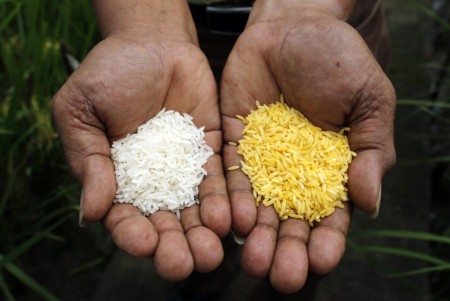
Greenpeace has spearheaded opposition to Golden Rice, which has the potential to reduce or eliminate much of the death and disease caused by a vitamin A deficiency (VAD), which has the greatest impact on the poorest people in Africa and Southeast Asia.
The World Health Organization estimates that 250 million people, suffer from VAD, including 40 percent of the children under five in the developing world. Based on UNICEF statistics, a total of one to two million preventable deaths occur annually as a result of VAD, because it compromises the immune system, putting babies and children at great risk. VAD itself is the leading cause of childhood blindness globally affecting 250,000 – 500,000 children each year. Half die within 12 months of losing their eyesight.
WE CALL UPON GREENPEACE to cease and desist in its campaign against Golden Rice specifically, and crops and foods improved through biotechnology in general;
WE CALL UPON GOVERNMENTS OF THE WORLD to reject Greenpeace’s campaign against Golden Rice specifically, and crops and foods improved through biotechnology in general; and to do everything in their power to oppose Greenpeace’s actions and accelerate the access of farmers to all the tools of modern biology, especially seeds improved through biotechnology. Opposition based on emotion and dogma contradicted by data must be stopped.
How many poor people in the world must die before we consider this a “crime against humanity”?
The list of signatories includes Nobel laureates who have one prizes for peace, medicine, physics, chemistry and economics.
Greenpeace in their rant against Monsanto have led campaigns against GMOs arguing that the only reason these crops exist is to drive higher profits to their developers at the cost of the environment and human health. They have stated this about medical breakthroughs like “golden rice” a GMO that is eliminating early childhood blindness in Southeast Asia.
The public because of organizations like Greenpeace continue to be uncertain about the safety of GMO. In a Pew survey in the United States, 57% believed that GMO crops were unsafe to eat. On the other hand 88% of scientists surveyed stated they were generally safe and do no harm to the environment.

But it is the issue behind Greenpeace’s action that should be of great concern to all of us on the planet. Russia has started shipping oil from Arctic Ocean oil wells. The Russians may soon be joined by American, European and Canadian companies with similar plans to exploit oil and natural gas deposits under that same ocean and ship them south by tankers to refiners.
What’s wrong with this picture? The potential for an accident in the Arctic Ocean is one that makes environmentalists shake in their boots. Today there is no adequate technology or infrastructure in place to clean up an oil spill in the Arctic. And once a spill occurs because of this any response would come from remote ports to the south taking weeks. Add to this the kind of conditions found in the Arctic Ocean with broken sea ice, oil trapped under sea ice, the oil impacted by the cold water so that it doesn’t evaporate to the same extent it would in more southerly spills, and the potential for the oil to linger for decades in icy, subzero conditions, and you have an environmental disaster.
For the people and wildlife of the Arctic it may mean a sentence of death. Marine mammals and birds will suffer from oil contamination. Arctic land animals that rely on food from the sea will face starvation, and when they do find a meal it may be contaminated by the toxins in the oil. The human communities of the Arctic will lose the sea resource on which they are so dependent.
The Exxon Valdez oil spill in Prince William Sound in 1989 is the closest approximation we have today to an Arctic Ocean oil spill. That ship killed 250,000 sea birds, 22 killer whales, 2,800 sea otters, 300 harbor seals and thousands of fish. And the killing continues 25 years after the spill with bottom-forages like the sea otters ingesting oil that remains in the seabed.
So Greenpeace, whether you like the tactics or not, has a point. If fossil fuel companies are hell bent on finding and pumping oil out of the Arctic Ocean basin then doesn’t it make sense that before they do this they have the infrastructure in place to deal with the potential for an oil spill?
Today we know that Russia pays little attention to oil spills. Back in October of last year I wrote a post entitled, “Russia and Arctic Oil Exploration – An Accident Waiting to Happen.” In it I described how Gazprom, the operator of the Mikhail Ulyanov, lost an oil rig in the Arctic Ocean in 2011, and in 2012 reported over 2,600 land-based oil spills in its extensive network of refineries, wells and pipelines. Its closest response vessels to its Arctic rigs are a three-day sail away.
Imagine the damage done by the 2010 blowout that occurred with BP Deepwater Horizon that gushed oil into the Gulf of Mexico for 87 days before being capped. The oil is still washing up on shore four years later. Now imagine something similar happening in the Arctic Ocean with no immediate response and the oil becoming trapped under sea ice and coagulating into thick globs. Imagine skimmers trying to work to get the oil off the ice-filled surface of the Ocean. And imagine the accumulation of the oil on the seabed where we humans can do little to remediate what collects there. Some 30,000 people responded to BP Deepwater Horizon. How many would be available to deal with a remote Arctic Ocean oil spill even of lesser magnitude?
North American and European fossil fuel companies are in no better shape than the Russians in dealing with the potential of an Arctic Ocean oil spill. Back in January of this year Royal Dutch Shell announced it was cutting exploration and development of its drilling plan in the Arctic Ocean. It did this because environmental groups and Arctic indigenous people filed a lawsuit to prevent drilling based on the argument that the company lacked the capacity to deal with a potential oil spill. Shell gracefully retreated rather than contest the argument and has put off its drilling for at least one more year.
But that’s not stopping Gazprom and the Russians. So maybe Greenpeace is making all the rest of us sit up and take notice.

Almost 8.5 million people lost electricity because of the hurricane that struck the New York and New Jersey coastline on October 29. More than 100 died and thousands remain homeless. Two weeks after the storm thousands were still without power. That’s why the idea of decentralized power, not dependent on the grid, is becoming more attractive, and renewables like solar represent one way to achieve this. With solar panels deployed, associated with large battery storage capacity in every home, a distributed network would prove to be far more resilient in times of disaster. If one solar array goes down it could be quickly replaced providing instant energy. Today Los Angeles is installing solar panels on 12,000 acres of rooftops in the city with the goal to meet a third of its electrical usage through solar by 2020.
Solar in emergencies like Sandy has distinct advantages. There are no moving parts that can be damaged by wind, or wear out. Solar panels are getting cheaper every year.They last a long time. And any excess power they generate can be directly fed into existing transmission lines. In emergencies, traditional fossil fuel portable generators burning diesel and gasoline are deployed. Solar represents an alternative that is lighter, less polluting, and when combined with battery storage, as reliable (consider the fuel rationing that New Yorkers have been experiencing and you might say even more reliable).


