
This week The Globe and Mail has been running a series of articles under the collective name, Headwaters, reporting on the current state of freshwater on the planet and in particular in Canada, the least likely nation to face freshwater shortages. Mark Hume opens the series of articles with the following comment, “Canadians, unlike billions of people around the world, see clean water as their birthright.” No truer a statement can be made. My country features 8,500 rivers and 2 million lakes. Not even Russia is so blessed by the freshwater abundance found in Canada.
More locally, Toronto, where I live, sits on the shores of Lake Ontario, one of five Great Lakes that contain more than 20% of the world’s surface freshwater spread over 244,000 square kilometers (94,000 square miles). Canada shares the Great Lakes with the United States and what should be a coveted water resource has largely been neglected.

For much of the 20th century the lakes have been the wastewater dumping destination for effluent coming from cities, industries and rural farms on both sides of the border. Only in the last 3 decades has there been a concerted effort by the bordering states and province to reverse centuries of damage. An International Joint Commission is doing hard science studying wastewater composition, lake chemistry and the complex ecosystems and biodiversity of the lakes. There are old challenges like dioxin and benzene pollution. More recent challenges include pharmaceuticals and antibiotic contamination, and the most recent, cosmetic microbeads and nano particles. Overall, the verdict for the lakes remains not yet determined with global warming adding to the challenges as scientists see not just warming air but also warming surface water temperatures.
But Canada’s freshwater problems are minuscule when compared to the larger global scene. At COP 21 freshwater is a major topic of discussion. In briefing notes prepared for the BAFW conference the global freshwater crisis and climate change are linked by:
In the briefing notes it states water-related climate change impacts affect “the capacity and reliability of water supply infrastructure. Climate change will impair non-consumptive water uses, including freight transport, tourism, and fisheries on inland waterways.”
Based on 2040 projections high freshwater stress is expected to impact 33 countries including the United States, China, India and 14 Middle Eastern nations. Irrigation freshwater demand alone is forecast to increase by as much as 20%. And in areas already freshwater stressed like the Colorado River basin, the forecast includes population migration as the demographic shift from Northeast to California, Arizona, Nevada and New Mexico reverses because of the lack of water. So the newly minted members of BAFW at COP 21 have lots to talk about.
Here are just a few of the anticipated items they will need to address in the coming decades:
BAFW members in establishing new policy and practices to manage and mitigate climate risk should lead by example:

The headlines:
Great Lakes Stressed Out by More Than Climate Change
So states a report published in the Proceedings of the National Academy of Sciences on Monday, December 17, 2012. The report, entitled, Joint analysis of stressors and ecosystem services to enhance restoration effectiveness, looks at human efforts to date to attempt restoration of North America’s Great Lakes environment through remediation projects.
What makes these lakes unique is that they contain more than 80% of the surface freshwater found in North America. The lakes are critical to the cities and towns that line their shores. They contribute to millions of jobs and generate tens of billions of dollars in income for Americans and Canadians. Recreational fishing alone generates $7 billion each year. They are used for recreation and are home for numerous species of birds, fish, mammals, reptiles, amphibians and insect life. I live in Toronto, the largest city of the Great Lakes region and am very aware of the importance Lake Ontario plays in my city and the region.
The report states that Lake Ontario, the most downstream of the lakes, the one with the largest population inhabiting its shoreline, is experiencing the highest levels of stress based on a measure of 34 indices. These stressors measured impacts on shoreline and near-shore lake habitats, water quality, coastal development, runoff from the land, biodiversity, fisheries, pollutants, and invasive species counts.
The influence of climate change as a stressor could be seen in a lessening of winter ice, deep water warming, lower water levels from less precipitation and higher evaporation rates because of warmer atmospheric temperatures. For the Great Lakes region, the researchers report that any existing or future remediation projects aimed at curing one or more of the stressors may be insufficient to overcome the impact of climate change. So now I’m stressed!

In the Mid-Western Heartland of U.S. Agriculture Drought Conditions Continue
Whacky weather has become the norm throughout much of North America. Hurricane Sandy is only one manifestation. The prolonged drought is another. From the Rocky Mountains to the Mississippi River valley, from the Dakotas to Texas, drought is impacting 80% of U.S. farms, destroying crops and killing livestock, bankrupting farmers and ranchers, and affecting the small business communities that serve them.
Currently, 52.4% of the contiguous United States is declared to be experiencing moderate to exceptional drought conditions. Those areas of the country experience the most extreme drought increased 8% from October 2012, with November ranked as the 20th warmest and 8th driest on record based on data collected since 1895.
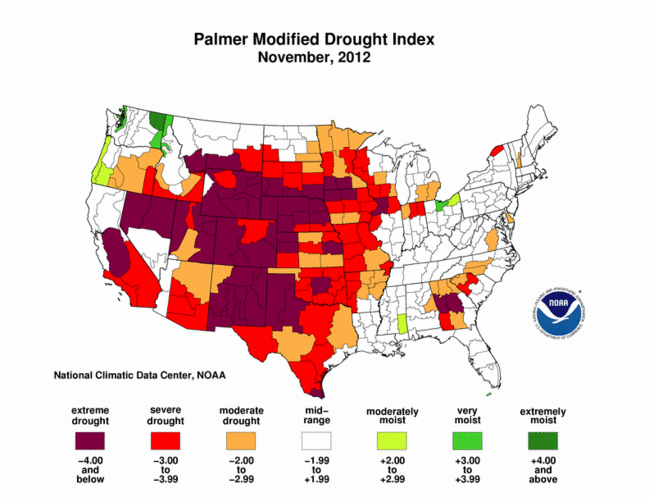
The drought has caused wells to run dry and is contributing to higher prices for meat and dairy products. At the same time the river systems and aquifers that provide irrigation water are seeing dropping water levels.
It may have taken Hurricane Sandy to make the majority of Americans finally accept that climate change is with us and impacting the United States significantly, but it is the drought that may redefine American agriculture for the foreseeable future. Also of interest, Oklahoma, which is experiencing the worst drought conditions in 90% of the state, is represented by Jim Inhofe, who sits on the environmental committee of the U.S. Senate, and who repeatedly has argued that global warming and climate change are hoaxes. Maybe the Senator should look at some maps!
What Do Record Low Water Levels on the Mississippi Mean for America?
The drought that is impacting the American Midwest is having an impact on transportation. How so? The Mississippi-Missouri-Ohio river system is the transportation hub of the United States. There is no comparable river transport system on any other continent on Earth. Ships can easily navigate along 40,000 kilometers (25,000 miles) of the river system, reaching as far north as Minneapolis-St. Paul on the Mississippi, and as far west as Kansas City on the Missouri. Barges can go even further. The total navigable river system covers the following states: Arkansas, Colorado, Illinois, Indiana, Iowa, Kansas, Kentucky, Louisiana, Minnesota, Mississippi, Missouri, Nebraska, Ohio, Pennsylvania, South Dakota, Tennessee, West Virginia, Wisconsin and Wyoming.
But the drought has brought water levels down to what are projected to be historic lows in the month of December. The river’s choke point today is south of St. Louis where rocks normally well below the river surface are posing a threat to navigation. This is causing shipping companies to reduce traffic and lighten loads on barges so that they float higher. Many stretches of the river system are reduced to one-way traffic to create a greater margin of safety. The economic consequences are large. If navigation has to be shut down at year end it will impact the movement of vital commodities including cement, coal, grain, steel, chemicals, and petroleum equipment and products. At this time last year the Mississippi was 6 meters (20 feet) deeper around St. Louis than it is today.

December Weather Continues the Climate Trend – 2012 Will be the Hottest Year on Record for America
And not just the United States but Canada as well. North America is feeling the heat. If it is not global warming then I don’t know what it is. The year 2012 represents, according to climatologists, a watershed year for climate change. More super storms, more wildfires, more drought, more buckled pavement and potholes, more warped steel rail lines, and certainly more heat. And scientists are saying even if the latter part of the month between now and the New Year should suddenly get cold it won’t be enough to offset the entire year’s increased warmth. So they are placing a bet that they are 99.999999999% sure that the year will end with 2012 the hottest on record since 1895 when records were first kept.
Here in Canada it is not too different, at least not in Ontario where I live. We continue to experience record warmth with no snow in sight in Toronto and Christmas just a week away. It has been this way much of the year north of the 49th parallel and the Great Lakes. Almost freaky with so many heat records falling, and not just daytime highs but evening low temperatures that are significantly higher than normal.
On the lighter side I guess it means another green Christmas here where I live. But for the United States the record heat, combined with drought conditions in many areas of the country, does not bode well for the country and the continent.
Do you think it’s time to address climate change in a meaningful way? I’d say so!
