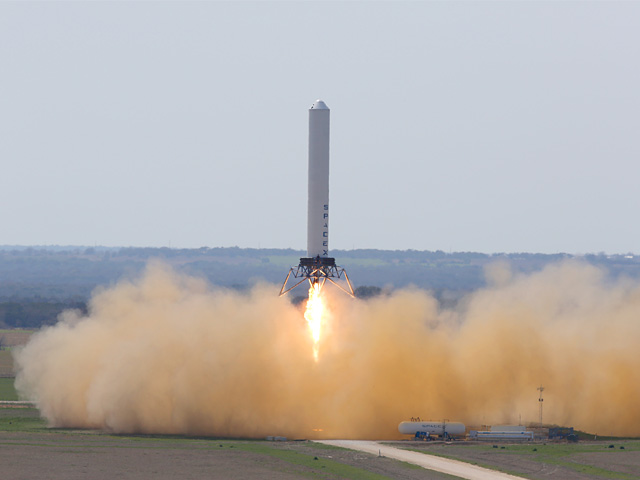
If Mars One is to succeed it will need a reliable technology that addresses this challenge. Currently SpaceX is working on controlled descent and landing with its Grasshopper test flights. That program successfully ended but at best the Grasshopper effected a controlled descent in Earth’s much thicker atmosphere, and did it from just over 600 meters (2,000 feet). In the coming weeks SpaceX will test controlled descent of a first stage Falcon 9 in its next Dragon supply mission to the International Space Station. If perfected SpaceX may have an answer for Earth descent but they will have to think about how this translates to the thinner atmosphere of the Martian environment where retrorockets alone are not the answer.
NASA, too, is working on developing heavy payload descent capability for robotic and future human missions to Mars. The parachute and Sky Crane method used to land the Mars Space Lab, Curiosity, is not viable for landing astronauts along with heavy supporting payloads. Even for the next planned mission, Mars 2020, a bigger and heavier robot than Curiosity, NASA needs a next generation atmospheric drag and descent technology. As a result they are starting to test one called the Low Density Supersonic Decelerator or LDSD. Testing of sub-components began in 2012 and will continue through to 2015.
Part of the challenge in landing on Mars is the deceleration from supersonic to subsonic speeds in a targeted controlled descent. Mars is neither the Moon, nor the Earth. On the Moon there is no atmosphere to speak of. On Earth the atmosphere is thick. But on Mars it is somewhere in between. Rocket descent as done by the LEM in the Apollo missions would not work on Mars. And parachutes deployed to create drag on Mars descents have been the biggest ever created by NASA because that thin atmosphere requires them. Where a team of parachutes slowed the Apollo crew capsule to an ocean landing, those parachutes could not handle a similar payload on Mars. That’s why Spirit and Opportunity used airbags to land and Curiosity used the rocket-powered Sky Crane.
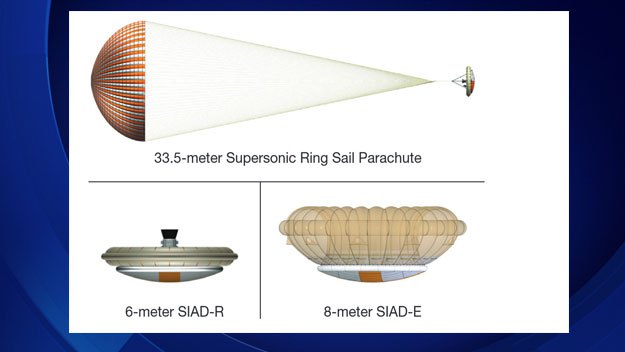
So what can be deployed to ensure a safe landing on the Martian surface? NASA hopes LDSD is the answer. It is a combination of technologies. First there is a 30.5 meter (100 feet) in diameter supersonic ring sail parachute. The parachute used by Curiosity was half that size. The descent modules, two are being tested, are much larger as well, one at 6 meters (just under 20 feet), and the other 8.5 meters (almost 28 feet) in diameter. In comparison Apollo’s crew capsule had a diameter of 3.91 meters (12 feet, 10 inches). The descent modules are undergoing supersonic testing in Earth’s atmosphere over this next year and by then NASA should have a good handle on what future payload weights are possible. Current capacity is 1.5 tons. LDSD is being designed to double that.
The combined parachute and descent modules are also being built to allow for landings in a wider range of elevations on Mars. Currently landings are limited to low altitudes to take advantage of maximum atmospheric drag. But LDSD may make it possible to land at elevations on Mars that are 2 to 3 kilometers (1.2 to 1.8 miles) above low lying areas. And the LDSD will also improve landing accuracy from a margin of 10 kilometers (6 miles) to one of 3 kilometers (1.8 miles).
Now think about Mars One and its ambitions to land a crew of four on the surface of the planet. NASA hopes to have landing capacity of 3 tons. Take those 4 Mars One passengers and all their gear and life support systems as well as some supplies just in case not everything on the Martian surface is in full operation for them upon arrival and you have very little if any spare payload weight.
Full high altitude testing of the LDSD begins this summer. The plan for the first flight is shown in the illustration below.

All of these speak well of SpaceX in its efforts to become the first commercial company with muscle and means to advance human and robotic space programs. And what makes SpaceX unique is that its doing all of this at a fraction of the cost of national space programs.
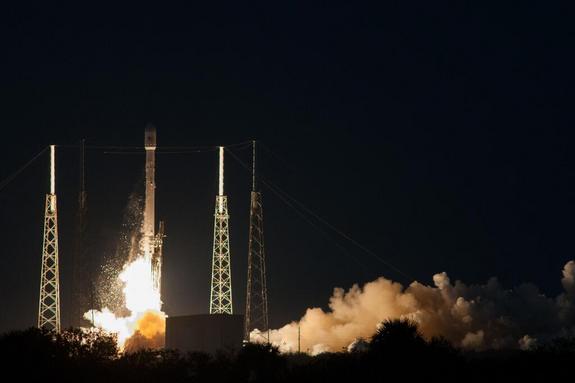
The latter achievement had its snafus with two previous launch attempts scrubbed but on December 3rd the Falcon 9 lifted off placing the SES-8 into low-Earth orbit before the rocket’s second stage re-ignited to place the satellite into its permanent geostationary position above the Earth’s equator.
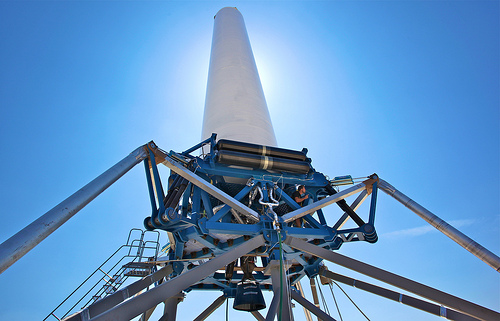
Even more interesting has been the evolution of the Grasshopper vertical takeoff-vertical landing (VTVL) technology which has been demonstrated successfully over several test flights. The SpaceX Grasshopper is a 10-storey high Falcon9 first stage outfitted with landing legs and hydraulic dampers. The last field test conducted in October continued to show that the rocket along with its software and guidance technology was more than capable of low atmosphere flight. A new Falcon 9 designated the F9R with the R standing for reusable is to begin undergoing low atmosphere testing in Texas in the near future followed by high altitude tests later in New Mexico. Creating reusable rockets will dramatically reduce the cost of space launches and SpaceX is further along than any other program in achieving this goal.
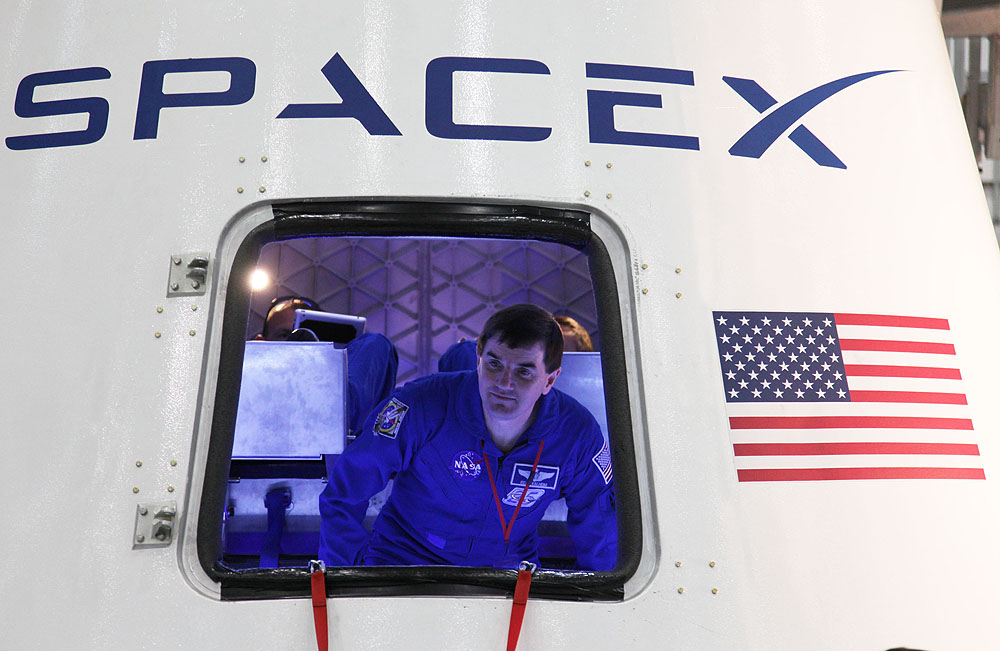
And finally SpaceX is in line to be the first commercial space carrier to launch human crews to the International Space Station (ISS). NASA has been studying the safety specifications of Dragon, SpaceX’s capsule that so far has been used on missions to deliver supplies and return payloads to Earth from the ISS. And so far NASA engineers are pleased with the progress the company is making in getting Dragon to a level of crew readiness for human spaceflight. The company has achieved milestone 9 of 15 in what NASA has designated the Commercial Crew Integrated Capability initiative (CCiCap). In 2014 SpaceX will conduct launch and abort tests at Cape Canaveral. If all goes well the company will have a fully integrated human launch capability ready for prime time before 2017 and will deliver crews to the ISS in that year.