Before graphullerene we had the following:
The three above are precursors to the latest discovery of two new materials coming out of research being done at Columbia University. These are graphullerite, a crystalline form of carbon that is stronger than graphene and fullerene. Graphullerite crystals are pure carbon and charge-neutral which makes them very attractive for use in semiconductors. And graphullerene is a superatomic cousin of graphene consisting of superlinked fullerenes that form a spherical mesh which can be combined in layers of pure peelable carbon crystal.
Graphullerenes incorporated into new kinds of optical and electronic devices will be able to withstand much higher currents and temperatures with the material an effective dissipator of heat. This thermal conductivity property continues to be critical in semiconductors’ evolution as more transistors get packed into tinier spaces.
It is likely that graphullerene will replace fullerene in many future solar, wind, battery, and sensor products, that is until the next big carbon material advance. This new form of carbon, state its discoverers, being both light, and strong will make photonic and electronic devices more durable and capable because the tunable superlattice structure is better suited to where superconductors and electronics are headed.
A description of the work done by the Columbia University researchers appears in the January 4, 2023 edition of the journal Nature in an article entitled “A few-layer covalent network of fullerenes.”
]]>The project is a high-speed rail system, called HS2, and will cost an estimated $147 billion US. The contractor is Skanska Costain Strabag, a joint venture between a Swedish and British company. The rail system will be 530 kilometres (330 miles) in length with the first phase due for completion from London to Birmingham by 2026.
Printfrastructure refers to a process of building infrastructure using on-site robot 3D-concrete printers. There are no prefabricated parts to ship and assemble, and no mixing and pouring of concrete foundations into forms and frames. The robot printer can work in a variety of settings including physically restrictive spaces without a human present. The print pattern is a lattice (see image above) which means much less concrete is needed during the build without sacrificing strength. The robot printers can operate without disrupting existing railway travel and other surrounding activities, so trains and commutes will be uninterrupted during construction.
The concrete materials breakthrough is the incorporation of microscopic strands of graphene, each just several atoms thick. Versarien, an advanced materials company is the inventor of the concrete with graphene which replaces the steel rebar that today is featured on most construction sites. The added graphene produces nearly invisible fine striping in the concrete as it is printed. And better yet, the graphene strengthens the concrete to make it resistant to corrosion whether exposed to air or water.
Imagine being able to print infrastructure and buildings no longer requiring steel rebar, often a material weakness as concrete buildings age and as was recently noted when an ageing Flordia condominium building collapsed north of Miamia costing the lives of more than 100 residents. After the building collapse, I investigated the material properties of reinforced concrete with rebar. This combination of two materials, cement and steel rods, produces an electrochemical process if exposed to air or water leading to corrosion as the building ages. Called carbonation, the rate of corrosion can be as much as one millimetre (0.04 inches) per year. In the UK where it rains a lot, carbonation corrosion rates will be as fast or faster than those in Florida.
That problem goes away if graphene-laced reinforced concrete is used instead of concrete with steel rebar. The commercial use is not limited to railway lines. You can imagine it becoming the material of choice for any projects where water is involved such as wastewater and freshwater infrastructure. And for homes, apartments, and commercial buildings it could extend the lives of these properties while reducing maintenance costs.
The use of 3D printers in building construction is not new. Dubai recently committed to using 3D printers in all new building construction. And in the latest issue of The Economist, it describes two California-based companies, Palari Homes and Mighty Buildings and a project to construct homes using 3D-printed concrete materials. The printing is done in a factory with no supporting moulds. Eaves, ceilings, and walls are then delivered to the building site where they get attached to a 3D-printed foundation. The process the companies are using is largely automated leading to dramatic savings in labour, and a doubling in the speed of production. Building homes this way produces 2 fewer tons of carbon emissions. And the emissions saved by Palari Homes and Mighty Buildings could even be more if, in future, they were to switch to graphene-reinforced concrete, the material HS2 is using for its new high-speed rail project.
]]>But Silly Putty is turning out to be more than a toy. Spiked with graphene it can become a wearable medical device to monitor blood pressure and other vital signs. In a joint effort by researchers at Trinity College Dublin, and the University of Manchester, an experiment blending graphene flakes with the putty produced something called G-Putty.
What is it?
Mostly the familiar silicone polymer that we played with in my younger days, but with 20-atomic layers of graphene flakes mixed in. It’s dark grey in appearance and reactive to external stimuli.
In a test, a piece of wired-up G-Putty placed on a volunteer’s neck picked up a visible pulse profile and accurate blood-pressure reading. Placed on the chest it accurately clocked respiration rates.
How does it work?
The graphene flakes create a conducting network within the silicone polymer that responds to any slight movement from the object upon which it is placed. So a person’s pulse or the rise and fall of a diaphragm leads to temporary deformation and reformation of the material which translates into readable data.
Voila, the beginnings of a new type of sensor that would be cheap to make, and non-invasive, and could replace much more expensive monitoring technologies. The bonus is instead of single-instance measuring, the G-Pugtty sensor could be worn continuously providing 24/7 monitoring.
The Trinity College researchers even tested G-Putty with spiders. The individual steps of a spider weighing a mere 20 milligrams were recorded. There were two spiders in the test and the only time the G-Putty experiment missed registering their activity was when the arachnids were left unattended, and one ate the other.
Since publishing the G-Putty discovery back in 2016, the Trinity team has been printing sensors made from the material. They have created G-Putty-based inks that they print on band-aids that can be attached to the skin.
States Jonathan Coleman, who heads up the Trinity physics lab where G-Putty was invented, “We have now turned G-Putty, our highly malleable graphene blended silly putty, into an ink blend that has excellent mechanical and electrical properties. Our inks have the advantage that they can be turned into a working device using industrial printing methods, from screen-printing to aerosol and mechanical deposition.”
With G-Putty the medical device market can move downstream into the consumer marketplace with personalized, wearable sensors that can be integrated into clothes or worn on the skin. Personal monitoring devices fit with the current home gym craze that has accelerated because of the global COVID-19 pandemic. G-Putty sensors would be able to monitor breathing, pulse, and joint motion and gait. They could even be used to monitor early labour during pregnancy.
]]>
From smart materials that are self-healing to novel chemistry that impacts energy storage, medicine and other fields, the science of engineering materials is undergoing a revolution in the 21st century. The U.S. government’s Materials Genome Initiative is focused on advanced materials with application to clean energy, national security and human welfare. New tools are making it possible to develop materials atom by atom creating endless fabrication possibilities. Carbon fiber composites make for lighter, more fuel-efficient vehicles. Advanced alloys revolutionize avionics. Bio materials change the way we repair or replace worn out body parts. And nano materials are contributing to the development of quantum computers.
So follow along as Carbeck outlines the current top 5 material science breakthroughs and 5 more that he forecasts are coming in the next three years and beyond.
———-

Top 5 Recent Materials Science Breakthroughs: 2013 to 2015
1. Materials Genome Initiative (MGI) predicts thousands of new materials.
In the same way that the Human Genome Initiative mapped every gene in our human body and then was able to use machine learning to make predictions, the Materials Genome Initiative seeks to map out the hundreds of millions of different combinations of elements in the periodic table. Why? Creating this database will allow scientists using AI to predict properties of new material combinations. Carbeck explains, “Over the last few years we’ve been able to take the 10,000 materials we know about, and, with the help of high performance computing and quantum mechanics, start to predict properties of new materials that don’t exist yet.”
2. Graphene empowers new electronics, sensors, and composites.
The potential impact of graphene, a two-dimensional version of diamond or graphite, is emerging. It will be a key factor in a world of ubiquitous sensing and ubiquitous computing. Graphene is two-hundred times stronger than steel by weight. In the last decade we’ve seen it emerge as a material of choice for very high performance transistors, sensors, and new composites.
3. Rechargeable metal-air batteries make grid scale storage low cost and reliable.
New types of batteries are emerging. These are metal-air such as aluminum-air, zinc-air and lithium-air. They are smaller and lighter because they don’t require the extra bulk and weight of a chemical oxidizer. They have the potential to power the 1.2 billion people around the world today who don’t have access to reliable sources of electricity. “Grids using metal-air batteries have the potential to leapfrog traditional centralized energy production and distribution, especially in places like Africa,” states Carbeck.
4. Transferable ultra-thin silicon circuits enable electronics on and in the body.
We are developing technology to transfer high-performance electronics from rigid silicon wafers to form factors that can go on or inside our bodies. This is changing the way we interface with electronics – from how we track our daily activities, how we monitor our health and how we communicate and connect to the Cloud.
5. Soft robotics starting to change the human-machine interface.
Materials science allows us to make robotic structures out of fundamentally different materials to behave in different ways. For example, rather than a rigid metallic prosthetic limb, imagine a soft robotic prosthetic that actuates like muscle when activated by an electric field. “These soft materials will create a completely different physical interaction between humans and robots, electrically active, allowing us to design push and pull systems, much like muscles.”
So what’s in store for the near future?
Top 5 Anticipated Materials Science Breakthroughs: 2016 to 2018
1. Meta materials will become widespread.
The continued convergence of super-computing, modeling software, and micron-level additive manufacturing plus other manufacturing techniques will allow us to increase our ability to predict, engineer and construct meta materials with incredible properties not yet found in nature (for example, invisibility cloaks that make objects covered by them invisible).
2. Perovskite solar cells will beat silicon photovoltaics.
Perovskite is an amazing material that happens to make very efficient and cheap solar cells. When perovskite’s solar voltaic properties were first discovered five years ago, they provided conversion efficiency of about 4%. Now it’s 20%, and expected to rise to 30% in the next few years. Perovskite is 100 to 1,000 times cheaper than current materials used to manufacture silicon solar cells. By 2017 we should see mass deployment, a major contributor in moving the planet towards a solar-powered future.
3. AI coupled with the Materials Genome Initiative will allow us to commercialize new materials exponentially faster.
The Materials Genome Initiative developed over the past few years will come into full impact as cloud computing and machine learning allow scientists to discover new material combinations and material properties. Expect a lot of new commercialization efforts resulting from the application of AI. You’ll be able to say, “I want to build a next-generation implant for my knee,” states Carbeck, and your AI will understand all possible materials available and help choose ones that will be the most reliable and safe.
4. Carbon nanotubes and graphene will significantly extend Moore’s Law.
If Moore’s Law is to continue, we’ll need fundamentally different ways to organize materials into computers. Graphene and carbon nanotubes are among the most promising solutions. These materials contain properties that will allow us to continue to improve computing price-performance. We’ll even be able to manufacture a chip using traditional technologies, then add graphene functionality through materially pre-programmed self-assembly.
5. Recyclable carbon fiber composites.
While high-performance thermoset and thermoplastic composites are enabling breakthroughs like the Boeing Dreamliner and the BMW i8, the challenge remains that once heated and set they are irreversibly cured and unalterable, unlike aluminum and steel, which both can be melted and reused. But recent breakthroughs can change this, increasing their utility. Carbeck explains, “There have been real breakthroughs in chemistry that allow us to reverse the chemical reaction that makes the plastic composite depolymerize back into liquid form for reuse.”
]]>Richard Kaner is a professor of chemistry and biochemistry and UCLA. Maher El-Kady was a graduate student working in his laboratory. Together they developed a technique to fabricate graphene using an everyday DVD burner. Before they discovered this breakthrough graphene was painstakingly harvested using lithography. The volume produced was small and the work was labour intensive.
What Kaner and El-Kady discovered is they could use a consumer product, a LightScribe DVD burner to manufacture graphene on a DVD, producing enough material for 100 micro-supercapacitors on a single disc in less than 30 minutes (seen in the image below).

The production process involved gluing a thin plastic layer onto a standard DVD followed by a coating of graphite oxide. They then inserted the DVD into the burner and the laser did the rest of the work oxygenating the graphite oxide and turning it into graphene.
In a video describing their work Kaner and El-Kady found something unexpected. They call it a “eureka moment.” El-Kady using a little piece of their manufactured graphene and a light bulb and a two to three second charge could make the light shine for more than five minutes.
I have written about super capacitors on this blog site before, but it would seem to me that Kaner and El-Kady are on the edge of creating a new energy storage technology that will prove to be a real game changer in the field.
Unlike a battery, a super capacitor is a one time use device. You’ll be able to charge a super capacitor for an electric vehicle in the time it takes to fill a gas tank at a service station. A smartphone with a super capacitor will charge in seconds.
And when discharged your graphene super capacitor, made of carbon will be something that you put in your compost or recycling bin.
Compare that to batteries which when discharged need to be treated as hazardous materials.
In a video describing their discovery, Kaner states, “When I was a kid, I wanted to be a scientist. And so, my goal has always been to develop something that will change people’s lives.”
Well I think you’ve done it!


In a paper entitled Harvesting renewable energy from Earth’s mid-infrared emissions, published in the March Proceedings of the National Academy of Sciences, just such a scheme is proposed through the creation of an emissive energy harvester (EEH). This would be an energy creating device capable of converting the wasted heat that bleeds from our atmosphere into space. It amounts to 100 million Gigawatts per second. The EEH would convert this heat imbalance into direct-current (DC) power.
Two schemes are proposed:
Whether thermal or optoelectronic the EEH would be an emitter rather than a receiver. The thermal EEH would act like a hot plate radiating energy to a cold plate which would lie on top of it facing the sky. The radiated heat energy would amount to a few watts per square meter and would be generated continuously, day or night.
The optoelectronic EEH would consist of nanoscale electronic components, tiny infrared-harvesting rectennas laminated onto a solar panel which each individually would generate a tiny amount of current and collectively could produce massive amounts of energy. Recent advances in plasmonics (the oscillation of electrons between two materials) using graphene makes this latter option potentially feasible.
What’s holding us back from building this type of energy generating source? We need to do more experimentation with nanomaterials to get just the right ones to optimize the energy we generate. And we need to develop a class of diodes in rectennas that can switch on and off 30 trillion times a second. A schematic of what one of these resistor generator circuits looks like can be seen below.

That’s why you find graphite in pegmatite, a rock found where magma or lava has intruded into other rocks causing a chemical and crystalline alteration. As a young boy with rock hammer in hand I remember collecting pegmatite and schist samples as I wandered through Ontario. You can see a sample of schist below.
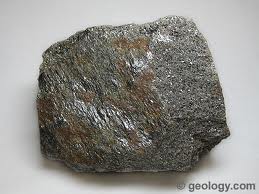
Graphite serves many purposes today besides its use in pencils.
The Miracle Material: Graphene
Graphene is a nanomaterial first discovered in 2004 at the University of Manchester in the United Kingdom. Graphene is described as a thin film material and consists of a single layer of carbon atoms bonded in a honeycomb lattice. Electrons that move through graphite encounter resistance but when they move through graphene there is virtually no resistance. That makes graphene a super material that can be used for many industrial applications including:
Transistors
Graphene transistors run at higher frequencies than any existing silicon transistor we use today. In fact a graphene transistor makes it possible to build computer processors capable of speeds of 10-20GHz. I’m typing on a Dell Computer running at 2.93 GHz and can only imagine what it would be like to use a system built using graphene. Not only would it be ultra-fast it would also be small, a form factor smaller than a paperback novel.

Gas Sensors
Because graphene is one-atom thick and forms a lattice it is capable of detecting the presence of a minute traces of hazardous substances. A graphene-built gas sensor would detect amounts as small as a single atom or molecule.
Thin Resistant Coatings
Graphite is used in impermeable paints. But graphene can be used to thinly coat pipes carrying highly corrosive acids or reactive alkali such as sulphuric acid or ammonia.
Carbon Nanotubes
Graphene is the material of carbon nanotubes – the stuff of space elevators. There are many other applications including lighting, electron microscopy, antistatic materials, radar-absorbing materials, electrolytes in batteries and fuel cells, conductive adhesives, thermal materials, fabric, catalysts, prosthetics and frameworks for biomedical applications such as neuron growth and regeneration.
Desalinization Filters
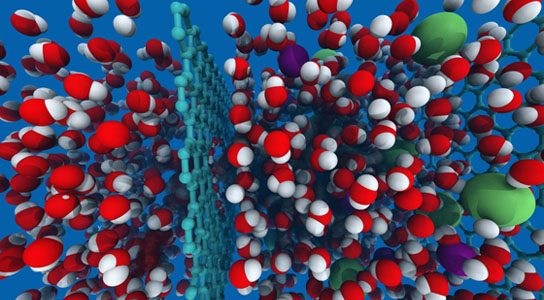
Massachusetts Institute of Technology engineers are using thin-film graphene membranes with strategically located pores just large enough to allow water molecules to pass through while resisting sodium and chlorine salt molecules. The strength of the graphene membranes, a mere one atom thick, can withstand the pressure of the osmotic process providing much faster flow through. This technological capability will reduce the cost of desalinization and make freshwater available for many parts of the world currently experiencing water stress.
Graphene Challenges – Make it Easier and Cheaper to Produce
When graphene was first discovered it cost a lot of money to create a single thin sheet. But new techniques are being pioneered at the University of Arkansas with the announcement last week of a breakthrough in controlling graphite to graphene production.
Up until now transitioning graphite to graphene was random. But the researchers have developed a technique called electrostatic manipulation scanning tunneling microscopy. This new technology uses a moving surface to migrate the graphene from graphite. The next step will be to scale this to commercial production levels.
]]>What is graphene? Discovered in 2004, graphene is a carbon-based material made from atoms bound together by double-electron bonds. It forms in thin films one atom in thickness. The picture below shows individual graphene crystals.

Graphene based ultrafast transistors would replace silicon-based technology. Graphene is seen as a potential high performance material replacing carbon fiber in avionics and aerospace construction.
In the Hong Kong study researchers did control tests on their graphene-based battery to ensure that the sustained energy output from the device was not coming from a chemical reaction. The jury remains out on this claim but if it is proven to be a workable technology then we may have a new power source for artificial organs that would be sustained by the heat generated within a body, or electronic devices that would continuously generate energy through interaction with a warm environment.
We’ll keep our eye on this one and let you know what the research community discovers when they attempt to duplicate these experimental results.
]]>

