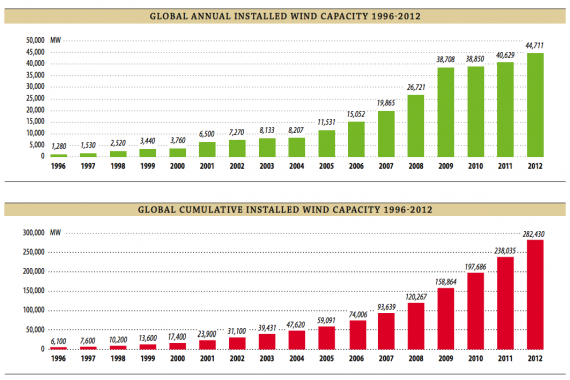
And in the last month the Global Wind Energy Council reported 44.7 Gigawatts of new wind power added to worldwide capacity in 2012, a 19% increase, bringing overall total global capacity to 282.5 Gigawatts. That represents a tenfold increase in wind power capacity over the last decade. What does that capacity mean in terms of a meaningful representation. In 2009, an average household in the United Kingdom used 18,639 Kilowatt hours per year of electricity. That translates to 51 Kilowatt hours per day. At 282.5 Gigawatts total energy generating capacity per day, that means wind currently can light and heat 5.5 million homes today globally. It’s a significant number but still small in the scheme of overall energy capacity. Compare the 5.5 million homes to the 91 million currently in the United States. Or compare 282.5 Gigawatts to total electrical energy capacity from all sources which approached 18,000 Terawatt hours in 2012.
The United States wind power capacity increased to 12.6 Gigawatts of which 5.3 Gigawatts came on stream in December 2012. In my country, Canada, total capacity grew to 6.5 Gigawatts with 1.5 Gigawatts slated to be added in 2013, and an additional 4 Gigawatts planned for installation by 2016.
European countries continue to be sold on wind power with Germany and Denmark leading the pack. China has aggressively been building wind capacity and currently has the most installations. A list of the top ten countries by installed and cumulative capacity can be seen under the two pie chart graphs that follow.

The report noted that onshore wind power greatly exceeds offshore installation. So even though winds over water may prove to be a more reliable source of wind energy, the cost of building the infrastructure continues to inhibit development. Estimates of future offshore capacity indicate it reaching 52 Gigawatts by 2020 with current capacity at 5.4 Gigawatts. The United Kingdom and Denmark represent those countries currently investing considerable resources in building offshore wind energy.
Some additional 2012 wind energy facts of interest:
So wind and its other renewable cousin solar are the two fastest growing sources of new electrical power generation capacity. Growing but not nearly fast enough to allow us to reduce our reliance on fossil fuel power generating sources over the next few decades. The consequences to climate of continued reliance on fossil fuels remains an enormous problem with conservation being the alternative strategy for us to keep carbon and other greenhouse gas emissions from contributing to further global warming.
]]>