In a summary statement, the steering committee of the summit along with presenters focused on the “quest for truth, knowledge, and innovation toward a better life.” In the summary statement, they called on humanity “to reinvent our relationship with planet Earth.”
It went further stating “The future of all life on this planet, humans and our societies included, requires us to become effective stewards of the global commons — the climate, ice, land, ocean, freshwater, forests, soils, and rich diversity of life that regulate the state of the planet, and combine to create a unique and harmonious life-support system. There is now an existential need to build economies and societies that support Earth system harmony rather than disrupt it.”
What is happening to the “global commons,” the term used above that signifies the environment in which we share all of the life here on Earth, is a crisis caused by our destabilizing impact on the planet.
The conference statement includes the following observations as justification for decisive action:
The conclusion is that we presently are in the decisive decade that will determine the future habitability of our planet.
In its concluding statement, the summit doesn’t ask whether we should be transitioning away from fossil fuel dependence, but rather can we do it fast enough. It proposes as a series of solutions, the following:
In one of the last seminars I virtually attended, a Nobel laureate suggested this basic principle as a means to guide us. It is, “do no harm.”
Imagine if this precautionary principle were adopted by all of humanity, all the nations and cultures of the planet, to guide our activities going forward.
But why imagine it, why not do it. And as the “Our Planet, Our Future” summit concludes, this is the decisive decade in which it needs to be done.
]]>Indigenous people, before Europeans arrived, lived close to nature and the land. Land wasn’t owned individually, but collectively. That made all people stewards of the environment. Their observations of the cycles of nature were critical to collective survival. Collective wisdom allowed them to thrive for much of the time. But even Indigenous people from time to time were overwhelmed by circumstances created by themselves or by nature. For example, Mayan civilization clearly was impacted by climate and other forces leading to conflict and social collapse. And the Anasazi who lived in what today is the Southwestern United States also experienced similar disintegration as a result of local deforestation and prolonged drought.
But there is no doubt that the societies of hunter-gatherers, and farmers, that made up Indigenous societies in Canada prior to the arrival of Europeans had a much better understanding of humanity’s relationship with the natural world. They had a strong sense of the “commons,” that which is held in common for the good of all in the tribe. They synthesized generations of observations and shared what was learned beyond their individual tribal units and extended families. Knowledge of best practices spread throughout the native peoples of the continent. Without European science and the scientific method, they used the power of observation and education to both understand and spread the knowledge about the fine balance within ecosystems. If they didn’t a tribe could end up starving, or going to war just to get enough to eat. And when they modified the natural environment to ensure their cultural and social survival, their impact on the resources of the land didn’t overtax it and lead to depletion of vital food stocks.
Can what Indigenous peoples know be transferred to the Canada that exists today? Can the collective wisdom of a culture based on hunter-gatherers and native farming help to overcome the challenges that the modern iteration of a nation faces from issues such as climate change, resource exploitation and depletion, pollution, industrial farming, and urban population growth, and then help it move to a more sustainable model compatible with the environment?
Back when the Pilgrims first arrived to establish a European colonial outpost in the place they eventually named Massachusetts, a word borrowed from the Indigenous population that interacted with the colonists, the founding fathers of what would become the United States, in their mythology of Thanksgiving, described how interaction with the native population proved lifesaving.
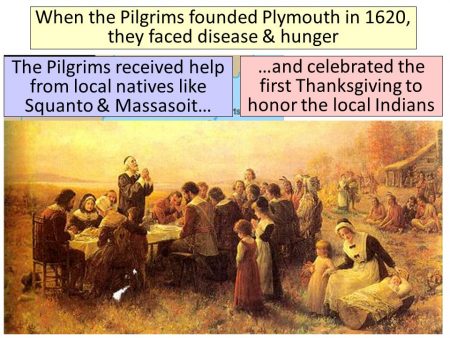
These so-called, sophisticated Europeans, who sailed from England to the shores of North America, came with their own native wisdom but it was clearly insufficient to deal with an unfamiliar environment and climate. It is a wonder that any of these early colonists survived. But many did by tapping into the native wisdom of Indigenous societies surrounding them. Too bad this cultural knowledge and interaction couldn’t be sustained.
Some four centuries later all of North America has undergone a transformation brought to fruition by foreign know-how. Transplanted European social, cultural, and economic models have changed the land. These European ideas have spread across the planet. The result for all the citizens of the world is a mixed blessing of technological progress accompanied by disastrous changes in the health of the commons with carbon-based energy byproducts polluting the planet and raising atmospheric temperatures and sea levels. And although the modern nations of the world have recently come together in Paris to commit to mitigating these changes, so far, the effort is yielding more words than results.
Could the planet have been different if we had adopted the native wisdom of Indigenous North Americans?
It is more than certain that our world would be a very different place than the one our children are being born into today. We would have a greater respect for what we hold in common. And what is so interesting is that even European culture had historical roots in the idea of a collective commons, from which the word commonwealth is derived, and was once a European fixture of feudal society.
How should we define Indigenous knowledge concerning the environment?
Let’s take a stab at this. Is it a collection of experiences, practices, and beliefs that create adaptive processes, culturally transmitted over many generations?
Yes.
Does it encompass an understanding of our human relationship with all living beings within a locality – every animal, every tree and every other kind of plant?
Yes.
Can it have broader implications that go beyond locality?
Clearly.
Why?
Because Indigenous people in North America have been keen observers of the characteristics of native species of animals and plants around them. They have noted adaptation strategies as species respond to the annual cycles of the seasons and different weather.
Hibernation and migration required native North Americans both past and present to adjust behaviour to sustain their societies. Paying attention could mean the difference between prosperity or famine.
Today Indigenous populations tell us that all the data we collect about climate needs to be heavily supplemented by these personal observations from generations past to the present.
The Inuit of the north don’t have to measure the thickness of the sea ice to tell us about changing patterns in the Arctic Ocean. Nor do they have to do herd counts to state what they know about the declining populations of animals both on land and sea. They don’t need to measure the methane rising from permafrost melt to tell us that the ground beneath their feet is melting. They have been observing all of this over generations, passing down the collective wisdom of centuries.
It is apt to describe the collective wisdom of the Indigenous people of North America as a library of ethnobiological and botanical information. That from this lore we can create environmental and conservation policy. That we can learn about the unique characteristics of the plants and animals of North America to help us to be better environmental stewards and better planners of resource management. That we can adopt the strategies from Indigenous populations that have worked for centuries and that reflect best practices for adapting to the unique characteristics of North America.
It starts with listening, continues with respect, and ends with a better model for the management of our natural environment, leading to a more sustainable future to follow.
]]>

The 12th edition of the report issued last week has put the environment at number one “even though the risk will play out over the long term.” That is evident as more and more “green” issues predominate. That the WEF describes the environment as a long-term high risk reflects what science has reported in this 21st century. Not just scientists provide evidence. The largest re-insurers, the companies that underwrite the insurance industry, report record payouts to cover rising extreme weather events. In the United States along the Atlantic seaboard, property owners are seeing the consequences with rising premiums for flood damage. And just this week NOAA and NASA issued their report showing 2014 through 2016 to be the warmest years since modern record keeping on global climate started back in 1880.
The WEF report states that “failure of mitigation and adaptation to climate change” will be the most prominent global risk, and that climate change will be “one of the top three trends to shape global developments over the next 10 years.” They describe the environmental risk as existential, a word we hear a lot these days.
What does existential mean?
Existential originally referred to a philosophy known as existentialism. Those who expounded existentialism were concerned with the nature of the human condition. They came up with their ideas during the late 19th and early 20th century. Existentialists saw the two world wars of the 20th century as the greatest threat to the way of life proposed by the philosophy. The greatest proponents were Kierkegaard, Nietzsche, Heidegger, Sartre and Camus. But existential has taken on a new meaning in the 21st century. Usually associated with the word threat, such as “the environment poses an existential threat to humanity,” its new means is about existence itself, about our survival as a species, and about the survival of the planet as we know it.
The WEF states that climate change ranks higher in terms of threat than “nuclear weapons or pandemic diseases.” The report talks about the emerging need to manage the “global commons,” another term that has become, of late, a new way of expressing a view of the Earth.
What is the global commons?
As I have written in the past here at Techso Mogro blog, there are no political boundaries visible from space. Earth from space is a totality with land, ocean and atmosphere shared among all who inhabit the planet. These three elements are the global commons. When a nation or industry pollutes the air, when urban wastewater, garbage and farm runoff reaches rivers, lakes and oceans, we impact what we hold in common.
In the infographic displayed below, which appears in the WEF report, environmental categories pose the greatest risk. They appear as green diamonds. Those in red are indirectly related to environmental risk. For example, involuntary migration, water crises, food crises and spread of infectious diseases.

What does involuntary migration have to do with climate change and extreme weather events?
In articles appearing in 2015 in both Time Magazine and Scientific American, the authors described the Syrian civil war as a consequence of climate change. Drought and bad government policies forced more than one million Syrian farm families to abandon their traditional livelihood. They crowded into Syria’s cities. They put stress on already bad urban conditions and corrupt politics. Water shortages, devastated farms, and pervasive corruption sowed the seeds of Syria’s version of the Arab Spring. And Syria didn’t stand alone. Drought and other climate change phenomena impacted much of North and Sub-Saharan Africa.
That’s why the American Pentagon has described climate change as a “threat multiplier.” The WEF Report concurs with this military assessment.

]]>