Climate change has been the catalyst for governments to create policies that are steering the global transition to renewable energy. International climate agreements and legislation like America’s Inflation Reduction Act (IRA) have created tax incentives and subsidies to promote the adoption of green energy technologies and are stimulating research and development in solar, wind, battery and other storage solutions as well as in modular, thorium and fusion reactor technologies. These government initiatives have come about in realization that the dependence on fossil fuel energy sources has produced the existential threat of climate change.
Collaboration among academic, public and private enterprise is driving technological innovation with significant research and investment being made in seeking new ways to light, heat and cool our homes and businesses around the world.
Climate change has shifted the focus of energy producers from fossil fuels to sustainable alternatives that include hydro, wind, solar and geothermal sources. The ultimate goal is a lower collective carbon footprint.
Solar panels are becoming more efficient and cheaper to make. Perovskite is replacing silicon as the material being used for next-generation solar. Innovative designs are increasing the energy conversion efficiency of panels beyond the former upper limit of 30%. New photovoltaics can now produce electricity even in less sunny environments.
With innovations in wind turbine designs, the amount of energy harvested per tower and from both onshore and offshore wind farms is increasing while the cost per kilowatt/hour (kwh) produced continues to fall.
Intermittency has always been the bugbear for renewable energy production. The sun doesn’t always shine and the wind doesn’t always blow. Innovative battery and other storage technologies are answering the challenge. New battery and storage technologies are balancing grids where renewable energy sources play an increasing role.
Modern battery systems using lithium-ion and flow batteries are proving their worth for both residential and industrial energy use. Pumped-storage solutions are enhancing the role of hydroelectricity in the renewable energy mix. This technology moves water between reservoirs at different elevations. When energy demand is low, water stored at a lower elevation is pumped uphill to a higher reservoir. During peak demand, that water gets released to power turbines and generators.
Geothermal energy is a largely untapped renewable power source around the world today. Countries like Costa Rica and New Zealand are exploiting their hydrothermal energy harvested from underlying volcanic formations. These facilities produce nearly zero-emissions and use much less land per Megawatt/hour (Mwh) (around 0.4 to 3 hectares (1 to 8 acres)) compared to 4 hectares (10 acres) for solar, 7.7 hectares (19 acres) for coal-fired powerplants, and 8 to 16 hectares (20 to 40 acres) for wind.
Beyond exploiting volcanoes, geothermal energy can be harvested several ways including using natural heat from depths of between 30 and 600 metres (approximately 100 to 2,000 feet) to power heat pumps or passively heat structures like greenhouses. At depths of 600 to 2,500 metres (2,000 to 8,200 feet) the harvested heat can be used to produce energy for larger structures, and at depths beyond 2,500 metres (8,200 feet) can power steam turbines.
From the accidents at Chernobyl and Fukushima, nuclear power became a pariah. Not so anymore. Growing data centre demand has Google investing in a mothballed nuclear powerplant at Three Mile Island in Pennsylvania and Bill Gates has put together an investment group to build a thorium-fuelled reactor in Wyoming.
Small modular reactor (SMR) designs are being built in Ontario and new SMRs are being deployed on ships where they can provide power to coastal areas recovering from hurricanes and other climate disasters. SMRs are being seen as alternative power sources for remote locations such as the Arctic or islands where they can provide electricity, heating, industrial steam, and seawater desalination.
Advances in academic and business circles, developing fusion reactors, are closer to the deployment of several commercial designs that hold promise to provide zero-emission power with no radioactive waste, the latter being the current challenge of fission reactor technologies.
Integrating renewable energy into existing power grids requires the robust transformation of power distribution systems. Real-time data monitoring and automated controls are smart grid features that facilitate efficient energy distribution, reduce outages, and optimize energy consumption patterns.
Microgrids are seen as an effective way to manage local power requirements for areas operating in isolation. These smaller grid networks can effectively integrate solar, wind, water-based turbines (wave and current), biogas and passive and active geothermal and can be combined with power storage backup to meet local demands, feed large-scale manufacturing plants, operate all the machinery and equipment in a factory farm, or provide power for desalination. There is even a play for SMRs in microgrid designs.
Microgrids are more effective cogenerators of power than large power plants in serving remote locales. An interesting example of local energy generation can be found in the City of London where waste heat from the Tube, the London subway, is being used to heat nearby homes.
While all of the above plays a part in addressing the pursuit of a zero-emissions energy future, individuals can significantly impact the current energy transition. Smart meters can help homeowners manage energy demand more effectively. Energy-efficient appliances, rooftop solar, and utilizing public transportation are effective ways individuals can contribute to the overall goal. Community-driven initiatives such as local solar panel cooperatives can empower neighborhoods to embrace renewable energy solutions collectively and make the 21st century goal of zero emissions possible by mid-century.
]]>Can geothermal energy help to increase the use of lithium battery technology? With so much emphasis on solar and wind power as less-expensive renewable power alternatives, geothermal energy is often overlooked as one of the world’s cleanest energy sources. But as the world ramps up its lithium oxide capacity to meet the growing demand for electric vehicles (EV), the technology may finally be getting its day in the sun.
Of course, many might wonder why the increasing desperation for lithium, and then again why geothermal energy sources could contribute to a lithium-based electric world. Well, the world is about to find out.
Under the current U.S. administration, the country is investing $100 billion in domestic manufacturing for EVs with the target goal of 50% in new car sales by 2030. EVs, however, require lithium-ion batteries in the absence of other material alternatives that have yet to be commercially developed.
A current challenge to our lithium dependency for EVs is that China dominates global markets with 1.5 million tons of lithium reserves. China’s lithium-ion battery manufacturing capacity has reached 74%, whereas the U.S. is only at 8%. That shortfall has to be made up with experts believing the U.S. alone will need 2.2 million tons of lithium-ion batteries to reach its goal by 2030. Currently, the country is heavily dependent on lithium imports from Russia (that’s changing because of the Ukraine war), Chile, Argentina, and China.
Another source is the recovery and recycling of existing lithium in batteries that today end up in landfills. Yet, recovery process improvements are needed, to ensure a domestic supply from these sources which can then supplement new lithium mines.
Lithium mining poses significant environmental risks. A single ton yield requires 2.2 million litres of water. Its extraction degrades soil and drinking water reserves, and emits toxic air pollutants causing nearby communities to be put at risk.
The Atacama Desert in Chile is a principle lithium source. There conflicts have erupted with local communities in the last four years because of a 65% decline in water resources caused by lithium mining operators.
Other studies show that the carbon dioxide (CO2) and sulphur-acid emissions associated with lithium mining account for 40% of lithium-ion battery production’s climate impact. The National Insitute of Environmental Health Sciences warns that lithium contributes to ozone and particulate matter pollution in the atmosphere leading to respiratory and cardiovascular disease, worsening allergies, asthma and reduced lung function.
These are the consequences of attempting to build an EV industry that advertises itself as 100% environmentally sustainable in support of achieving net zero emissions.
So where does geothermal energy enter the picture to alter the environmental and human risks of the EV transition?
Geothermal energy is a renewable power source that derives from the earth’s internal heat. It is a nearly zero-emission source of continuous energy. Geothermal energy requires drilling into the Earth and in the process these facilities extract saline solutions containing lithium, zinc, and manganese.
In the Salton Sea in California, engineers today are extracting lithium salt from the hot liquids found at depths of 1,220 metres (4,000 feet). These results point to the potential of geothermal plants not only becoming a growing renewable energy source but also a primary means of lithium production contributing to 10% or more of current demand for EV batteries.
Currently, geothermal energy costs between $4,000 and $6,000 per kilowatt-hour making it more expensive than solar and wind renewable sources. But economies of scale would suggest that in time geothermal will become more cost competitive with these existing renewable sources that in their time were far more expensive than electricity produced from fossil fuel sources.
Another benefit of geothermal energy is its tiny footprint on the landscape. A typical geothermal field uses 0.4 to 3 hectares (1 to 8 acres) per Megawatt produced compared to 4 hectares (10 acres) for a solar array, 7.7 hectares (19 acres) for a coal-fired powerplant, and 8 to 16 hectares (20 to 40 acres) for wind turbines. And extracting lithium from a geothermal energy source would be far less destructive to the environment than current mining operations with less demand on land and freshwater resources, and fewer destructive emissions.
When you consider geothermal capacity currently in the U.S. at 3,676 Megawatts and a Department of Energy estimate of 530 Gigawatts in potential, one can see just how significant the rapid development of this renewable energy source can contribute not only to reducing greenhouse gas emissions but also to the production of environmentally sustainable lithium for EV batteries.
]]>In 2013, geothermal sources accounted for less than 8% of the country’s total electrical power generation capacity. But that 8% produced 15% of the total energy consumed by Costa Ricans.

Why the difference between capacity and actual power consumption? Geothermal, unlike solar and wind, represents baseload capacity because the source of the energy is the continuous heat lying underneath Costa Rica’s geologically active volcanoes.
At Rincon, we didn’t get to the main caldera (see image at the bottom of this posting) which would have required an all-day hike uphill and back. Instead my wife and I traveled along a 3 kilometer trail that wound through a variety of landscapes including lush rainforest and dry desert-like scenes. We visited fumaroles, boiling mud fields with mini-geysers, steaming water pots and a volcancito (Spanish for, tiny volcano), growing on the flanks of the larger active peak.

Water contacting the magma chamber under the mountain was producing megatons of steam, a perfect source for driving turbines connected to generators.
As we approached the hiking trail, large pipes snaked across the landscape. These conduits of power generation disturbed what was a pristine landscape, bearing a similarity to Yellowstone in the United States, but with added tropical and dry rain forests, and howler and spider monkeys.

Rincon is one of the volcanoes contributing to Las Pallas, a geothermal installation consisting of five power plants contributing as much as 41.5 Megawatts of energy for the country. The energy derived comes from seven production wells and four injection wells. The injection wells are used to feed water into the underground chamber of hot rock. The production wells channel the steam to the surface where they provide the energy to drive turbines attached to generators.
It seems obvious to me that geothermal would be a key component in Costa Rica’s efforts to become a renewable energy powerhouse. The country has 100 volcanoes with six currently active. Yet it has only begun to tap the potential that lies beneath.
Having said that Costa Rica, unlike most countries in the world, pretty much generates all of its energy needs from renewable sources today including hydro and wind.
Do you need volcanoes to exploit geothermal energy capacity?
No. Back in October of last year, I wrote about the plume geothermal capacity of the United States. No volcanoes involved. Yet the U.S. continues to develop its geothermal potential at a snail’s pace.
In 2016 the global operating capacity of geothermal was spread across 24 countries and amounted to 13.3 Gigawatts. This year will add 12.5 Gigawatts covering 82 countries. And future estimates indicate an additional 18.4 Gigawatts to be added by 2021. By 2030 geothermal is expected to contribute 32 Gigawatts of power globally. This represents a 500% increase in geothermal capacity from 2014 but only 6 to 7% of the current global potential.
32 Gigawatts, when compared to solar growth is a mere fraction. In just one year solar capacity grows by that amount. And when compared to total energy consumed by humanity, over 104 Terrawatts, geothermal is a mere drop in the bucket.

In a 57-page document, entitled Climate Change Action Plan, it outlines 80 policies linked to 32 actions, each with a specific price tag and emission reduction estimate. The $7 billion is to come from the cap-and-trade marketplace that Ontario is joining along with Quebec and California. The Premier describes the plan as transformational, to “forever change how we live, work, play and move.”
The Government of Ontario has incorporated some of the ideas pioneered in New York State to combat climate change. The U.S. state recently launched a $5 billion clean energy fund to advance renewable energy and clean tech industries.
The $7 billion budget breaks down as follows:
The Plan is not yet official but a formal announcement is expected in June. The reaction of automakers has been of concern leading to a concerted behind-the-scenes effort to reach out to the sector for consultation and in advance of the Plan’s release.
To put the the challenge into perspective it will require the industry to deliver 200,000 hybrid and EV units to Ontario customers every year between now and 2024. For General Motors, Ford, Fiat-Chrysler, Toyota and Honda, all manufacturers within the Province, this amounts to a major sea change, a retooling of assembly lines, and a significant investment in new technology. The targets are far removed from the present reality which amounted to 6,933 total EV sales for all of Canada last year up from 5,235 in 2014. And in Ontario where the companies are being asked to promote EV and hybrid vehicles, to-date the numbers have represented a paltry 2% of all units sold annually.
Strangely missing from what has been shared with the public to date is a strategy to lower carbon emissions in mining, agriculture, forestry and Great Lakes shipping, all significant contributors of greenhouse gas emissions.

In our recent downsizing move to an apartment we had to sell much of our furniture to accommodate a smaller place. IKEA became a destination place for us as we picked out the kind of furniture, lighting and home furnishings better suited to our new place. I noted that the store here in Toronto had solar panels on its roof.
But geothermal is something entirely different and rarely found in North America. For the new store in Merriam, Kansas, the geothermal heat pump system lies below and around the facility. It contains 180 boreholes each 15 centimeters (6 inches) in diameter, spread over 7.69 hectare (19 acre). Each borehole is 183 meters (600 feet) deep and containsa network of underground pipes. The hole depths have been determined by soil conditions and thermal conductivity.The picture below shows you just what a geothermal heat pump system looks like before installation.
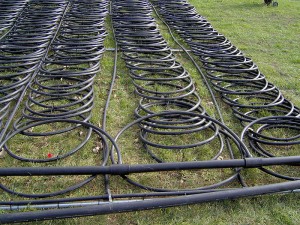
For the Merriam store the pipes contain 136, 275 liters (36,000 gallons) of a water-based antifreeze solution which as it circulates cools to the ambient underground temperature, a constant 12.8 Celsius (55 Fahrenheit) degrees. In the store 64 heat exchange pumps provide cooling for summer and warming for winter. The geothermal system also provides power and water for bathrooms and the in-house restaurant refrigerators and freezers. On the roof the store has 2,850 solar panels producing 1.3 million Kilowatt-hours of electricity. The combination of geothermal and solar is expected to meet 20 and 40% of the store’s entire energy requirements.
This latest installation is part of a much larger effort by IKEA to implement a sustainable business model to transform its business. In the company’s IKEA Group Sustainability Strategy for 2020, it states, “we can no longer use 20th century approaches to meet 21st century demands.”
IKEA is a private company and its focus on sustainability is about corporate citizenship. It has installed or plans to install 120 rooftop solar arrays on stores and warehouses throughout its chain. It has recently acquired six company wind farms and to date the investment in renewables is generating 27% of the company’s total operational energy needs, while at the same time the company is reducing energy consumption per store and warehouse facility. Today stores and warehouses are respectively consuming 10% and 33% less than in 2005.
The company has also reduced the amount of waste it generates from its stores with less than 15% going to landfill. Waste wood is being turned into composite boards for use in some of its furniture. The lacquers and glues used in production now contain reduced levels of chemicals like formaldehyde. Store lighting today is compact fluorescent with the stated goal to move to LEDs throughout the chain in the next two years.
IKEA is making sustainability a core value as it strives to meet three stated objectives in its “People & Planet Positive” strategy:
To this end the company’s 2020 objectives include a fourfold increase in the sale of products and solutions focused on sustainable living at home. This includes objectives in terms of sourcing sustainable wood products, cotton, and packaging.
In energy consumption the 2015 objective is to produce 70% of the company’s requirements from renewable sources and by 2020 achieve 100%.
All new facilities are being designed and equipped based on sustainability standards.
All suppliers are being assessed and measured against the company’s own sustainability standard.
All energy consuming products by 2020 are to be 50% more efficient than the products the company was selling in 2008.
By 2016 the company’s lighting products will be exclusively LED.
By 2016 the majority of wood, leather and other materials used in furniture and accessories, and palm oil used in candles and food will come from sustainable sources.
By 2020 30% of the wood used will be recycled.
IKEA is a private company. They are not accountable to shareholders. The company leadership, however, feels it is responsible for its participation as a citizen of the planet and sees climate change and sustainability as critical to its survival as well as that of its employees and customers. So it has chosen a path to incorporate sustainability in everything it does knowing that in the end a sustainability business model will be profitable much sooner than most would think.
I keep wondering why a company like IKEA can embrace sustainability as a core value while governments cannot.


How reliable is geothermal energy?

All of the above are utility-based geothermal power plants. There is another type of geothermal that exploits low-temperature sources, those where the heat source is 150 degrees Celsius (270 Fahrenheit) or less.
Low Temperature Geothermal
Geothermal power generated from low temperature sources has many uses. The heat can transferred to the surface to heat homes, buildings and greenhouses. Geothermal heat pumps can be used for heating and cooling by taking advantage of the constant temperature of the ground, 10 Celsius (50 Fahrenheit), just a few meters below the surface. The heat pumps recirculate antifreeze or air in buried pipes and cool down buildings in the summer and warm them in the winter. These can be passive or active systems. Passive systems use pipes that pass through a building or home and emit heat or cool the air. This is a low cost solution that would work well in the Developing World. Active systems use compressors and pumps to maximize heating and cooling.

For commercial applications of low temperature geothermal the heat can come from a variety of sources. These include:
For power generation from low temperature geothermal conventional turbines are ineffective. But new technology is making it possible to generate electricity for commercial use with turbines that operate much like refrigerator compressors running backwards.
At Southern Methodist University in Texas, the Geothermal Laboratory is researching new technologies for generating energy from geothermal associated with oil and gas fields using waste water to power small binary electric turbines. The energy recovered from these installations is sold to utilities. The cost to produce the energy is much cheaper than comparable solar and wind installations.
In future postings to this blog site we’ll explore this subject even further, and will look at other natural sources being assessed by engineers and researchers to provide alternative heating, cooling and power here in the 21st century.
]]>