
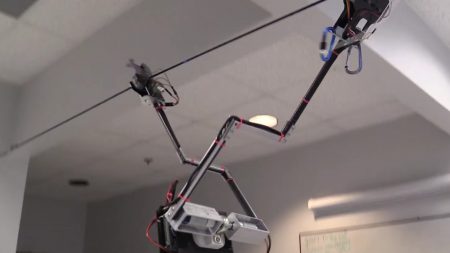
Tarzan swings back and forth holding onto guy wires that can be stretched across open fields, factory floors, or warehouses. As the robot swings its free arm eventually can reach up to grasp the wire further along. It then releases the anchoring arm and continues to swing its way along the wire. If many guy wires are strung across an area it can swing from wire to wire over an entire space providing continuous aerial coverage.
Why a swinging robot over one that walks on the ground or flies?
Rogers sees disadvantages in the latter two when doing long-term monitoring over a specific space such as a farmer’s field. He states that Tarzan with sensors and cameras on board can follow a row of crops while traveling along a guide wire. If powered by a photovoltaic array, the robot could give farmers continuous coverage of their fields. The data collected could be instantly analyzed revealing insect infestations or environmental problems with pinpoint accuracy. The alternatives, a land-based robot traveling through fields would not have a bird’s eye view of crops. And a drone would constantly need to return to base to recharge.
Rogers states, “This is the best way to keep something out of the way and off the ground without having to have something in the air all the time.” Although Tarzan could be useful in monitoring any kind of open space, Rogers sees agriculture as the sweet spot for its use. With a world population continuing to grow, crop health and increased yields are critical. Rogers points out that besides monitoring crop health, Tarzan could be designed to spot deliver herbicides, insecticides or fertilizer to a problem area. Not solar-powered as of yet, (they are working on it) Rogers argues that once the feature gets added, Tarzan will be able to live outside through an entire growing season. The robot is currently undergoing testing at a university agricultural test farm outside of Athens, Georgia, monitoring a 1.6 hectare (4-acre) field.
]]>

The concentrator is a Fresnel lens and has been developed for Ford by engineers at Georgia Institute of Technology. Although Fresnel lens technology has been around for centuries for use in lighthouses, in this case, instead of pushing the light beam out, the lens concentrates sunlight to produce up to 8 kilowatts of energy. Even the solar cells being used by Ford are 50% more efficient than those currently available commercially.

With a full charge the new vehicle which is a hybrid will have a driving range of 1,000 kilometers (620 miles). On electric-power alone it will be able to go 33 kilometers (21 miles).
Built using the C-MAX as its vehicle platform, the Solar Energi addition remains a concept for now but Ford hopes to start building solar power into its fleet of vehicles to help it achieve its carbon reduction targets. Ford estimates if all light-duty vehicles were to use the equivalent technology it will be demonstrating at the show, the U.S. would reduce annual greenhouse gas emissions by 1 billion metric tons.

