Mars Food Australia, the subsidiary of the global food giant, is using HERO® to help decarbonize its processes. The 18-month pilot project is the first step in developing alternative heat sources for the food industry. Bill Heague who is General Manager of Mars in Australia states, “Thermal energy is crucial to the business of cooking food and this technology has the capability to create limitless heat without any combustion and zero emissions.”
But this is only the beginning because Star has plans to introduce the technology into legacy coal-fired power plants to retrofit existing generators to run on green hydrogen. In an interview with Bloomberg Green, Andrew Horvath, Chairman of Star Scientific states, “We think there are a lot of opportunities in existing steam turbines that have some longevity…Why would you throw them away? They’re already connected to the grid.” He cites the example of Japan where 70% of its existing turbines still have 40 years of life left.
It is using hydrogen without burning it. That’s what sets Star Scientific’s technology apart from others trying to harness the combustible gas. The patented catalyst heats in the presence of hydrogen and oxygen to reach temperatures of 700 Celsius (1,292 Fahrenheit).
For energy utilities with billions invested in legacy power plants, the ability to leverage its assets rather than demolish them has considerable appeal. The industry recognizes the need to commit to net-zero and the challenge to achieve this is no mean feat.
Many utilities are trying to use fossil fuels and carbon capture in combination to produce what is called blue hydrogen which can then be burned to power steam turbines. One such power plant is the Wabash River Generating Station, a 972.7 Megawatt coal-fired power plant operated by Durke Energy Indiana. In partnership with Honeywell UOP, it hopes to produce 300 Megawatts of zero-emission energy from this facility by 2024 while capturing 1.65 million tons of carbon dioxide (CO2) annually.
Australia’s new government is proposing that a proposed gas-fired thermal power plant in New South Wales currently under development be converted to green hydrogen. Refitting to burn hydrogen rather than natural gas which is methane (CH4) isn’t just like switching from unleaded to premium gas in your car. The two gasses when burned do not produce the same amount of energy. More hydrogen fuel will be needed to yield the same amount of energy needed to drive the plant’s steam turbines.
General Electric has been working with hydrogen for more than three decades. It currently has an inventory of more than 100 gas turbines running on a mixture of fuels combining hydrogen with fossil fuels. It provides U.S. utilities with a hydrogen and CO2 emissions calculator to answer questions related to converting existing power plants.
The big difference between Star Scientific and other players in the emerging hydrogen power plant sweepstakes is that the former isn’t igniting the gas to create heat. For those of us who have read the story of the Hindenberg 1937 fire, there is something both novel and reassuring about a technology that can deliver heat without combustion. I would think the utility companies of the world with legacy coal-fired and natural-gas power plants would be knocking on Star Scientific’s door.
]]>
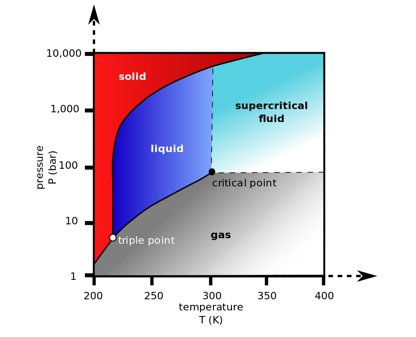
Supercritical is defined as a state above a critical threshold. In reference to a fluid, it is the state when one cannot distinguish between gas or liquid phase for the substance. The graph below shows the critical point when a gas or liquid enters supercriticality. In this state produced by exposure to high pressure and high temperatures supercritical fluids such as ScCO2 display interesting properties. For a demonstration of just what happens watch this YouTube video.
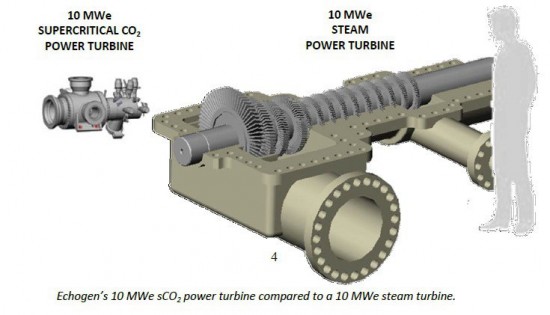
Using ScCO2 in power turbines has been of interest to the energy industry for a number of years. Why? Because as an energy driver ScCO2 remains stable compared to steam. It also packs more punch per square meter because of its small form factor as you can see in the illustration below. In addition to being more stable, ScCO2 turbines produce more energy because of 20% higher efficiency rates than steam.
So why haven’t we seen mass adoption of this technology by power utilities?
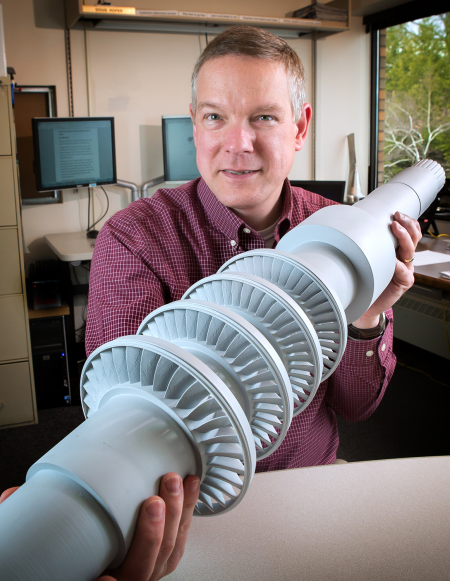
The challenge in the past has been to find the right materials capable of withstanding the elevated temperatures and pressures required by ScCO2 turbines. That’s what GE’s engineering team set out to do. And they think they got it right in developing a ScCO2-powered turbine prototype capable of generating 10 Megawatts in a form factor no bigger than a desk. There next step is to scale it to 33 Megawatts.
ScCO2-powered turbines do not require as much energy input to reach supercritical phase and they can be up and running within a minute or two. That’s up to 30 times faster than bringing a steam turbine on line.
ScCO2 has another advantage. It doesn’t corrode or fatigue materials like steam. And the technology is lower maintenance because it has no associated water quality and treatment costs which are necessary for steam-based turbines.
GE believes this technology is a good fit for providing spot-power generation for utilities during peak demand periods. It also sees it as a substitute for storage batteries at solar thermal plants where it can use heat from the molten salt reservoirs to fire up and provide continuous power even when the sun is not shining.
But GE is not alone in using ScCO2-turbine technology. Another company, NET Power has been building a power plant that generates zero emissions employing a similar technology to that of GE.
How does the NET Power technology work?
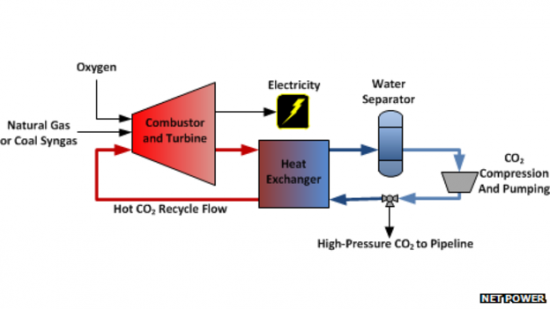
The above diagram illustrates the process. The source of fuel can be coal or natural gas. When burned with pure oxygen produced in an Air Separation Unit it also produces CO2. The latter is subjected to high pressure and heat in an oxy-combustion process. That turns the CO2 into ScCO2 which then powers a turbine.
The byproducts of the energy generation include water and CO2. Both are captured and go through a heat exchanger where the water condenses and is recycled while the CO2 either loops back to the turbine or gets sent through a high pressure CO2 pipeline and pumped underground into oil wells to enhance petroleum recovery.
Like the GE technology, NET Power doesn’t require a large footprint saving significant space compared to traditional coal-fired or natural gas power plants. A 50 Megawatt demonstration power plant, the first of its kind, is expected to be up and running in Texas by the end of 2016.
Imagine the potential this represents for both addressing energy demand while utilizing fossil fuel sources for power. The potential big fly in deploying lots of NET Power technology is the viability of a strategy where sequestration of CO2 is a key component. That may limit site selection because proximity to oil fields or to a stable underground rock formation where the CO2 when pumped underground in a super critical state would bind with the existing minerals. The last thing the industry would want to do is potentially create a CO2 leak to the surface negating the purpose of the sequestration effort.
