When the Galileo mission first started circling Jupiter in 1995. It made eleven close flybys of Europa and magnetometer readings from one of those a mere 150 kilometers from the moon indicated something was erupting from the surface. This flyby approximated the location where Hubble first detected cryovolcanism. And coincidentally, the area where the plume was detected showed a thermal anomaly which indicates that what is emanating from the surface is warmer than what is found on its surface. The height of that plume is estimated to have reached 160 kilometers above the surface.
The implications of the existence of water beneath Europa’s crust that is warmer indicates that the moon has conditions that might be amicable to life.
Europa is considered to be a high-probability site for exobiology. That’s because liquid water is very close to the moon’s surface.
What causes Europa’s plumes?
The interaction of Jupiter and the neighbouring Jovian moon Io produces an incredible amount of energy in the form of tidal forces on Europa. And it is these tidal forces that planetary scientists believe is causing shifting in the icy surface and allowing for cryovolcanic eruptions.
What we still don’t know is the nature of Europa’s core. Is it solid or is the entire moon water? If solid, could the warming be caused by a hot core that features marine volcanoes erupting into the global ocean, transferring heat which is then leading to cryovolcanic activity at the surface?
Or are the plumes erupting from local warm spots, pockets of water in the crust that eventually reach the surface and escape into space?
NASA has planned a mission to Europa known as the Europa Clipper. It is planned for between 2022 and 2025. The Clipper will visit Europa at least 44 times in its mission and descend to heights above the surface as low as 25 kilometers. It is likely that cryovolcanic plumes will intersect with Clipper as it flies by.
Clipper will map the subsurface ocean. In addition, the instrumentation will be able to detect chemistry and constituent matter on the surface and within Europa’s plumes. Indirectly this may be able to tell us that microbial life exists on Europa.

]]>
With Jupiter our first destination, followed by Saturn, two members of the Asteroid Belt, and Pluto and Charon, these voyages straddled the end of the 20th and beginning of the 21st century. So let’s begin with our return to Jupiter on a spacecraft named Galileo and then discuss other missions in progress or planning and why we keep going back to this gas giant.
What compelled us to return to Jupiter after the successes of the Pioneer and Voyager missions? There were lots of unanswered questions about Jupiter, when it formed, where it formed whether it has a solid core and its structural composition, and which if any of its moons had liquid water and the ability to sustain life. We wanted to understand how one moon, Io, could be constantly going through the throws of reforming its crust with more active volcanoes than any other body in the Solar System including Venus.
Galileo – A Voyage of Discovery That Changed Our View of Jupiter and its Moons Forever
The Galileo mission was designed to address some of these questions. A spacecraft designed in the 1980s, it took nearly six years from its launch in 1989 to get to Jupiter. Its route took it first by Venus once and Earth twice before developing the gravity-assisted speed necessary to coast past Mars and through the Asteroid Belt to Jupiter.
While on route it rendezvoused with two asteroids, first Gaspra in 1991 and later Ida in 1993. While passing Ida it captured a picture of the asteroid and its accompanying moonlet named Dactyl. A year later on approach to Jupiter it bore first-hand witness to the destruction of Comet Shoemaker-Levy as it impacted the planet.
Galileo finally arrived at Jupiter in December 1995. It launched a companion atmospheric probe on July 13, 1995. The probe descended through 200 kilometers (124 miles) of the planet’s outer atmosphere collecting data on local weather conditions – for July 13, a dry day with a few clouds and distant lightning. As the probe descended further it experienced winds exceeding 720 kilometers (450 miles) per hour and finally vaporized in the intense heat of the atmosphere after 61 minutes of transmission.
Galileo’s path around Jupiter took it in long elongated orbits around the planet, each averaging about two months. The orbits allowed the spacecraft to sample Jupiter’s magnetosphere in different locations while performing close rendezvous with Jupiter’s many moons. After 35 of these orbits and almost eight years of operation in the planet’s vicinity Galileo was instructed to self-destruct in the Jovian atmosphere to avoid a potential contaminating impact with the moon Europa.
What answers did Galileo give us to the questions we had about Jupiter and the Jovian system?

Because of these discoveries and the many still unanswered and new questions that arose from Galileo’s mission, Jupiter is once again to be visited by a new spacecraft, Juno, that will focus on the planet exclusively. The Juno mission will be followed by a new robotic spacecraft, Juice, with a mission to study the Jovian system and in particular its ice moons.
Juno – Dissecting Jupiter to Understand How the Solar System Formed
Jupiter is the largest planet in the Solar System. Its mass is greater than all the other planets combined. Scientists theorize it was the first planet to form out of the nebula that condensed to form our proto-Sun and its planetary companions. What is not known is where Jupiter formed? The presence of large quantities of noble gases as found by Galileo suggests that Jupiter may have formed much further out than its present position as fifth planet from the Sun. Juno, the next mission to Jupiter may provide us with answers and help us learn more about the earliest period in the Solar System’s formation.
In returning to Jupiter with Juno the goal this time is to focus on the planet itself and not the larger Jovian system. Scientists hope to learn more about the origins of the Solar System by studying Jupiter, its composition, whether it has a solid core, and the mechanism behind its powerful magnetic field.

Juno is a very different spacecraft than Galileo. It is solar powered. Galileo was powered by a Radioisotope Thermal Generator (RTG). In choosing solar over RTG the spacecraft designers have built a significant solar array with three panels, each 2 meters (6 1/2 feet) wide and 9 meters (almost 30 feet) in length. The size of this array is significantly larger than any previous robotic spacecraft. Why? Because sunlight near Jupiter is 27 times weaker than sunlight near Earth.
In addition the spacecraft is designed to fly with its solar panels always sun facing to maximize its ability to power the instrumentation package on board (see image below).
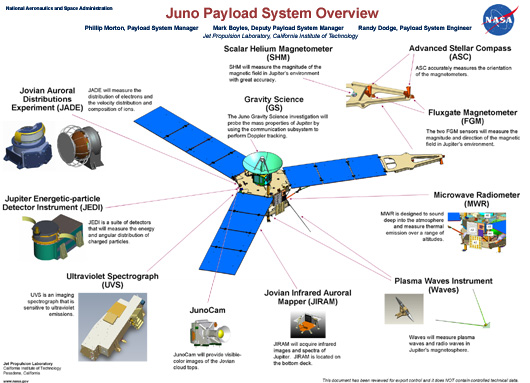
Upon its arrival in 2016 Juno will enter a close polar orbit around the planet taken it within 100 kilometers of the cloud tops. In this way Juno will be less exposed to the Jovian magnetosphere while it directs its scientific instruments at studying the planet below. After 32 to 33 orbits taking approximately one year the plan is to deorbit the spacecraft to burn up in the atmosphere in October 2017.
Juice – Europe’s Contribution to Exploring the Jovian System
The Juno mission is not our last visit to the vicinity of Jupiter. Other missions are planned including a lander with technology to drill into the surface of Europa to sample its subsurface ocean, and a new mission from the European Space Agency (ESA), named Juice, planned for a launch in 2022 with arrival at Jupiter by 2030.
Juice stands for Jupiter Icy Moons Explorer. The mission will study Europa, Ganymede and Callisto. The spacecraft will make several flybys of these moons while doing further studies of Jupiter’s atmosphere and magnetosphere and how the latter interacts with its moons. The plan includes a final rendezvous with Ganymede with Juice entering into orbit around that moon in 2032.
In choosing Ganymede as its final destination Juice will study its atmosphere, icy surface, internal structure and subsurface ocean as well as its unique magnetosphere.
Our next stop in our exploration of the outer planets – Saturn.
]]>