The fanciful dream of unlimited clean energy through the harnessing of nuclear fusion, in my opinion, will be the most significant advance humanity makes in the next 15 years because its implications are so significant. It will truly end our need to use fossil fuels for power generation. That means no more carbon emissions to fuel global warming. Fusion energy will become a backup for intermittent renewables as well as a peak-demand source of power that will be carbon-free.
Candidate fusion prototypes exist on the drawing boards of many companies and in university laboratories these days. Demonstration systems are being built, some costing tens of billions of dollars. But most are not even close to being ready for prime time.
One, however, appears to be moving closer to the finish line than the rest. The Canadian company, General Fusion, recently was awarded a contract in the United Kingdom to build a fusion power plant demonstrator near Oxford, England. It will be 70% to scale of what eventually will become the first working commercial fusion reactor. The project completion date is 2025.
This is not the first time I have come across or written about General Fusion. My first introduction to the company was back in 2013 when it announced it was about 15 years away from developing viable commercial fusion. I wrote about it then. Three years later the company made the news once more as it perfected its technology and received investment backing from the Canadian government. Since then General Fusion has received a cash infusion from the likes of people like Amazon’s Jeff Bezos.
The demonstrator reactor in the UK will cost approximately $400 million with much of the money coming from that government. Its purpose will be to demonstrate that Magnetized Target Fusion (MTF) technology works reliably for power generation. To move past the 70% to full commercial implementation, the company will build a follow-up facility and switch fuels from pure deuterium to a deuterium-tritium mix to push energy output to vastly exceed input making it commercially viable.
MTF involves a spherical chamber confining a superheated plasma fuel. In the demonstrator that is deuterium. The confinement is produced using powerful magnets. Pistons located outside the sphere compress the plasma heating it to 100 million degrees Celsius (over 180 million Fahrenheit) which causes fusion to occur. The heat from fusion transfers to liquid lead-lithium that is rotating within the interior of the sphere. Using that heat allows the facility to power a steam turbine which is connected to a generator to produce electricity.
Once complete and operating as a demonstrator, how many more years will it be before a fully operational nuclear fusion plant will replace it? Here is where my fifteen-year projection seems spot on. The demonstration reactor should be up and running in three years. Let’s say it runs successfully for five years thereafter, then the building of a full-scale reactor may take another five years before it’s ready for commercial use. That takes us to a little before 2035 to see the first fusion energy reactor producing power to light and heat UK homes and businesses.
What issues remain before fusion replaces fossil fuel-powered thermal energy plants? Currently, we cannot solely rely on intermittent renewable power to meet the energy demands of the world for the remainder of this century. Fusion reactors that produce no nuclear waste issues, and no greenhouse gas emissions to drive global warming, provide an answer. A better solution than current fission reactor technology as a backup to intermittent solar and wind, fusion can be the world’s energy game-changer.
In business there is an old saying: first to market brings legitimacy. In this case, General Fusion is ahead of the pack although others are waiting in the wings to try and outflank the Canadian company.
Issues still to be resolved include a reliable and abundant source of the materials and fuel needed for fusion reactors. Is there sufficient deuterium and tritium?
Deuterium, also known as hydrogen-2 or heavy water is used today in CANDU fission reactors, a technology that has been operating in Canadian-designed reactors for nearly 70 years. Tritium is a radioactive isotope of hydrogen that CANDU reactors produce from deuterium. Tritium is produced as well by irradiating lithium which can be done in other fission reactor systems that don’t use deuterium. Then there are other potential material sources such as the lunar regolith which has an abundance of hydrogen radioactive isotopes to mine.
So, getting back to the survey question I and others were asked, there is no doubt in my mind that fusion reactors within 15 years will bring to our planet abundant emission-free energy as we have never seen before.
]]>Last year I read an article that forecasted 2025 as the year for the arrival of the first commercially viable fusion reactor. I thought, how could that be when every time fusion reactors come up in the news it seems that commercial versions still lie decades ahead.
Nuclear fusion as opposed to fission is very attractive if we can pull it off. Why? Because a mere 30 grams (one ounce) of the fuel used for fusion reactors produce the energy equivalent of 9,000 litres (304,000 ounces) of heating oil. That’s a 304,000:1 payback which makes the quest to harness this technology a worthwhile endeavour. Then add two other benefits that put fusion well ahead of fission: the former produces zero radioactive waste, and it will never in an accident lead to a meltdown such as occurred at Chernobyl and Fukushima. Instead, the fusion reaction will just die.
The technical and material problems, however, remain significant. These include:
Fusion reactor design has been a challenge. The most common model has been the doughnut-shaped vessel called a tokamak. The European Union is the home of the ITER, a tokamak that when it finally gets working will produce between 2,000 to 4,000 megawatts of power.
The tokamak isn’t the only concept design on the market. For example:
Not to be outdone by commercial enterprises, universities and research institutes are also in the race to perfect fusion reactors. For example:
So it would seem we have both a commercial and academic fusion reactor arms race on the go that could allow us to transition away from carbon-generated energy even faster than previously estimated. Where ITER had set a 2040 target date, these competing designs appear to be a decade ahead or better which is encouraging news. With nuclear fusion added to the mix, the intermittency issues of renewables like solar and wind no longer pose a problem for our clean energy future.
]]>
Fusion power requires lots of heat to create an ionized plasma. To contain the plasma you need a strong magnetic field. Since 2006 an international group has been trying to build the ITER Project, a reactor with these features. It is, however, based on current timetables, not expected to be ready until 2027. And it is expected to cost many billions of dollars more before finally operable. The figure now is approaching $50 billion U.S.
As ITER sucks more research and engineering dollars from partner governments and university budgets, some academics and energy businesses are seeking cheaper alternatives to commercial fusion reaction. But it is fundamentally hard to create and contain the Sun on Earth. Why I say this is because that’s what a fusion reactor is all about. It is the recreation of the power that drives the Sun.
In fusion reactors we heat up hydrogen or other element isotopes (deuterium, boron or helium-3 for example), stripping them of electrons and creating a plasma which we then compress using powerful magnets. The nuclei of the hydrogen then fuse and in the process release excess amounts of energy.
But what the Sun does naturally, because solar fusion can be contained by the star’s immense gravitational field, we, here on Earth, must mimic by using external containment provided by powerful magnets. Is ITER and its design the only way?
Thomas Jarboe and a group of researchers at University of Washington in Seattle don’t think so. They are attempting to build a much smaller fusion reactor that costs 1/10th the price. Jarboe is pictured here with a prototype of his reactor. The schematic drawing to the left provides a good illustration of the device he and his team are building.

Jarboe, a professor of nuclear engineering and Director of the Plasma Science and Innovation Center at University of Washington, is collaborating with Princeton’s Plasma Physics Laboratory on this experimental fusion reactor which they call a Spheromak. In their research they have discovered they can create a stable contained plasma using 1% of the energy required by a device like ITER.
TheSpheromak resembles two coffee mug handles surrounding a wheel, a far far different appearance than ITER which uses a tokamak design (see below).

Two decades of research have gone into Spheromak’s design which Jarboe believes will be far more efficient for containing plasma. That’s because the two mug-handle-shaped coils generating alternating currents on either side of the central core create what is called an imposed dynamo current drive. This creates a sustained closed magnetic field within which the plasma is contained.
Right now the reactor is a small laboratory-sized device and its size presents a problem. It is far too small to fully contain all of the plasma within it and some escapes as gas. That’s why the researchers want to build a larger version where they believe the size will solve the plasma leak problem. Total cost – approximately $2.7 billion U.S.
The United States Department of Energy is putting money into the project which is more than can be said for ITER this year. The U.S. Congress voted not to make its annual contribution to the multinational project.
The Twente-developed technology uses interweaving to withstand the super cold temperatures needed for superconductivity to maintain the magnetic fields and the fusion reaction. Those magnetic field coils represent one-third of the cost of a fusion reactor. In the past the cables have been the Achilles heel. They couldn’t withstand the 40 to 60,000 charge cycles needed to make fusion reactors economically viable. The new design, however, has the ability to extend fusion reactor operational life to meet or even exceed these limits and thus dramatically lower costs.
What’s involved in a fusion reactor? The fusion chamber contains super-heated 150-million Celsius degrees plasma which is held together by a strong magnetic field. The field is maintained at a temperature far below that, -269 Celsius degrees. This super-cold temperatures creates superconductivity, that is, zero-resistance within the cables that generate the magnetic field. Liquid helium is the refrigerant. Although rare on Earth helium appears to be abundant on the Moon and that’s why there is interest in lunar mining of it, but that’s another story.
As you can imagine the juxtaposition of heated plasma and near absolute zero temperatures can play havoc with any wiring. Rapid changes in the magnetic field as well leads to excess heat within the cable system itself/ That causes superconductivity and fusion to stop. Interweaving the wires, however, prevents this from happening.
Each superconducting cable contains 864 individual wires, each 0.8 millimeters (0.03 inches) thick. This design reduces current eddies and any heat build up that could impact superconductivity. The cable system in total stands 13 meters (42 feet) high and consists of six coils containing the interwoven wires which you can see in the picture below. The material used consists of a pair of wires made from niobium-tin and one from copper. The latter provides greater heat resistance to maintain a superconducting state.
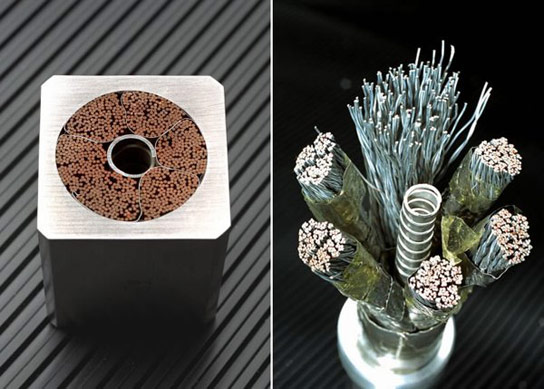
The new cables will be incorporated into the multinational-financed nuclear fusion reactor project, ITER, under construction in France, expected to become operational by 2020. Both China and South Korea, each with independent fusion reactor programs, have also expressed interested in incorporating the Twente design which will probably become an international standard.


