
So an inventive bunch has taken 10 years of research done by Berkeley National Laboratory in California and come up with an inexpensive technology to exploit the energy and output of open fires and cook stoves. Their invention, the Voto, a metal-supported solid oxide fuel cell uses biomass as fuel to generate electricity. They call the process of conversion of biomass to energy, Votosynthesis. That’s because the device does the reverse of photosynthesis converting carbon compounds in biomass, combined with oxygen, into electricity, heat, water and CO2.

The 5-watt Voto can run on any biomass but works best with charcoal, a common fuel used in cook stoves throughout the Developing World. Voto can be used as a home charger for mobile devices or as an energy source for indoor lighting replacing kerosene lanterns.
How does it work? Voto uses a thin layer of ceramic placed on stainless steel cards combined with a low-cost catalyst to create a thermal shock tolerant technology that is inexpensive to manufacture. It works optimally when heated to 700-800 Celsius (1,292 – 1,472 Fahrenheit) degrees. Two cooking sessions fully charges each unit. Because fuel sources vary the cards degrade on average in 3 to 4 months. But the cost savings from using less kerosene more than offsets replacing the cards.
Voto is being marketed by Point Source Power which has plans to distribute its product in Kenya later this year.
]]>
The American Navy Plans to Stop Using Dolphins and Sea Lions in War
I’m sure that the U.S. isn’t the only country that exploits dolphins and other marine mammals in its military operations. But in December of 2012 the U.S. Navy announced it would phase out dolphins by 2017 in its search for undersea mines, very dangerous work, and would instead replace them with robots like the Nekton Research Transphibian prototype pictured in the image below.
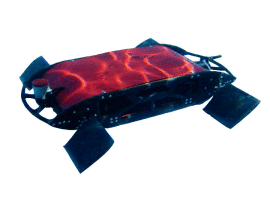 The navy started employing dolphins in 1960 as part of its marine mammal program. The fact that dolphins are self-aware, sentient creatures that have powerful echolocation sensory skills and can be trained by human handlers to expose themselves to the danger of mine explosions has had no bearing on the decision making. According to the navy it’s a cost thing. The robots that will replace them can do the job from a longer distance and can work 24×7 unattended. The dolphins aren’t the only ones losing their jobs to robots. So are sea lions who will join the unemployment line. I am sure both marine mammals will be happy to be relieved of duty.
Pee May be the Latest Power Source for Battlefield Fuel Cell Technology
SiGNa Chemistry makes mini fuel cells for charging smartphones. The U.S. military likes the technology so much that it has launched a pilot project to test the fuel cell in battlefield conditions. Called the PowerTrekk, the device, seen below with a smartphone attached, is a mobile hydrogen fuel cell containing dry-powdered sodium silicide. Combined with any water source including pee it turns into a fuel-cell power source that can be used to recharge a smartphone, MP3 player, GPS, LED lighting, camera, battery of sensors, you name it.
The PowerTrekk provides consistent power output and, unlike batteries, zero power degradation. The sodium silicide is non-inflammable, stable in ambient temperatures, and works with any water source including salt water and, of course, urine in the absence of other sources of moisture. For soldiers in the field it means a weight saving of 12 kilograms (25 pounds) in field gear.

Can a Cure for Type 1 Diabetes in Dogs Eventually Lead to a Human Cure?
A single session of gene therapy has cured type 1 diabetes in dogs. The research, done at the Univesitat Autonoma de Barcelona, reported this month in the journal, Diabetes, a publication of the American Diabetes Association, describes the protocol used to introduce gene therapy vectors, one focused on the insulin gene and the other on the glucokinase genes. We all know the role insulin plays. Glucokinase is less well known and serves to regulate enzymes responsible for removing glucose from the bloodstream.In combination the two genes act as a glucose sensor and reduce excess blood sugar.
The dogs were treated with a single administration of gene therapy and exhibited no episodes of hypoglycemia, even after exercise, showing improved body weight with no secondary complications four years after treatment. The research team and some of their very happy subjects appear in the picture below.

Scientists Create Solar Sponge to Capture CO2
To sequester carbon from the atmosphere you need an efficient way to capture it. A new smart material called metal organic framework or MOF is the invention of scientists at CSIRO, an Australian scientific research institute. MOF acts like a sponge soaking up and storing gases. The process is called dynamic photo-switching.
MOF has the ability to capture a liter of nitrogen gas per gram of material. That’s because every gram contains a surface area equivalent in size to a football field. When exposed to UV light the azobenzine molecules in the MOF release as much as 64% of the captured gas.
MOF is a flexible material so you can put it almost anywhere where you need to soak up polluting gases. It should prove to be an effective way to capture CO2 and with the right carbon storage technology fit into a sequestration strategy quite well.

Geoengineering Idea Promoted as Cheap and Easy Way to Solve Global Warming
The plan is simple. Get a bunch of business jets outfitted with equipment to disperse fine powdered sulfur into the atmosphere at an elevation of 20 kilometers. The sulfur would combine with water vapour to form a fine dilute sulfuric acid aerosol. The aerosol would spread through the stratosphere acting as a sunlight blocker to reduce the total amount of solar radiation falling on the surface by 1%. Scientists believe a decrease of 1% in solar radiation would be enough to offset the warming caused by greenhouse gases.
David Keith, who teaches at Harvard University, is the scientist who has proposed this geoengineering experiment. He notes that even if we halt spewing CO2 into the atmosphere entirely, the current levels of the gas approaching 400 parts per million would continue to warm our atmosphere for 1,000 years. But if we were to pump fine sulfuric acid particles into the atmosphere for an indefinite period of time we could reduce the impact somewhat. Just a few grams of sulfur could offset warming from a ton of CO2.
He is not the first nor the last to propose seeding the atmosphere to reduce sunlight striking the Earth’s surface. And it seems more and more scientists are considering experiments such as this.

Postscript
Today I placed a deposit on a new place for us to live. This means in the next three months my family and I will move to a smaller abode and a smaller carbon footprint. We will leave our house on the city edge to move downtown where we will continue our lives in an apartment. Soon one of our two cars will no longer be needed because we will be close to rapid transit lines and will be able to walk almost everywhere to do shopping. I hope we can make many more environmentally conscientious choices for daily living to help mitigate climate change. Everyone on the planet, and particularly those of us fortunate to live in North America and Western Europe have to be looking at ways to reduce our carbon footprints. It’s just another living challenge of the 21st century.
Once again I thank you for your continued readership and welcome your questions and comments.
– Len Rosen
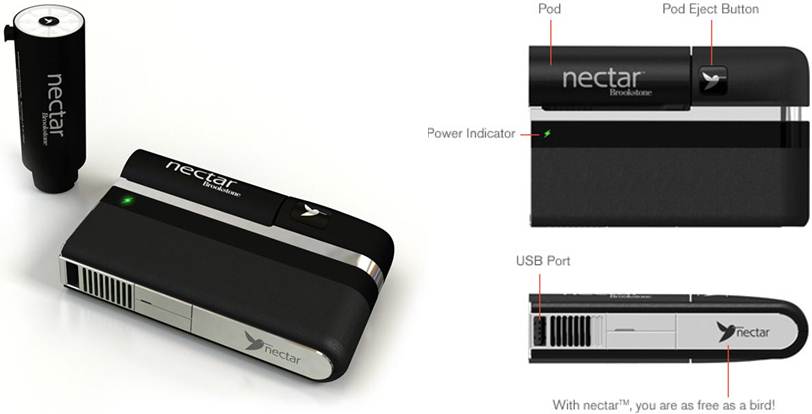
]]>The Nectar uses a solid oxide thin film fuel cell (SOFC) to generate a +5 volt charge to any device plugged into it. It can power a wide range of electronic devices through its USB 2.0-compatible port. Each Power Pod stores 55,000 MW-hours of energy in a single cartridge.
Why and where would you use it? When power goes out like it did for a number of days when Hurricane Sandy struck in 2012, the Nectar would have been an ideal emergency power source. Typically, however, it would be used for travel in areas where conventional power sources are nonexistent. Each of the hot-swappable Power Pods can provide enough juice to power a single device such as a smartphone for up to a month or about 10 charges.
You can pre-order a Nectar before January 28, 2013. The first order comes with two Power Pods. Additional Power Pods are sold for $19.99 a pair. Nectar will begin shipping in summer 2013.
That is the future of medical implants powered by fuel cells that use glucose (sugar). No external or internal battery pack to replace. Just do what you normally do to fuel yourself and you will keep all the medical devices inside you running.
That’s because fuel cell technology has the potential to use fuel like glucose and a team of engineers at Massachusetts Institute of Technology (MIT) have exploited this in designing one that mimics the way cells process glucose as fuel. Built of silicon with a platinum catalyst, the cell uses the catalyst to strip electrons from glucose molecules creating an electric current. It currently can generate hundreds of micro-watts, enough to power an implanted device. The focus of the team is neural implants. With no requirement for an external power source, these fuel cells can run as long as you keep feeding yourself. So an apple a day sounds like a plan!

Energy Update: Print or Paint on Solar Cells
Sounds like an ideal way to maximize surface areas for power generation. No longer science fiction, University of Southern California researchers recently announced a liquid printable solar cell using solar nanocrystals that are so small you can fit 250 billion of them on the head of a pin. The work at USC follows a December 2011 announcement of a similar nature made by scientists at University of Notre Dame who have developed a solar paint.
The downside to the current technology is poor conversion efficiency compared to traditional photovoltaic technology. The upside is the nanocrystals can be applied to plastic as well as glass. Plastic panels can be flexible and shaped to fit anywhere.
The current nanocrystals use cadmium which is toxic but scientists believe they can work with other materials to perfect this technology and improve power yield efficiency for commercial production.

Space Update: 100 Goldilocks Planets within 30 Light-Years of Earth
A Goldilocks planet is one that has the potential to support life on Earth. That means it’s not too hot, not too cold, just right for liquid water to exist on its surface.
Since astronomers developed the technology to find planets circling neighbouring stars they have been stunned by the sheer numbers. Currently they estimate tens of billions which is why astronomers think there are 100 Goldilocks planets in close proximity to us. By close we mean within 30 light years. Based on our current propulsion systems no one will be going to visit these planets for awhile.
Research at the La Silla Observatory in Chile conducted over 6 years surveyed 102 red dwarfs, the most common stars found in the galaxy. The astronomers identified 9 super-Earths, that is planets between one and ten times the size of our Earth. The methodology detected only a fraction of the total planets around red dwarfs but using the discovery astronomers were able to calculate an estimate that 40% of all red dwarf stars have Goldilocks planets orbiting around them. There are 160 billion red dwarf stars in our galaxy. So you can do the math.
If we within the century (see my predictions in a previous blog) develop propulsion technologies that reach between 10 and 50% sub-light speed it is feasible that robotic spacecraft can journey to these systems. And where robots first go, humans will follow.

Transportation Update: Wireless Recharge for Battery-Powered Vehicles
If electric-powered vehicles are to replace internal combustion engine technology then making recharging accessible anytime a vehicle is parked makes sense. With that in mind the United States Department of Energy is rewarding grants to companies who develop static wireless charging systems for electric cars similar to the Powermat used to charge portable electronics.
Nissan has announced that the Leaf 2013 model will include a wireless charging option transferring power from a ground transmission unit to a receiver on the vehicle using electromagnetic induction. But Nissan’s solution is specific only to its automobiles.
What the Department of Energy seeks is high-efficiency wireless charging technology that works with any vehicle and that can be installed in parking lots and garages. The system would employ electronic payment. Delphi, the automotive parts supplier is working with MIT to develop such a system.
A wireless charging system would include:

Urban Landscapes Update: Singapore Creates City Garden with First Mechanical Forest
The project is called Gardens by the Bay. It features a 101 hectare (250-acre) garden that includes a massive climate-controlled conservatory and the first mechanical forest. The garden opens June 29, 2012. Visitors can experience indoor themed gardens representing flora from around the world, a flower dome, a cloud forest, an exhibit called The World of Plants, and two indoor lakes.
Dominating the landscape are 18 supertrees, varying in height from 25 to 50-meters (80 to 164 feet), made from concrete and steel. Each tree is a vertical garden with the canopy designed to collect rainwater, absorb heat and provide shade for the plants in the gardens below. The trees are also outfitted with photovoltaic cells to generate electricity for lighting and other uses in the gardens. The trees serve an additional purpose as ventilators for the neighbouring conservatory. Each supertree will house over 226,000 plants representing 200 different species.

]]>
The theory that hydrogen could be shrunk to form hydrinos was first described in 1986. The energy net gain from multiple collisions with catalytic ions could continuously shrink the hydrogen into smaller and smaller hydrinos with each shrinking releasing enormous amounts of energy. We know that hydrogen when combined with oxygen to form a water molecule releases 2.5 electron volts (eVs). Hydrinos can release much higher levels than 2.5 eVs as they shrink from collisions resulting in an net energy yield. What does this all mean? That water could be a fuel, and since our planet surface is more than 70% covered by water we could have a source of unlimited potential.
This theory of hydrinos as a power source is suddenly in the news. A company, Blacklight Power Inc., in New Jersey, has just issued a release claiming that independent experts from six academic and industry laboratories validated its technology, the production of electricity from the conversion of water vapour to hydrinos. Blacklight believes that hydrinos may be the dark matter that scientists speculate makes up most of the mass of the universe.

The company has developed a proprietary technology it calls the Catalyst Induced Hydrino Transition cell or CIHT. A CIHT extracts energy from water vapour in the air. It does this with much higher energy yields and at a much smaller cost than conventional hydrogen fuel cells. And unlike a fuel cell it doesn’t require the burning of fossil fuels to generate the chemical reaction that initiates the process. In fact it doesn’t require any fuel source other than that to initiate electrolysis for extracting hydrogen from water to get the process started. Once the hydrogen to hydrino cycle initiates water becomes the ongoing fuel source generating a continuous output of energy.
Blacklight reports that the independent studies involved groups of scientists who fabricated and tested CIHT cells, operating them for periods of from 30 to 70 days. The analysis of the results validates the company’s claim that it can run its cell technology on water vapour and produce a net electrical output 1o+ times greater than the energy required to initiate the electrolytic process.
The potential of the energy yield of a single CIHT cell could operate a standard mid-sized automobile for 5,000 kilometers (approximately 3,000 miles) on a liter of water (0.26 U.S. gallons). A 133-liter cell would be capable of delivering 200 kilowatts or 267 horsepower while weighing one-third that of an equivalent internal combustion engine with a net benefit of producing no carbon pollutants.
If Blacklight continues to get validation from third parties and can bring CIHT cells to market then mark May 22, 2012 as an important milestone in our human search for unlimited energy resources that come with no negative environmental impact.
]]>Picture this. The year is 1900. Automobile manufacturers in the United States produce 4,192 vehicles of which 1,681 run on steam, 1,575 run on electricity and 936 use gasoline-powered ICEs. When consumers are asked at a National Automobile Show in New York City their preference, their responses favour an electric automobile first followed by steam. ICE automobiles trail the pack.
So Why Didn’t the Steam Engine Take Off?
The beginning of the automobile age provided buyers with many engine choices. One of those was steam. Considering steam had a legacy of a century behind it one would have thought it would be the engine of choice for the new automobile industry. After all trains used steam. All the automobile makers needed to do was take the train steam engine and scale it down to fit something smaller than a locomotive. Soon steam-engined automobiles appeared on North American and European roads.
Steam had some advantages over ICE. Steam was quiet when compared to ICE engines with their noisy pistons and valves. Steam ran on water and a little bit of fuel to heat the boiler. The fuel could be almost anything – wood, charcoal, coal, kerosene. ICE required gasoline, a distillate from oil refining, used more as a solvent than a fuel. Although early steam-powered automobiles needed frequent stops to take on water, once water-condensing and recycling systems were added these vehicles could cover very long distances. One even was able to travel over 2,400 kilometers (1,500 miles) before making a pit stop.
But steam also had disadvantages. The engines needed to be warmed up for a long time before the boiler could build up a proverbial “head of steam.” This meant delay before the steam-engine automobile could drive, and early steam cars literally ran out of steam requiring frequent water stops.
Steam eventually lost out to ICE technology and by 1920 steam-powered automobiles had disappeared. We will deal with the why a little later in this blog. But it should be pointed out that a few clever inventors continued to tinker with steam and today steam may be making a comeback because of its low-carbon footprint.
Electric Cars – Been There, Done That!
Like steam the electric automobile has a long history dating back to the 19th century. Electric vied with steam and ICE technology at the outset of the automobile age.
Electric automobiles suffered from the same problem that all-electric vehicles have today. Storing the power was the key and battery technology in the early 20th century made these vehicles prohibitively expensive when compared to the Model-T produced by Ford.
Travel distance between recharges represented a further obstacle to commercial success. A popular electric car in the early 20th century, the Detroit Electric achieved a record of 340 kilometers (211 miles) on a single charge. The Detroit Electric, however, was an exception to the rule.
Finally the electric cars of the early 20th century were not considered to be manly, largely driven by women and doctors. Why? Because the cranks that ICE automobiles used required considerable strength (the word “cranky” comes from the mood it put drivers in when trying to start the car). Women weren’t expected to crank an ICE engine so electric cars were sold to them. And the reason doctors were considered a market for the electric car was similar. A doctor simply couldn’t afford to get injured when cranking the starter to get an automobile going to do emergency visits and house calls.
The Triumph of ICE Technology
By the end of World War 1, ICE technology had proven itself on the battlefields of Europe and the Middle East. ICE predominated because:
Of all of the reasons mentioned above it was the electric starter that drove steam-engine and electric cars from the market with 1913 being the year of dramatic change. In that year while sales of electric automobiles declined to 6,000 units Ford sold 182,809 Model Ts.
In 1890 where would you buy gasoline? Not in gas stations but in your local hardware story, sold by the can. What did you use it for? As a solvent and occasionally as a heating fuel. The predominant “vehicle” of the time was the horse and horse-drawn carriage or wagon. The cost of feeding and caring for a horse was high compared to the cost of operating a motor vehicle. By 1905 motor vehicles were consuming 600,000 barrels of gasoline a year in North America, representing approximately 9% of total annual gasoline production. By 1916 the livery and bicycle repair shops evolved into 18,500 automobile repair garages dispensing gasoline from cans and barrels.General and hardware stores, and independently operated tank wagons were other ways to get gasoline. For the well-to-do, companies like Bowser started outfitting homes with their own indoor tanks and pumps. Soon this technology found a new home, gas stations.

The service station as we know it began to appear by the mid-1920s. These stations offered amenities like clean washrooms, free maps, air and water, and accessory products such as tires, and batteries.

Today, the ICE infrastructure represents the single most compelling reason for its continued global predominance.
What is Driving Us Away from ICE?
In the 21st century humanity confronts two challenges that make ICE less compelling as a technology option. These are climate change and fossil fuel supply.
What are the Alternatives Today and Tomorrow?
Better ICE, Diesel and Natural Gas
Although diesel engines have always been an alternative to ICE, diesel technology is just as reliant on fossil fuel production and will be subject to the same rising price curve. Improving the performance of ICE technology so that it uses less gasoline per kilometer represents a stopgap measure as well. Natural gas-driven automobiles represent another technology but once again we are talking about a fossil-fuel energy source. If we are to eliminate fossil fuels as the energy source to power automobiles then we need to look at other technologies.
Biofuelled Automobiles
Many automobiles today operate using blended gasoline or diesel that combines fossil and bio-derived fuel. Producing biofuels to-date requires significant energy input for the energy output. Biofuels from fallow fields, such as switch grass or fuels produced from algae would be much preferred to those derived from corn and sugar cane. Biofuel ICE technology is already on the market and could very well be its saviour. For additional information see my earlier blog discussion on biomass and biofuels.
Hybrids a Stop-Gap
Hybrids represent a stop-gap technology. They use a propulsion system that marries ICE to electric motors and batteries, and captures energy from braking to recharge batteries to create very low gasoline consumption. Hybrids are not a new idea. Ferdinand Porsche in 1898 built his first hybrid automobile using a combination of ICE and electric motors located in the wheel hubs. The automobile could travel over 60 kilometers (approximately 40 miles) on electricity alone. Throughout the 20th century manufacturers tinkered with engines that combined ICE technology and electrical motors but it wasn’t until the oil embargo of the 1970s that hybrids were given serious consideration as an alternative power source for automobiles. Even then no commercial vehicles appeared in the market despite gasoline shortages.
In 1976 Toyota built its first hybrid but the vehicle never became a commercially produced car. But the company never gave up on its early foray into this technology, By 1997 it launched the Prius, the first mass-produced hybrid vehicle. By 2010 Prius sales had reached over 2,000,000 vehicles worldwide and an average of 400,000 new orders each year. The hybrid had come of age and today represent a better solution than diesel, natural gas or improvements to ICE technology alone.
The Rebirth of the Electric Car
We have talked about the electric car in a previous blog. The rebirth of the electric motor in automobiles represents a move away from fossil-fuels and a serious reduction in carbon emissions. These vehicles combine electric-motor drive systems with batteries and sustain a charge for 100 or more kilometers (about 60 miles). These are urban commute vehicles at best, limited by current battery technology. The electricity sustaining this technology comes from plugging-in to a power source which may be a coal, natural gas or other fossil-fuel power plant, and therefore not exactly a zero-carbon solution. But it represents a significant initiative with engineers and scientists devoting considerable effort to finding greater efficiency and capacity in storage technology while reducing it scale (see my blog on energy and storage).
Fuel Cells – Not Just for Spacecraft
Fuel cell technology has been with us for more than a century but it was only in the last 35 years of the 20th century that space scientists and engineers at NASA popularized this technology for use in the Apollo Program and subsequently in the space shuttle. Fuel cells are powered by hydrogen to generate electricity. Water is the byproduct, a highly valued need in space.
Fuel cells that work in automobiles do not have to carry on board oxygen. They get oxygen from the air. But they do require stored hydrogen. A Polymer Electrolyte also known as a Proton Exchange Membrane or PEM acts as a filter only allowing positively charged ions to pass through it while forcing the electrons to travel around it creating a current. On its own a single fuel cell produces on 1.16 volts of electricity. As a result, just like the lithium battery stacks in electric cars, fuel cells are stacked together to generate enough energy to run an automobile.
The major challenge with fuel cells is hydrogen itself: how to produce it and store it. Hydrogen packs a lot of punch when burned producing 3 times the energy of gasoline when compared by weight. But by volume hydrogen produces only 1/3 of the energy of gasoline. So the trick is to compress the hydrogen using a number of options that include:
Currently the first two methods are used in a limited number of test automobiles, bus and trucks. The liquefaction method is one more familiar to us from watching hydrogen and oxygen being vented from liquid rocket boosters sitting on launch pads. Placing a liquid hydrogen tank system with on-board refrigeration represents a real challenge in scaling down the technology.
Storing hydrogen in materials requires no heavy or high pressure storage equipment on board a vehicle. Instead the hydrogen gets extracted from a chemical hydride such as ammonia-borane which contains by weight 19.6% hydrogen. Extracting hydrogen from such complex chemistry can re;ease toxic chemicals such as ammonia and borazine in ammonia-borane. A company, Cella Energy, has developed a method it calls coaxial electrospinning or electrospraying to extract hydrogen and trap unwanted chemicals in a nano-porous polymer made from polystyrene. The process is designed to protect the hydrides from oxygen and water, making it possible to be handled in normal air. The technology is as of yet not commercially available but represents a workable solution to deliver hydrogen as a fuel for automobiles. Expect to see vehicles using hydrogen compounds as fuel in the not too distant future.
ICE Will Remain With Us for Awhile
Don’t expect to see ICE technology disappear in the near future. Our automobiles and trucks will continue to run on ICE technology well into the mid 21st century with hybrid systems increasingly replacing ICE-only vehicles. It is amazing that a technology which demonstrated so many disadvantages at its inception has retained such a hold on human society. And it is all tied to our love affair with the automobile.
]]>In Energy in the 21st Century – Part 7: From Biomass to Biofuels we talk about alternative energy sources that includes fuels such as ethanol, bio-diesel, natural gas, propane and hydrogen. The problem with ethanol and bio-diesel is two-fold:
Natural gas and propane are fossil fuels. Using these fuels doesn’t solve the problem of fossil fuel dependence.
A Hydrogen Transportation Alternative
Hydrogen is the most abundant element in the universe and on the planet but for us to make it we have to separate it from water or fossil fuels. Hydrogen is seen by environmentalists as the miracle solution to revolutionize transportation. But building capacity to produce it and an infrastructure to fuel automobiles and trucks means an enormous investment on the part of national governments and private enterprise. Today the energy required to deliver gasoline and diesel represents about 10% of the energy derived for automobile and truck usage. There is no political will at present in North America or Europe to create a system with similar or better efficiency to deliver hydrogen. Besides the challenge of infrastructure hydrogen has some other challenges:
Hydrogen as an alternative to fossil fuels, therefore, has considerable challenges to overcome before it can displace our current dependence on gasoline and diesel as the fuels of choice for automobiles and trucks. Conservation gains are more than offset by the massive investment needed to develop the technology and infrastructure to make it practical.
Electric Vehicles
The Toyota Prius was the first commercial, mass-produced hybrid vehicle, combining an electric motor with an internal combustion engine. The Prius was not designed to operate purely using its electric motor. The Chevrolet Volt, however, combined an electric motor with a supplementary internal combustion engine making it possible to operate the automobile on electricity alone for short distances. In 2006, Tesla Motors launched the Roadster, an all-electric vehicle capable of driving close to 400 kilometers (245 miles) before its batteries needed recharging. The Roadster uses lithium-ion battery technology and is rechargeable through a conventional 110 volt or 220 volt circuit. Tesla has launched a second vehicle, a more conventional sedan using the same technology. Of the major automobile manufacturers Nissan is first to market with the Leaf, an all-electric vehicle.
Electric vehicles or EVs truly represent a significant technology paradigm shift. They offer lots of advantages including:
This advantages are largely related to the state of current portable storage technology and include:
With all these limitations, EVs are still proving an attractive alternative to hydrogen and other fuel technologies with more and more automobile and truck manufacturers in the planning or delivery stage of bringing them to the market. By 2020 EVs will represent about 3% of the total market. But as the cost of fossil fuel technologies increases EVs should rapidly build market share and predominate by mid-century.
Some EVs will use hydrogen fuel cells. Most will be plug-in battery driven and hybrids will be only a small percentage of the automobile market but will play a more significant role in heavy truck market where the technology will deliver conservation along with long distance performance.
]]>