Biomedicine Update: New Insertable Robot to Enhance Minimally Invasive Surgical Procedures
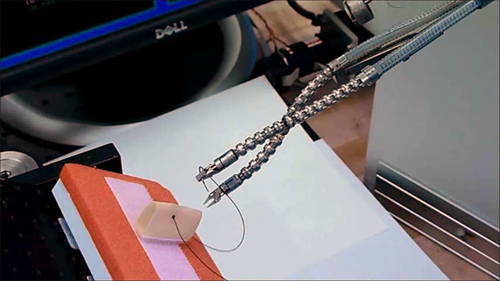
The Insertable Robotic Effector Platform, IREP for short, seen in the picture below, has been licensed to Titan Medical, a Canadian company focused on advancing robotic surgical technologies. An invention coming out of a collaboration between Columbia and Vanderbilt Universities in the United States, the IREP is the world’s smallest single-port surgical robotic device capable of performing laparoscopic procedures. IREP has two arms, a 3D vision system that has two controllable miniature cameras that provide real-time visual feedback for surgeons. The robot arms look like miniature snakes and the device can be easily mounted in a surgical suite because it is much smaller than other surgical robotic tools.
Energy Update: Is Shale Gas Production a Bubble Ready to Burst?
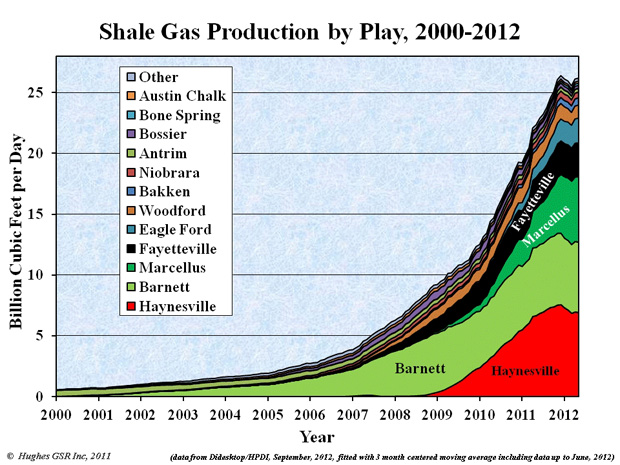
One of the knocks on fracking has always been the quick depletion that seems to happen soon after a new gas or oil well is drilled. In the U.S. it seems that shale gas has reached a plateau and that the 100-year supply may prove to be an inaccurate assessment of what can be forced out of the ground through fracking. The U.S. today uses 24 trillion cubic feet of natural gas per year. Based on current proven reserves including fracked fields there may be less than 20 years of reserves if consumption remains flat. Shale gas production in the U.S. earlier this year was at 27 billion cubic feet per day. But that production has leveled even with new fields coming on stream. Part of the problem goes back to my first comment. Shale gas well production tends to drop by 50% or more after the first year. As fossil fuels go, gas is the cleanest, but the United States may not have the grace period it has been talking about if these fields continue to encounter significant production drops. Either the technology improves to bump up yields or alternatives will have to be found to meet future energy demands.
Energy Update: Solar Costs Going Down
How much has solar energy technology gone down in cost? In the last two years solar has gotten 60% cheaper. Compare that to wind which has seen the technology reduce its costs per Kilowatt by 15-20%. Why is solar getting cheaper? Because the cost of solar panels continues to drop while the conversion efficiency of photovoltaics continues to improve. That means smaller panels can yield more energy. In August, residents in Boston were told they will pay less for electricity produced from solar than from other sources under a program called Solarize Massachusetts. Is cheaper solar rates a reflection of the drop in the cost of solar technology? Yes and No! Massachusetts is implementing cheaper solar electricity rates to encourage more clean energy investment in the industry. What is surprising is the cost of producing solar is appearing to be competitive with non-renewable alternatives.

Mining Update: Ending Mountaintop Mining for Coal a Priority of the EPA
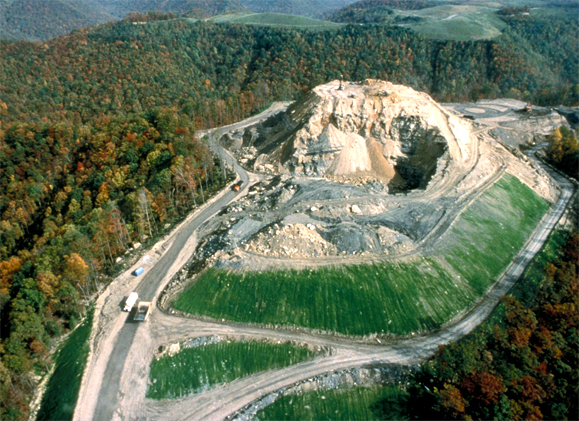
Of all mining practices in Appalachia mountaintop mining is the most environmentally destructive. Yet the coal industry continues to push to get permits to blow off the tops of mountains to expose seams for excavation. What mountaintop mining continues to do is destroy natural habitats and wildlife, change the course of mountain stream and the quality of water in them, pollute valley bottoms with tons of debris, and introduce chemical toxins into wells and drinking water sources. That is why the Environmental Protection Agency in the United States is trying to reverse a permit originally awarded to Mingo Logan in 2007, a subsidiary of the second largest coal producer in the U.S., Arch Coal. It is interesting when you visit the Arch Coal website and read the page on “How We Mine” you don’t see any examples of mountaintop mining practices. I guess it wouldn’t give them an environmentally responsible look. And when you read the company’s vision although they use the phrase “environmental stewardship” it takes on a whole new meaning when you see one of their mountaintop mines in operation or look at the level of selenium in local water supplies.
Space Update: India Joins the Space Race with an Ambitious Set of Missions
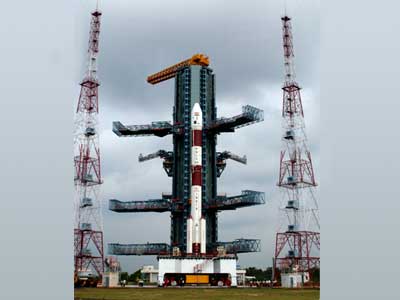
In 2008 India successfully launched its first unmanned lunar probe, Chandrayaan-1, placing a satellite in lunar orbit and hard landing a probe on the Moon’s surface. It received very little notice here in North America but it established India as a space faring nation. Today the Indian Space Research Organisation, or ISRO, is expanding its exploration of near-Earth and deep space with 58 space missions planned for the next decade and beyond. Missions include sending robot to land and explore the moon, an Indian-made global positioning satellite network called IRNSS, new satellites for communication, Earth observation and imaging, solar observation, studies of extra-solar objects, all to be launched with a new family of rockets capable of deeper space missions and heavier payloads. In 2013 India will launch its first mission to orbit Mars. And last but not least, India intends to join the U.S., Russia and China with its own human space flight program. “Baaharee duniaayaa” is Hindi for “outer space” and India intends to take a leadership role in the 21st century.
A Postscript
Once again I have to thank the many thousands who continue to visit Techso Mogro each month. Lots of you have become subscribers which is great. Keep on sending me your questions and comments. They inspire me to investigate and report back with even greater diligence. Let me know if there is a topic, not yet covered by Techso Mogro blog that you would like to see. If you have written an article that fits within the themes of this blog then let me know. Guest articles are welcome! And thank you again for continuing to drop by.
– Len Rosen
]]>
Fracking technology works as follows:
So what we know about fracking is the potential polluting effect of the process. Safeguards to address the hazardous chemicals that are byproducts of the process can be monitored and regulated.
But two consequences of fracking that are little understood keep on cropping up. They are:
Contaminated Drinking Water
When fracking releases oil and natural gas from bituminous sedimentary rocks it also releases other bounded chemicals. In the process of extraction, however, there are numerous complaints about toxic chemicals and methane entering local wells even though they are drawing water from much higher underground sources than those targeted by fracking. In the movie, Gasland, a documentary looking at hydraulic fracturing, the film shows dramatic images of tap water laced with methane that can be lit with a match. Although the fracking industry denies the claim there are numerous cited examples of drinking water contamination in areas where drilling has occurred.
The industry claims that any water pollution evidence comes from variability in fracking methodology around cementing the casing and lining of the well bores. In areas where the bituminous layers are well below the aquifer that water wells draw upon, and sedimentary limestone layers act as barriers to seepage, the industry claims that occurrences of chemicals in drinking water have nothing to do with fracking.
Earthquakes Linked to Fracking
In a 2011 report entitled, Are Seismicity Rate Changes in the Midcontinent Natural or Manmade?, a U.S. Geological Survey team writes that since 2001 there has been a six-fold increase in the average number of earthquakes occurring in the mid-continent. The rate of increase is unprecedented in recorded history and the authors believe the cause is primarily from the well-site injection of fluid used in hydraulic fracturing.
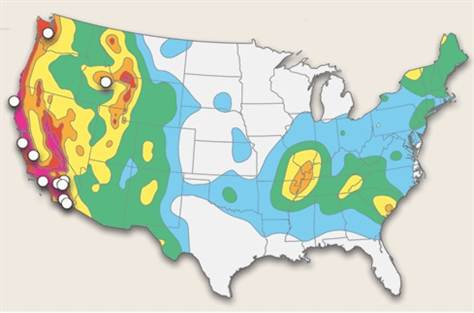
Recent earthquakes in Ohio have resulted in lawmakers temporarily banning fracking in the state. On New Year’s Eve of 2012 a 4.0-magnitude quake was attributed to a fracking process in which waste water collected during drilling was disposed of by injecting back underground for disposal. Previously thought to be a safe practice, geologists and seismologists now believe that this particular practice should be banned.
In November 2011, Oklahoma experienced a 5.6-magnitude earthquake damaging 14 homes. The quake was followed by a number of aftershocks. Oklahoma is normally seismically stable averaging about 50 small quakes annually. But since 2009 that number has suddenly spiked to 1,047. What has been the big change in Oklahoma? Experts point to hydraulic fracturing. Although experts believe the large quake may have nothing to do with fracking, the enormous increase in minor quakes is too coincident with drilling and injection well activity within the State. Oklahoma is home to 185,000 drilling wells and hundreds of injection wells. Waste water injection is considered the primary culprit in this state as well.
Is there a smoking gun to absolutely prove the causal link? Not yet, but there sure are a lot of bullet casings on and underground to suggest a correlation.
]]>