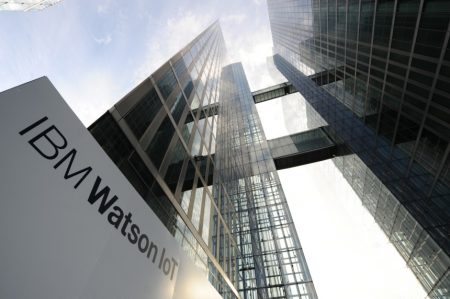
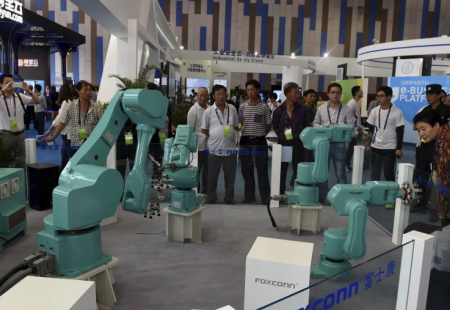
Foxconn is automating its factories and recently announced it had replaced 60,000 of its employees by deploying robots in their place. The robot being developed for Foxconn by IBM, a robotic arm, is capable of doing almost anything it is told through a voice recognition interface. Sebastien Chaumiole from IBM, describes the the robot as a co-worker. “It will behave naturally with you and understand the context you are in.”
How does it translate what you say to execution?
IBM has created a cloud computing environment consisting of several layers. Voice commands are sent to cloud-based transcription and translation services which can convert an English instruction into another language such as Mandarin. In the recent demonstration the robot was asked by its human co-worker to draw some intricate Chinese word characters. It did this with ease using a calligraphy pen which it dipped repeatedly into an inkwell before returning to the writing pallet.
There is nothing unique about the robot arm being deployed. it is a pretty standard Foxconn industrial robot that operates using proprietary software developed by the manufacturer. But the messages and instructions for execution all come from IBM Watson.
As a demonstration of the potential of the integration of human and robot workers, the IBM Watson cloud interface is quite exciting. A human worker could request the robot arm to do almost anything. Translating an English-language request into the execution of a program all happens through the cloud interface. The key will be the accuracy of the voice recognition to translation.
To add to this growing human presence we have another dilemma. Our population is aging with more humans living longer lives. What was rare in1950 by 2050 will be common – millions of centenarians, and many in our 70s, 80s and 90s still capable of gainful employment. So we will have a new generation of people under 50 and an almost equal number over 50.
Now throw a real spanner into the works. Artificial intelligence and robotics. Whether our home is the Western or Eastern Hemisphere, the world of work, in particular, the world of manufacturing, is undergoing a revolution because of intelligent machines with articulated arms and the ability to work 24 x 7, day or night, with or without the lighting and heating humans require, and with a precision no human can match. And it is not just in manufacturing where intelligent, articulated machines are impacting the workforce. Warehousing and distribution is also witnessing a transformation from humans to machines. And coming soon to that white collar job near you, the artificial intelligence revolution. It’s already creating waves in the stock market with recent headlines showing just how disruptive a technology computer-based trading can be.
In an article that appeared in the New York Times on August 18, John Markoff tells the story of a number of companies that today are deploying robots instead of people to do repetitive work under minimal supervision. Here are some of his examples:
To the examples Markoff provides add these recent announcements:
These are all examples of what is being called the great restructuring by researchers, Erik Brynjolfsson and Andrew McAfee in their book “Race Against the Machine.” The authors see encroachment by robots and artificial intelligence into human skills and describe this digital progress as a challenge that is leaving many of us in the dust. In fact, they attribute part of the reason for the slow recovery of employment numbers globally to the rise of machines.
It is true that there are lots of things we as humans can do that robots and computers cannot. But the race against the machines is now “full on.” Artificial intelligence is rapidly advancing. Robots are moving into every aspect of our domestic lives and we will see profound changes over the next decade particularly as our population ages.
These machines will employ natural language, voice recognition, mobility and dexterity. They will be self aware. They will be attached to the web with access to our human-built knowledge base. They will be able to learn and assimilate information of use to them in doing the jobs we have instructed them to take on.
So what can we non machines do to retain work? Do we have to reinvent humanity in order to compete in the world we are creating? One thing we know will still be needed, someone will have to know how to program machines because today’s computers are lousy at it. But that will not employ the many billions of us on this planet. So on this Labour Day, September 3, 2012, all of us need to be part of a conversation on how we move forward as a society to co-exist with the machines of our creation because we have let the genie out of the bottle. For parents raising children in this new machine age my advice is get your kids to engage both the left and right-side of their brains. A balance of the arts and sciences should be part of every child’s education. And remember neither East or West has any advantage any more. Wikipedia is at the fingertips of every one of us with a smartphone. Today that number is 2.7 billion. By 2020 it will be 5.7 billion. With all of that on-hand knowledge easily accessible to the majority of us on the planet, our world will rapidly become a very different place.

]]>