Rainforest hopes to produce fuel substitutes not derived from extracting oil or gas, but rather from the waste products of forestry (burn slash) and agriculture, the latter not to be confused with crops like corn purposely grown to produce ethanol. These synfuel-derived alternates would include gasoline, diesel, and propane substitutes.
The company intends to capture the carbon dioxide (CO2) as well from its biorefineries and through partnerships sequester it underground, use it in other industrial processes, or be source material for carbon composites and other high-value products like carbon-infused cement.
Rainforest feedstock includes forestry logging detritus as its main source for biorefinery operations. That means wherever forest operations exist, a Rainforest biorefinery can be operated to divert slash-burn waste into synfuels rather than into greenhouse gas (GHG). It seems to be a worthwhile cause and by the look of it, profitable as well.
How does Rainforest technology work? It begins by dehydrating the forest waste feedstock. It then gasifies that waste in closed chambers where oxygen is injected. Instead of incineration, gasification occurs transforming the waste into a syngas that contains unwanted byproducts including CO2, nitrogen, tars, chlorine, hydrogen and trace metals. The syngas can then be converted into gasoline, diesel, and propane. Chemicals can treat and remove unwanted byproducts and the CO2 can be captured.
As much as Rainforest would like you to believe they are producing a green product, it is not the case. When syngas is used to make synfuel, the downstream end result is that it gets burned in an internal combustion engine. The byproduct of that combustion includes CO2, methane, and carbon monoxide. So that means capturing the GHGs has to happen at the tailpipe in addition to at the point of production to be zero-carbon.
Rainforest acknowledges that the processes it intends to use are not new. The technologies already exist including methane reforming which is used today by fossil fuel companies. CO2 capture is also a growing industry that includes many different methodologies well beyond the concept stage.
But if the timelines experienced by these companies are any measure of how quickly the biorefinery operations can get up and running, my guess is this will not be a quick turnaround. It has taken more than a decade to get pilot carbon capture projects up and running, and another decade to scale them to start capturing millions of tons of CO2 annually. Meanwhile, our industrial civilization continues to pump out gigatons of the stuff contributing to global heating.
It should also be stated that biorefineries that produce syngas don’t solve climate change. What they do represent is a way to harvest the energy potential from waste that today gets burned in slash piles in forests. It redirects emissions from the forest floor to when internal combustion engines use the synfuels, pushing the emissions downstream.
So the big thing I get from learning about Rainforest is that it uses biomass to produce fuel rather than allowing that biomass to be burned where it is produced or carted off to be put into landfills. This is its added value. And capturing CO2 and other greenhouse gas byproducts in its processes also provides value.
But Rainforest is definitely not green. Maybe greener is a better definition because, in the end, the synfuels it produces will cause GHGs. Until there is 100% electrification of transportation and electrification gets adopted across other industrial sectors, Rainforest biorefineries are, therefore, no more than a transitional stopgap.
Don’t get me wrong. Burning forest waste is a significant contributor of GHGs. Wherever forestry is practiced, the burning of slash waste is a common practice. Every Rainforest biorefinery could stop this. Each would be able to take 200,000 tons of slash-burn waste annually and eliminate 404,000 tons of greenhouse gas emissions from forest slash-burn sources. The captured CO2 can be stored underground, or repurposed. And with thousands of sites around the world, Rainforest biorefineries could do some good. But you can’t call the operations green.
Check out the infographic below which summarizes the business case. Through multiple partnerships with government and industry, the company hopes to roll out hundreds if not thousands of these biorefineries. As a transitional strategy to achieve net zero emissions by 2050, there is a place for Rainforest. But calling it a green solution – it just ain’t so.

]]>
There are so many things wrong with this insensitive, less-than-presidential reaction to the disastrous reoccurrence of wildfires in California. Let’s parse the content.
“There is no reason for these massive, deadly and costly forest fires…..”
Let me suggest one very big reason.
Climate change. California has been experiencing severe drought conditions. An agency of the National Oceanic and Atmospheric Administration (NOAA), the National Integrated Drought Information System (NIDIS), monitors the intensity of drought across the country. On November 6, 2018 the map for California showed the entire state as abnormally dry to exceptional drought. Trump doesn’t seem to know that during the previous six-year drought in California, almost 130 million trees died because of the abnormally dry conditions. Clearing dead wood and dry brush has become an important aspect of forest management. But the trees keep dying and keeping up doing ground clearance to limit what could become kindling is an arduous task.
The map below is the first exhibit that should have been shown to the President before he started tweeting. But I guess there was no time to put in his briefing book.

“in California…..”
Trump is not a great fan of this west coast state. It didn’t vote for him in the presidential election, and in the mid-terms it returned far more Democrats than Republicans to both the U.S. Congress and to the state legislature. If the state had been a Wisconsin, Kansas, or one of the Dakotas I wonder if this tweet would have been similarly composed.
“forest management is so poor….“
On the U.S. Department of Agriculture website, you can find a portal to the California’s Forest Management Plan including conservation planning, ecological studies, land use data, maps and analysis and more. The document template located here is designed for local counties and forest resource managers to submit their ground practices related to land management. In every case fire management is covered with a degree of thoroughness that exceeds most other state standards. From air quality to soil to plant materials, the coverage is comprehensive. The plan includes maps, satellite and air photo imagery, and a resource database. If this is poor, then what is rich.
“gross mismanagement of the forests…..”
There are few places that manage forests better than California considering the contribution the trees make to the state’s image. Giant Redwoods and Sequoias are among the most iconic symbols of California’s conservation efforts.
The reality is that California draws people to it and more and more are moving to the edge of urban centres where they are building homes next to the natural wilderness. It is this urban sprawl that has made wildfires far more dangerous than in the past. The California Department of Insurance has published a map that defines the urban-wilderness interface and it correlates directly to where wildfires naturally or human created happen.

In a recent study by the University of Colorado, it reported that humans were responsible for starting 84% of wildfires in California over the last 20 years with the top 10 causes listed below:

Only 34 cases out of 2,032, (1.7%) represent activities attributable to those in forestry management. The remaining 98% the study linked directly to human-forest interaction which encroachment on the wilderness enables.
Trump may not know it but an old standard practice for forestry management almost universal to North America does play a part. Referred to as the Smokey the Bear policy, wildfires in public forests are subjected to too much interference in trying to contain or prevent natural burns. Natural burns create open spaces that form fire breaks. By suppressing small fires, a common practice in California and elsewhere, we interfere with the natural fire cycle. By preserving trees that normally would we leave forests more congested and trees competing for a finite amount of water. Add drought to the mix and we exacerbate conditions for wildfire outbreaks. And finally, by preserving trees in close proximity to each other it makes them far more susceptible to invasive insects that end up killing whole stands of forest and turning trees into potential kindling.

“so many lives lost…”
The lives lost reference is buried in the President’s tweet when, in my opinion, it should have been the centerpiece of his response. The death toll stands at 31 with more than 200 still missing.
U.S. Congress takes a different approach to tweet threats. Congress continues to provide some funding to fight against wildfires although the greatest amount from state budgets. In March of this year, the federal government set up a $2 billion annual fund for wildfires. In 2017, California’s wildfire fighting budget exceeded that number and by the look of the latest wildfire outbreaks will exceed it again in 2018. California Governor, Jerry Brown, has requested that the President take time from his tweets to declare the state is facing a major disaster.

]]>
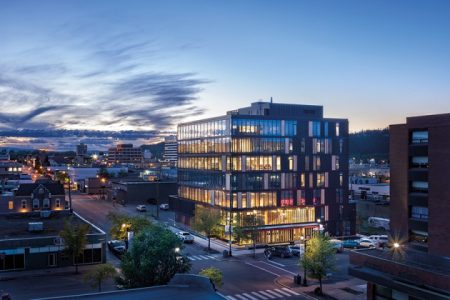
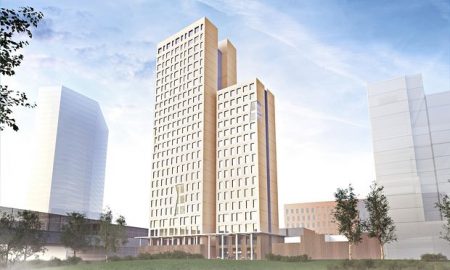
The tower in Prince George isn’t the tallest wooden building on the planet. Bergen, Norway has the Treet, which translated means “The Tree,” standing 14 storeys and 52.8 meters in height. And Vienna, Austria is building the HoHo, which when completed this year will stand 24 storeys and 84 meters in height.
For conservationists, the idea that using wood for large building construction is beneficial to the environment seems bizarre. After all, you are cutting down living trees and harvesting the wood. Wouldn’t that be equivalent to destroying a natural carbon sink? If we are talking about sustainable forest practices, harvesting trees shouldn’t reduce its carbon sink capacity. That, of course, only holds true where forests are properly managed.
The advantage of wood over traditional steel and concrete is more than just environmental. Wood is stronger than steel and concrete compared kilogram to kilogram. And according to research at University of California, buildings made of wood withstand earthquakes far better than those of steel and concrete. Wood is a better insulator keeping building interiors cooler in summer and warmer in winter. And counterintuitively, properly treated wood resists structural damage in a fire better than steel and concrete. Steel melts and concrete cracks, whereas, wood may scorch while continuing to retain structural integrity.
And counterintuitively, properly treated wood resists structural damage in a fire better than steel and concrete. Steel melts and concrete deforms and cracks, whereas, wood may scorch while retaining structural integrity. The construction material used in the Prince George building, Douglas Fir, a commonly found tree in the Pacific Northwest of North America, was char tested and showed that it could endure an hour of fire with penetration limited to 39 millimeters over that amount of time.
The industry knows wood because it has been used in residential homes as a primary material for centuries. But what the industry didn’t realize until it started measuring GHG contributions, the manufacturing and transportation of concrete and steel represent an enormous GHG emission volume. The architects of the HoHo project in Vienna, where 76% of the building will be made of wood, estimate a saving of 2,800 tons of GHGs over concrete and steel. Overall emissions, when compared to concrete, will be 1/8th that of an equivalent building made of concrete and steel. States one engineer, “when you compare a wood building with a concrete building, wood wins every time.”
If more buildings are built using wood, are the forests sustainable? Currently, in the United States, 80% of all houses are of wood construction. The total impact on existing forest stocks is equal to a third of the annual forest growth. Experts believe that use of wood in building construction could easily double without impacting the natural carbon sink capacity of existing forest stocks. And that building with that kind of wood volume would equal putting out of commission 9 utility-sized coal-fired thermal power plants.
The government of Finland in doing its own studies for the European market estimates that increasing wood use by 4% annually for construction in the European Union would reduce carbon emissions by 150 million tons annually, equalling the total annual emissions of The Netherlands.
Two remaining challenges exist:
So wood, made from carbon, may become one of the most important tools for humanity in developing a zero carbon economy. Where else could we see would replace steel or concrete? In ships? In other forms of transportation? Why not?
]]>