Conceived initially by explorer, Sam Cossman, to assist in his work studying active volcanoes where visibility conditions when descending into a caldera are extremely limited, the C-Thru technology brought a team of engineers and neuroscientists together to produce the end product. The C-Thru augmented reality provides a wearer with a combined thermal and edge detection overlay in real time for a rescue worker or firefighter to successfully navigate a burning building or other disaster sites where human vision alone is impaired.

C-Thru technology is a wearable pack the size of a deck of playing cards. Combined with the augmented reality display built into the helmet, a firefighter or rescue worker can see through smoke and dust, and be alerted to potential toxicity and hotspot threats along the path ahead. The technology incorporates NVidia Tegra mobile processors and wireless communications to create “advanced situational awareness.”

States Tom Calvert, Menlo Park Fire Protection District battalion chief, “The ability to see in the types of environments that we work in is a game-changer for our industry.” Wearing a C-Thru helmet gives search and rescue workers eyes in zero visibility conditions.
C-Thru technology is portable enough to be incorporated into robotic search and rescue for on-the-ground and flying drones. Imagine the implications for dealing with rescue after earthquakes, or combatting forest fires.
]]>

The speed of the fire as it spread, the engulfing of much of the exterior surface, the materials used in resurfacing the tower, and a history of inadequate fire safety technology on site, all contributed to the high mortality. Residents living in upper floors had little opportunity to escape. With no balconies and no external fire escape, Grenfell was an accident that its residents feared would happen. But Pearson found when he went online a fireproof escape chute that could be extended as high as 100 meters (330 feet) using a skylift crane or if attached to a balcony, external ledge or window. The Grenfell Tower stood 70 meters (220 feet) in height. So if London’s firefighters had this type of technology on hand it may have come into play to help save more lives.
Pearson decided to see if a technology existed that could have helped save the lives of Grenfell residents. He did a Google search and found both a permanent and portable external fireproof escape chute. The portable one which can be extended to 61 meters (200 feet) could have been used to rescue people from the upper floors of the Grenfell Tower which stood 70 meters (220 feet) in height.
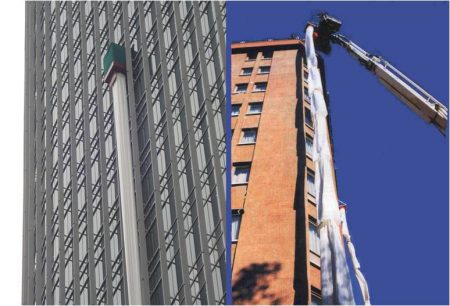
Called the Ingstrom Escape Chute (R), the technology has been developed by Mobiltex Evacuation Systems, a Swedish company. Is the technology new? No. On its website, Mobiltex describes it as “standard rescue equipment used by fire brigades worldwide for high rise rescue operations.”
What is its composition? It consists of three material layers. The outer containing fiberglass is fire resistant. The middle layer is Spuncell elastic and designed to allow those in the chute to manage a safe rate of descent. The innermost layer is Kevlar and designed to support the weight of the entire apparatus. Once inside the chute, evacuees are shielded from the fire, heat, and smoke. The chute can also be accessorized to include emergency lighting, exit light, walky-talky, and escape smoke hood.
How do people move through the chute? The illustration below shows how the chute conforms to the person descending and allows them to use their arms and legs to slow the rate of descent.

The chute can be installed permanently externally to a building with access from a balcony, ledge or window. Multiple chutes which would lie flat when not in use could give a building many escape routes.
The chute also comes with an internal multiple-escape system which if installed in a vertical building shaft could provide an effective escape route for many floors in case of fire.
A summary of the chute’s benefits follows:
I have no idea the price but it would seem to be an invaluable accessory to any firefighting operation in an urban setting. Too bad it was not available at Grenfell Tower.
]]>