My headline is stated from the perspective of an environmentalist who has watched Exxon through the years lie to the public or obfuscate facts known since the early 1970s that global warming was directly linked to the greenhouse gas (GHG) emissions from burning fossil fuels that the company continues to explore for and extract to this day. Of late, Exxon has promoted itself as green in its advertising to the public. But nothing can be farther from the truth.

In the latest Exxon move, the company which has advertised its work with environmentally-friendly fuel-from-algae projects (see image above) for the last ten years is walking away from Viridos Inc., of La Jolla, California, its technical partner since 2009. Viridos will continue to move forward but slashed 60% of its staff in late December to keep the lights on.
In addition, Exxon pulled its money from an algae project at the Colorado School of Mines after working with them in partnership for eight years. Add Exxon dropping its funding of a venture with the National Renewable Energy Laboratory and you begin to get a consistent picture. These projects looked good on the website promoting the oil giant as green, but one gets the feeling that the public continues to be sold a public relations bill of goods.
Algae into biofuel seems like a good investment because it allows Exxon to continue to produce fossil fuels but with only half the GHG emissions. And algae is better than ethanol-from-corn because it can be grown in brackish water and doesn’t take away land for staple food crop production.
Despite these perceived benefits the company has chosen to end its involvement in this and several other projects while emitting 630 million tons of GHGs from its operations just in the last year. Those GHG emissions total don’t accurately reflect the total damage to the environment Exxon is doing because tailpipe and chimney emissions aren’t included in the reported numbers.
In the last year, meanwhile, Exxon reported US $59 billion in profits assisted by a spike in fossil fuel prices from the fallout created by the Russian-Ukraine war. It appears, however, none of these profits can keep the company involved with its now former biofuel partners.
REM Tec is an Italian company that has designed a patented system of photovoltaic modules that can be incorporated into working farms without removing land from crop production. The panels seen in the picture below stand four metres in height and change position to ensure they can coexist with crops grown beneath.

A recent study done by the University of Piacenza tested 7,680 photovoltaic panels covering 11 hectares (approximately 27 acres) where corn, wheat, soybeans, lettuce, cabbage, endive and tomatoes were being grown. Not only did the fields yield millions of kilowatts of electricity, but they also produced higher crop yields per hectare than neighbouring ones without the panels. REM Tec has since added four additional agrivoltaic parks in Italy, one each in China and France, and two in Japan. Six more will be completed on farms in Portugal, Italy and France this year.
This technology can be used on farms without having solar panels compete for land with food crops. The agrivoltaics also reduce a farm’s dependency on grid-delivered electricity and can help reduce GHG emissions by replacing the use of diesel generators and by electrifying farm operations previously dependent on fossil fuel energy.
This week NRStor Inc., a Canadian alternative energy provider based in Toronto, announced it was developing the Oneida Energy Storage Project, an energy storage facility that will produce up to a gigawatt-hour of power to feed to the grid using lithium-ion battery Megapacks from Tesla. This grid-balancing service is designed to draw surplus power from the grid during off-peak periods and release it back when energy demand peaks.
NRStor’s joint partner is the Six Nations of the Grand River Development Corporation. The facility should reduce the need for Ontario’s energy provider to use gas-fired power plants during peak demand periods and will help reduce GHG emissions by 4.1 million tons each year.
The Megapack is a commercial version of Tesla’s Powerwall, a smaller battery storage solution designed for individual homes. Each 3 Megawatt-hour unit contains an integrated battery stack, inverters, and thermal control systems, and is managed by Tesla’s proprietary software. When completed the site near Nanticoke, Ontario (see illustration below) will feature well over one hundred Megapacks. It is expected to be online by 2025.

The profit motive for capturing carbon emissions, the pollution that these companies have largely been responsible for, is now a market opportunity said to be worth as much as $800 billion US annually by 2030. Not bad when you can create a global environmental problem and then have others give you money to partake and profit from the solution. And it appears, governments, both national and local, are in an offering mood.
The alternative, of course, would be for these same governments to create a timetable for the closure of existing fossil fuel extraction and distribution operations, as well as the phasing out of polluting power generation facilities. But this is proving to be harder to do, particularly for those countries that rely on a big chunk of revenue coming from coal, oil, and natural gas royalties to help finance government programs.
In the latest move by the U.S. Congress, the federal government is showing that it is buying what the industry is selling, pouring money into projects to support carbon capture. The current amount coming from the latest infrastructure bill is $12 billion. What could $12 billion spent elsewhere buy? If invested in renewable energy projects, such as geothermal, wind, or solar, $12 billion would produce the equivalent of 250 Gigawatts of zero-emission electricity and equal half the cost of 500 Gigawatts of power being generated by coal-fired thermal power plants today.
Instead of building the added infrastructure to capture greenhouse gasses from coal-fired plants, and building and maintaining an infrastructure to pipe and pump the gas underground, the shutting down of coal-fired thermal energy plants and replacing them with zero-emission renewables (note geothermal has no intermittency challenges) would be a far more planet-friendly solution.
Breaking down those costs even further, look at an early commercial implementation of CCS. The SaskPower Boundary Dam in Saskatchewan, Canada, began operating in October 2014. This 824 Megawatt coal-fired plant was rated to capture 1 million tons of CO2 annually. It has yet to achieve that target which represented only a portion of the plant’s total carbon emissions. The cost to capture an optimal one million tons cost the Canadian federal and Saskatchewan provincial governments $1.5 billion CDN or approximately $1.17 billion US.
Now, look at that $12 billion the U.S. Congress is allocating for CCS projects in its latest infrastructure bill. What would that buy? 10 equivalent projects to the one being run by SaskPower, and optimal capture of 10 million tons of carbon emissions annually. Sounds like a lot of CO2, but it’s not.
Here’s a comparison number that will put CCS plans in perspective. Fossil fuel operations today, that is coal, oil and natural gas extraction and distribution, contribute 34.7 billion tons of CO2 to the atmosphere annually. That $12 billion investment Congress has authorized would address 0.02% of those emissions. But, spent on renewables, it would buy 250 Gigawatts of net-zero emission electricity.
The environmental movement sees CCS as a canard, and I am in agreement when one looks at the present cost of these projects and the paucity of emissions captured. The argument environmentalists present notes that money appropriated for capturing CO2 emissions from existing fossil fuel operations allows them to operate well into the future while not capturing nearly enough of the carbon emissions to make a difference. At the same time, these operations contribute additional toxic chemicals and waste harmful to the environment. Environmentalists, instead, see investing in renewable alternatives as a much better bet. They argue for a push to electrify every home, building, and business using net-zero emission sources. And they further state that what they propose would come in at a fraction of the cost of the money needed for CCS investments that have yet to prove their worth, while meeting the goals set out in the Paris Climate Agreement.
But one should never underestimate the lobbying power of the fossil fuel industry which has found in CCS another way to make money while continuing to operate as before. The outward appearance of being more environmentally aware masks an intent to prolong their carbon polluting business model. And when they put on their environmental hats, the projects they propose are no more than delaying tactics to prolong the industry indefinitely into the future.
Take for example ExxonMobil’s proposal in April to build a $100-billion CCS project aimed at capturing emissions from Houston, Texas heavy industry with storage under the seabed of the Gulf of Mexico. Of the $100 billion, how much is ExxonMobil’s contribution? A pittance. Instead, the company is soliciting money from the federal and Texas governments as well as from the City of Houston and industry partners. What does this ExxonMobil proposal buy-in annual captured emissions? Between 50 and 100 million tons of CO2 at best annually by 2030, or less than 1% of the industry’s annual contribution to global greenhouse gas emissions. Extrapolating further, if $100 billion captures 1% of global emissions, then a CCS global solution to capture all emissions would minimally cost $10 trillion and only work if we could find sufficient subsurface storage for the sequestered CO2.
A final note: energy utility companies looking to CCS to prolong coal and natural gas thermal power plants have a pretty poor track record so far. SaskPower in Canada continues to underperform. And in the U.S. the only operational CCS plant, the Petra Nova CCS project in Texas, capturing carbon emissions from a coal-fired power plant, has been mothballed. Petra Nova’s cost, $1 billion US with more than 10% of the money coming from the federal government. To make matters even worse, the emissions Petra Nova was to capture weren’t going to reduce atmospheric warming at all. That’s because the captured CO2 was being pumped into old fields for enhanced oil recovery, which of course when burned, would have just negated the CCS environmental benefit.
So readers. Is CCS worth it? Let me know what you think.
]]>At the Paris climate meeting known as COP21 back in 2015, 196 countries set a goal to limit atmospheric warming to below 2.0 Celsius (3.6 Fahrenheit), with a preference to not exceed 1.5 Celsius. To achieve this, the signing countries pledged to rapidly reduce greenhouse gas (GHG) emissions to achieve net-zero by 2050. Sadly, just six years later, it appears we are likely to see global temperatures exceed the 1.5 Celsius lower limit. The WMO noted that in 2020 we had already hit a 1.2 Celsius (2.16 Fahrenheit) rise.
Breaching the 1.5 Celsius rise before the decade ends was unforeseen by many in the political community, but not by scientists. The WMO’s 40% probability assessment may help make governments do more in terms of policies to accelerate mitigation and adaptation projects and programs. Let’s hope so, particularly from the largest GHG emitters – China, and the United States. And let’s hope the companies that have most profited from emitting GHGs into the atmosphere are finally brought to heel by global citizenry. The air we breathe knows no boundaries. Nor do the oceans we depend on that as primary carbon sinks continue to slowly acidify and deoxygenated.
Citizens initiatives, courts and shareholders are beginning to push back against current fossil fuel company behaviours. In the past week, a Dutch court (The Netherlands is the home of Royal Dutch Shell) ruled on behalf of 17,000 Dutch citizens, that one of the world’s largest energy companies had to meet a deadline to cut its carbon dioxide (CO2) emissions in 2030 by 45% from 2019 levels.
The court’s ruling applied not only to the company but also to its suppliers. In other words, the engineering contractors doing the exploration and extraction of oil and natural gas, the tankers involved in distribution, and the refiners and pipeline operators. The company plans to appeal arguing that it has accelerated its efforts to achieve net-zero emissions by 2050 in compliance with the Paris Agreement.
Two other energy giants, ExxonMobil and Chevron in the past week both found themselves under attack by shareholders who didn’t like the two companies’ carbon emission strategies. In the case of Exxon, the shareholders replaced two members of the board with “green” candidates. And with Chevron, the shareholders voted by 61% for more vigorous action to cut GHG emissions. These two actions were preceded this month by similar shareholder assaults at ConocoPhillips, and Phillips 66.
BlackRock, an institutional investor that owns a 6.7% stake in Exxon, joined Engine No. 1 (EN1), a hedge fund activist group, in supporting the campaign to replace two board members with greener choices. BlackRock’s Chairman and CEO, Larry Fink, had recently announced its conversion to a greener future asking companies in which it held shares to apply climate risk metrics in their business plans, to provide details and milestones to keep global atmospheric warming below 2 Celsius by century end. EN1, launched in December of 2020, has been purpose-built to apply sustainability principles to the companies in which it invests. Exxon has been a target of its efforts from the get-go.
The action of the court in The Netherlands and the shareholder revolts underway in the oil patch represent a small victory for our planet and those of us dependent on it. It cannot come soon enough considering the forecasts of the WMO.
]]>If you are familiar with the term “gaslighting,” which seems apt coming from an energy company, that’s precisely what ExxonMobil continues to do when confronting the public space.
The ExxonMobil strategy reminds us of other industry liars who in the past have tried to pull the wool over the eyes of the public. I’m thinking of one in particular, Big Tobacco.
Cigarette companies knew from their own internal laboratory reports that their products caused lung cancer. But that didn’t stop them in their pursuit of profits to the detriment of public health. Instead, they manipulated consumers through messaging. How so?
But much worse was the deliberate effort to increase nicotine content in each cigarette smoked. Nicotine which occurs in the tobacco plant naturally was enhanced, a psychoactive drug that the industry knew worked on the brain to foster addiction which made consumers buy more.
Big Tobacco knew their products caused cancer, pulmonary and lung disease, heart attacks, strokes, and premature deaths. They knew more people were dying from cigarette smoking than from all the murders, HIV infections, suicides, car crashes, alcoholism, opioids, and illegal drug use. They knew that exposure to secondhand smoke from cigarettes was unsafe at any level.
So what did Big Tobacco do?
And they were largely successful for a very long time.
The same has been true for ExxonMobil and other fossil fuel energy giants. In fact, ExxonMobil hired Hill & Knowlton to do the same number on the public that they had been doing for Big Tobacco.
But the latest perversion of the truth from ExxonMobil is to saddle the blame on consumers. The company accuses the public of making poor consumer choices. Instead of buying energy-efficient automobiles, high-energy use trucks and SUVs are the rage. Instead of electric and hybrid vehicles, consumers continue to purchase en masse fossil-fuel-powered cars and trucks.
One could say that the automobile industry is complicit in the big lie as well. The industry has never made electric and hybrid vehicles front and centre in their product offerings. They have never priced them to drive consumer demand. Only now are they promoting them in their advertising, another gaslighting exercise, when the vast majority of what they continue to produce burns fossil fuels.
In a recent RollingStone article by Amy Westervelt she writes about the deceptive and misleading messaging of the fossil fuel industry as a whole stating “It’s not just ExxonMobil telling us that it’s consumers, not companies, who are responsible for climate change…Chevron regularly highlights how it’s keeping the lights on for all of us. Shell leans on consumers to “do their part” by choosing carbon neutral energy. And BP famously invented the ultimate tool for pinning greenhouse gas emissions on individual consumers: the carbon footprint calculator.”
In light of the revelations this last week of the restored U.S. Environmental Protection Agency’s take on climate change, and of the latest global review by the International Energy Agency (IEA), both topics that I will be pursuing in future postings here, it is clear that we can no longer afford to be taken in by an industry that would rather lie than take responsibility for its contributions to the growing threat of rising atmospheric temperatures caused by the burning of the products the fossil fuel industry keeps selling.
When Nobel laureates gathered a few weeks ago to talk about the existential climate threat, a prime tenet within the discussion was to “do no harm.” ExxonMobil, Chevron, Shell, BP and other energy companies believe in doing no harm to their bottom lines, not to the planet and the life upon it.
]]>The numbers say it all. The industry has no interest in combating climate change. It has no interest in altering its business model even in the face of growing shareholder demands for asset risk accountability.
London-based InfluenceMap, is a not-for-profit organization that brings together experts from around the world to track the current state of government and business responses to climate change and energy through policy and investment activity. It tracks the numbers and activities of companies related to climate change. States Dylan Tanner, its Executive Director, “As the pressure of climate change and the actual physical manifestations of it become accelerated, this account of what oil majors consider to be ‘on board with climate change’ becomes disconnected from reality.”
The InfluenceMap graphic appearing below positions the oil majors compared to other corporate entities in terms of corporate accountability when it comes to lobbying efforts to counter any action on climate change. Note all five oil majors sit within the upper left quadrant indicating their strategic opposition to any action on climate change.
Singling out ExxonMobil, it is among the most egregious of the five continuing its obfuscation activities related to climate change and actively promoting anti-climate change lobbying efforts and blocking actions to meet the objectives of the Paris Climate Agreement. The track record goes back many years.
Back in 1997, ExxonMobil’s CEO, Lee Raymond denied that human activity was influencing climate even though his own researchers had proven the case two decades. At the time he stated “the scientific evidence is inconclusive.”
When Rex Tillerson took the company’s helm, this former Secretary of State did his own song and dance stating on two occasions that human impact on climate “is very hard for anyone to predict,” and that the market should be the “best tool for emissions,” not government-mandated caps or carbon pricing.
In 2012 it funded and supported an anti-climate change report published by The Heartland Institute, an NGO not-for-profit backed by it and other fossil fuel companies.
Two years ago, the company’s CEO, Darren Woods stated, “the solution is not just to leave fossil fuels in the ground.” Finally, the ExxonMobil truth came out. The company had no intentions of transitioning in the near-term to a low-carbon business model but was doubling down on new investments in oil and gas projects globally, and in particular, in the United States, welcomed by the Trump administration and its anti-climate science rhetoric and actions.
Advertising deception has been a prime ExxonMobil strategy. Consider two ads which appeared in the New York Times, one in 2009 and the second in 2018. If you didn’t know better you would be inclined to believe that ExxonMobil’s future was in biofuels and alternate forms of zero-carbon energy. But with InfluenceMap’s reveal, you now know how ExxonMobil sees its future. It’s not biofuels. It’s putting more carbon into the atmosphere without regard to consequences.

A few more facts to ponder. The big five oil companies spent in the last three years almost $600 million promoting their actions to address climate change. They spent in the same period close to $3 billion publicizing corporate sustainability initiatives. Leading the pack in this obfuscation was ExxonMobil. In terms of lobbying the government, the spend was $200 million per year with BP spending $53 million to ExxonMobil’s $41 million annually. Considering BP’s Deepwater Horizon exposure, it is no surprise that this oil giant is spending more to influence legislators regarding its long-term liability in The Gulf of Mexico.
]]>
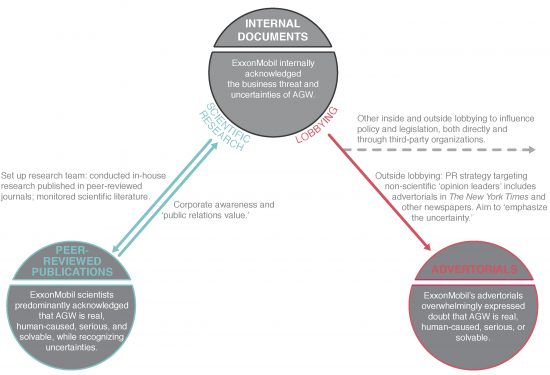
In an empirically peer-reviewed paper published in IOP Science this last week Geoffrey Supran and Naomi Oreskes, of Harvard University, studied 187 climate communications from ExxonMobil Corporation, the company that was recently headed up by Rex Tillerson, the current U.S. Secretary of State. In their analysis, the researchers look at those within the company describing their position on whether climate change is “real, human-caused, serious, and solvable.”
Based on these four criteria what the researchers discovered was the watering down of climate change message, casting doubt, the closer the communication came to be open and public.
Here are some interesting statistics from the analysis:
The conclusion based on these statistics is undeniable. The management of ExxonMobil deliberately misled the public while its internal scientists contributed to academic publications on climate change and its human cause. Could one describe ExxonMobil’s executive suite as being anything more than duplicitous?
ExxonMobil faces charges of racketeering and deceiving of consumers and investors through their external communications. Attorneys General in 17 American states and territories plus the U.S. Securities and Exchange Commission (SEC) have begun an investigation to reveal the deception with issued subpoenas to ExxonMobil executives, alleging the company’s accounting of climate risk “may be a sham.”
In response to these allegations and subpoenas, ExxonMobil has responded stating, “We unequivocally reject allegations that ExxonMobil suppressed climate change research contained in media reports that are inaccurate distortions of ExxonMobil’s nearly 40-year history of climate research. We understand that climate risks are real. The company has continuously, publicly and openly researched and discussed the risks of climate change, carbon life cycle analysis, and emissions reductions.” The company further states that the attorneys general and SEC are “cherry-picking” the internal communications to create their case.
Waith an open invitation to study ExxonMobil’s documents, Supran and Oreskes took up the challenge concentratin on the internal and external communications made available in an on-line database. They specifically looked at content to determine whether it was designed to dissuade officials from action and build public opinion doubt about anthropogenic climate change.
The documents studied included:
Supran and Oreskes applied rigor to their analysis. For documents published 1990 or prior they exempted any expression of doubts about anthropogenic climate change described. After 1990 and the first Intergovernmental Panel on Climate Change (IPCC) report indicating scientific consensus regarding the human causal link to global warming, Supran and Oreskes assigned to ExxonMobil communications such attributes as deception, denial, confirmation and complicity.
In the paper the authors provide excerpts from internal, peer and non-peer reviewed, and advertorial publications produced by ExxonMobil over a range of dates from 1979 to 2008. In one 1979 internally distributed document, staff write,
“The most widely held theory is that:—The increase [in atmospheric CO2] is due to fossil fuel combustion;—Increasing CO2 concentration will cause a warming of the earth’s surface;—The present trend of fossil fuel consumption will cause dramatic environmental effects before the year 2050.”
So the company is already engaged in assessing CO2 and its role in climate change.
Three years later another internal document states,
“The question of which predictions and which models best simulate a carbon dioxide induced climate change is still being debated by the scientific community. Our best estimate is that doubling of the current concentration could increase average global temperature by about 1.3° to 3.1 °C….”
Twelve years later in 1995, in a peer-reviewed paper, ExxonMobil scientists propose geoengineering to limit climate change stating the following,
“We present a preliminary analysis of a geoengineering option based on the intentional increase of ocean alkalinity to enhance marine storage of atmospheric CO2.”
A year later in a non-peer reviewed paper, an ExxonMobil writer asks the question: “Global warming, who’s right?” and goes on to describe anthropogenic warming as an “unproven theory.”
And as late as 2008 in a non-peer reviewed paper, an ExxonMobil writer denies any direct connection between greenhouse gas emissions from the oil and natural industry, “and the phenomenon commonly referred to as climate change.”
In advertorial content produced by ExxonMobil, the denial of fossil fuel industry complicity in anthropogenic global warming is remarkable. Here are two quotes from separate advertorials published in 1997. The first states,
“Let’s face it: The science of climate change is too uncertain to mandate a plan of action that could plunge economies into turmoil…Scientists cannot predict with certainty if temperatures will increase, by how much and where changes will occur. We still don’t know what role man-made greenhouse gases might play in warming the planet.”
The second is very much of the same ilk and states,
“There is a high degree of uncertainty over the timing and magnitude of the potential impacts that man-made emissions of greenhouse gases have on climate.”
Consider that both of these public statements occur 18 years after ExxonMobil’s own scientists circulated internal documents that conclusively linked their industry to global warming.
As for stranded assets, that is, the leaving of oil and natural gas in the ground, an internal 1979 circulated document states that CO2 and dramatic climate change are linked and concludes,
“Should it be deemed necessary to maintain atmospheric CO2 levels to prevent significant climatic changes, dramatic changes in patterns of energy use would be required. World fossil fuel resources other than oil and gas could never be used to an appreciable extent…Removal of CO2 from flue gases does not appear practical due to economics and lack of reasonable disposal methods. If it becomes necessary to limit future CO2 emissions without practical removal/disposal methods, coal and possibly other fossil fuel resources could not be utilized to an appreciable extent.”
But nowhere in any ExxonMobil annual report dating back to 1979 is there any hint of risk to the company’s assets. No shareholders are given the scoop. And the public at large remains unaware of what ExxonMobil already knows.
It should, therefore, not be a surprise that Supran and Oreskes conclude that ExxonMobil misled non-scientific audiences about climate science while studying climate change internally and reporting results in peer-reviewed journals.
It’s almost schizophrenic, this two-headed monster that ExxonMobil created, one steeped in science and the other in deception. One can guess that as the scientists’ research reached the extreme altitudes of corporate head office and its marketing division, facts were suppressed or whitewashed to make them more palatable to shareholders’ profit expectations.
The scientists at ExxonMobil weren’t actually restricted from publishing what they found out about anthropogenic causes of global warming and the role the company was playing in the problem. But the audiences that read these published studies were limited to academics and readers of limited circulation science and engineering journals.
And as for advertorial content, all one can say is that ExxonMobil blatantly lied to its largest reading audience. Advertorials were bought and paid for to give prominence to a message of uncertainty. Sponsored content appeared within the pages of American mass media such as the New York Times, Los Angeles Times, Wall Street Journal, and the Washington Post to name just a few.
]]>
In another segment of the film it describes how increasing CO2 from the burning of fossil fuels would leave no country unaffected by an amped up weather machine. It also expressed the following, “Global warming is not yet certain, but many think that to wait for final proof would be irresponsible. Action now is seen as the only safe insurance.” Shell was basing the film’s conclusions on data it had been collecting for a number of decades. It produced a 1986 report that described observed climate changes as “the greatest in recorded history.” A sister oil giant, Exxon, now ExxonMobil, had come to similar conclusions in 1977, nine years before that Shell report. Yet both companies continued to explore for oil and natural gas knowing the contribution they were making to climate change. Where Shell warned about taking action now to prevent a foreseeable tragedy, the action it did take was to keep on doing business as usual. Exxon, on the other hand, buried the company research which resurfaced in 2015.
After releasing the film Shell went on to invest in the Alberta oil sands, Arctic exploration and drilling, and other fossil fuel ventures, helping it to pad its bottom line. The company also actively participated in lobby groups that stated the opposite message to what was in the film. These groups are still with us today spreading their anthropogenic climate change denial nonsense.
One of Shell’s external review committee members from 2012 to 2014, Tom Burke, has stated, “They knew. Shell told the public the truth about climate change in 1991 and they clearly never got round to telling their own board of directors.”
So do you think Shell has learned its lesson and stopped expanding its fossil fuel operations? Not a fat chance.
Shell pays lip service to anthropogenic climate change by calculating a carbon emissions charge of $40 U.S. per ton when evaluating new energy projects. The company has also expanded natural gas exploration and investments in ethanol biofuels. It even has some solar and wind plays on the go. And to be fair, it must be stated that the company has built the Quest carbon sequestration facility in Northern Alberta to capture CO2. But the vast majority of the company’s business remains heavily dependent on oil exploration, extraction, and refining for its profits, all carbon intensive businesses that contribute to global warming.
Polluting the collective commons, our atmosphere, land, and water, while knowing the science and the damage you are doing to the planet, is not yet considered a crime against humanity. Maybe it should be.

]]>
Well now Southern Company, a subsidiary of Alabama Power, will play host to a FuelCell Energy, Inc., and ExxonMobil test pilot project at the James M. Barry Electric Generating Station, a 2.7 Gigawatt mixed-use coal and gas-fired power plant located near Mobile.
How does the technology work?
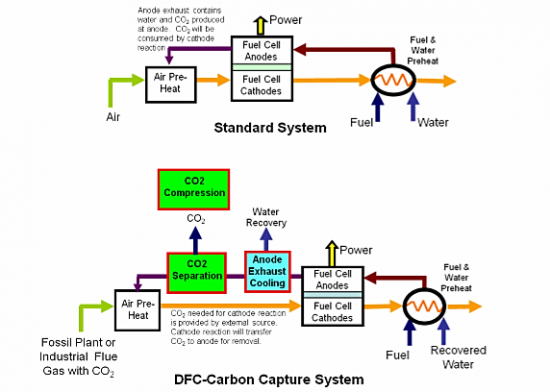
The technology, a DFC3000 fuel cell power plant consists of two modules each with four fuel-cell stacks, eight in total. Each fuel cell stack generates 350 kilowatts. A side effect of the electrochemical reaction between carbonate ions and the electrolyte is that CO2 introduced through an air inlet gets converted to carbonate ions, transfers through the electrolyte to the electrode and then converts back to CO2. This gives the DFC stack the ability to act as a carbon purification membrane without the need for additional technology. In a closed system the DFC stack recycles the CO2 continuously. But when put next to a thermal-power plant emitting CO2 it passes the gas through the fuel cell and then captures it when it has completed the transformation from gas to ions and back to gas again.
The schematic below shows two configurations for the DFC technology: as a standalone seen at the top, and beneath, as a carbon capture system when joined to a thermal-power generator spewing CO2.
Two additional benefits to the technology:
The typical transfer rate of a 2.8 Megawatt DFC3000 in normal operations processes 3,200 kilograms (7,000 pounds) of CO2 per hour with a carbon capture rate of 2,300 kilograms (over 5,000 pounds or 2.5 tons) per hour.
Seen in the image below the footprint requirement is small which makes this type of technology suitable for use as a standalone power generation technology that can supplement the transmission grid during peak period use. A number of utilities are looking at distributed power generation to supplement larger thermal plants.

The technology is scaleable and can be installed in modular increments. If the pilot is successful the next phase will include installation of eleven additional fuel cell stacks to generate 27.6 megawatts of power and capture 700 tons of CO2 while generating 648,000 kilowatt hours of ultra clean power daily.
Think about the implications if carbonate fuel cells were installed at all existing coal-fired power plants on the planet. We would decrease carbon emissions and produce a net power generation gain to boot. Makes you wonder why this project isn’t front and centre in the minds of utilities, fossil fuel energy companies and governments around the world.
]]>Well now the proverbial “sh–t has hit the fan” for the oil giant with all manner of organizations and Democratic presidential candidate, Hillary Clinton, calling for a U.S. probe into Exxon. The other Democratic candidate of consequence, Bernie Sanders, has sent a letter to the U.S. Attorney General calling for a task force to investigate the company. The “what did they know and when did they know it” questions need answers although the 1981 email memo pretty much answers both questions.
Joining Clinton and Sanders are nearly 50 environmental, civil rights and indigenous people’s groups. It is not so much the “what they knew” that has put off all of these people. It is the question that when they knew it, why did they fund climate denial groups such as the Heartland Institute? Why did their chairman, Rex Tillerson, at the May 27, 2015 annual shareholder’s meeting, tell his investors that climate change science is “not that good.”
Clinton at a New Hampshire town hall meeting is captured on video and posted to Twitter stating “there is a lot of evidence that they [referring to ExxonMobil] misled…..” One Senator in a speech to Congress describes the action of ExxonMobil as a “deliberate smokescreen.”
In a jointly-signed letter sent to the U.S. Attorney General ExxonMobil is compared to tobacco companies whose scientists knew for decades that smoking their products had health consequences, yet the companies mounted external campaigns to discredit independent third-party science that had uncovered the same evidence.
ExxonMobil stopped directly funding the Heartland Institute in 2008 according to investigative reporting done by the Los Angeles Times. The decision came about because of some shareholder complaints as well as those coming from scientific organizations studying global warming. But instead the company gave money to third parties who then funneled it to the Heartland and other climate change denial groups.
And as for Tillerson’s negative remarks about climate change science, it was Exxon from the early 1970s that put money into climate change research. Exxon scientists created global circulation models working in cooperation with NASA and the Canadian Climate Centre. And it was a senior ice researcher for Imperial Oil, Exxon’s Canadian subsidiary, that stated at a conference in 1991 that greenhouse gases are rising “due to the burning of fossil fuels….nobody disputes this fact.” That is nobody but ExxonMobil’s own chairman and its board.

If you are a regular subscriber then you know about Heartland and about the postings I have written regarding ExxonMobil, Royal Dutch Shell, Chevron, BP and Canada’s Suncor describing their indifference to the issue of global warming, their defense of continued fossil fuel exploration and expansion, and their financial and political pursuits. You have also read my coverage on Canada’s oil sands and the implications for the globe of ongoing develpment of this greenhouse gas intensive fossil fuel resource. You have also learned about the Canadian federal government’s climate change stance and its efforts to stifle researchers on government payrolls from offering evidence that runs counter to stated policy. I have also written about the on and off commitment from fossil fuel companies to carbon capture utilization and sequestration (CCS and CCUS) projects, and about the number of projects of this type that have been mothballed or cancelled at the first sign of any fossil fuel economic hiccough.
So it was no surprise to me, but clearly it was to at least one reader, to find out about internal emails from an ExxonMobil engineer that date back to 1981 and expose that the company knew about anthropogenic climate change and its correlation to the extraction, processing and burning of fossil fuels.
Who was the engineer? His name is Lenny Bernstein and back in 1981 he wrote an internal memo about a field off Indonesia that Exxon wanted to develop. The study of the resource showed it contained 7o% carbon dioxide (CO2) and if developed was described as a “carbon bomb” that would become the largest point source of CO2 emissions on the planet.
Why did Bernstein write the memo?
Because he was responding to a question from someone within the company related to business ethics. Bernstein later wrote a follow up to his 1981 memo in which he stated:
“Having spent twenty years working for Exxon and ten working for Mobil, I know that……ethical behavior comes from a business calculation that it is cheaper in the long run to be ethical than unethical. Safety is the clearest example of this. ExxonMobil knows all too well the cost of poor safety practices.”
In that last remark he is referring to the Exxon Valdez. Bernstein is no saint when it comes to arguing for climate change consideration in business decision making. In the 1990s he served on an advisory committee to the Global Climate Coalition, an industry group that espoused skepticism about anthropogenic climate change.
But at the time of the first memo the scientific research on climate change was already 85 years old. In 1896 Swedish chemist, Svante Arrhenius, published On the Influence of Carbonic Acid in the Air upon the Temperature of the Ground, establishing the link between warming and CO2 and showing that the Industrial Revolution was adding to the atmospheric greenhouse effect. Surely someone at ExxonMobil other than Bernstein must have read Arrhenius’ paper or some of the many others that followed on this subject.
Yet in the public forum ExxonMobil acted prior to and after 1981 as if climate change and atmospheric carbon-producing fossil fuels were not linked. The facts show the company not only ignored the implications of fossil fuel burning but also provided money to organizations such as the Heartland Institute, (more than $600,000 between 1998 and 2006) to discredit the science and deny that fossil fuel burning was contributing to global warming. One of the scientists on the take, Dr. Willie Soon, of the Harvard-Smithsonian Center for Astrophysics, recently outed for publishing junk science on climate and the atmosphere, received $1.5 million US for his “research.” Some of that money came from ExxonMobil.
Here is a revealing excerpt from a Bernstein memo related to ethical corporate behavior:
“Corporations are interested in environmental impacts only to the extent that they affect profits, either current or future.”
See if Bernstein’s above comment relates to ExxonMobil’s corporate positioning. Well back in May I wrote about the company’s recent annual shareholders’ meeting during which CEO, Rex Tillerson, stated that climate models “just aren’t that good.” Really, it’s about the models? It’s not about the observational science?
At that same meeting when Tillerson was asked to consider adding a climate change expert to the corporate board he remarked, “to set aside one seat for an environmental specialist or for any single attribute or area of expertise would, in our view, not be in the best interests of the company or its shareholders because it would dilute the breadth needed by all directors to make informed decisions for the company.”
I guess being informed about climate change by a subject expert not named Willie Soon would throw a spanner into the works.