Why is purple referred to in this way? The article focused on the search for biosignatures on exoplanets. It noted because anoxic and oxic environments are conducive to purple-coloured bacteria, terrestrial-type exoplanets may have an abundance of this type of life. This would widen the search for extraterrestrial life.
To date, we have catalogued over 5,500 exoplanets. Finding biosignatures on any of these worlds usually involves looking for conditions similar to what we have here on Earth. We talk about planets in the Goldilocks Zone of star systems. These environments are not too hot, not too cold, just right.
On Earth, photosynthesis in the presence of oxygen has given this planet a green tinge. But on planets with very little atmospheric oxygen, purple sulphur and purple non-sulphur bacteria may be colouring the landscapes.
The article makes this argument by noting that “Before the emergence of chlorophyll-based oxygenic photosynthesis, anoxygenic photosynthesis prevailed relying on bacteriochlorophylls.” These are anoxygenic phototrophs, bacteria that are non-sulphur, designated PNSB, and purple sulphur designated PSB.
PNSBs use inorganic compounds like hydrogen for energy. They are less sensitive than PSBs to oxygen and darkness and more sensitive to the presence of sulphides. PSBs prefer reduced sulphur compounds instead of water and don’t produce oxygen as a byproduct of photosynthesis. On Earth, we find these two classes of bacteria in deep-sea conditions adjacent to hydrothermal vents, or the hot springs of Yellowstone National Park. When light is absent the bacteria turn purple. At other times they appear yellow, orange, brown or red.
So what does this mean in our search for extraterrestrials? We need to change the parameters of our search through the accumulating totals of exoplanets being discovered. Our algorithms must go beyond seeking atmospheres with oxygen and planets of green hue. We need to search for the byproducts of anoxic bacteria and investigate exoplanets with colour variations that would mark their presence.
The Cornell scientists argue that purple bacteria “could dominate a wide range of environments on exoplanets.” Why? Because the environments of the planets orbiting M-stars may prove to be the ones most common in the galaxy and our Universe. M-stars also go by the name Red Dwarfs. They are abundant throughout the Milky Way accounting for 75% of the stars in our galactic neighbourhood. Most have surface temperatures cooler than our Sun’s 5,500 Celsius (close to 10,000 Fahrenheit). We are talking around 3,300 Celsius (almost 6,000 Fahrenheit).
Some astronomers add Brown dwarfs to the M-star category, although as I have previously written they are also called failed stars because their masses are insufficient to trigger fusion and have limited luminosity. Their masses, however, are large enough to have exoplanets circling them.
Other M-stars aren’t dwarfs. These are M-giants. Iname four:
Even around these Red Giants and the binary systems described above, we are discovering exoplanets.
The Cornell scientists believe that stars that appear as red may prove ideal candidates for purple bacteria to thrive. The stars emit red and infrared light and purple bacteria thrive in its presence. In contrast, the light from the Sun’s spectra encompasses the full rainbow of colours which allows our planet to host both green and purple bacteria.
So far, no biosignatures have been detected on any exoplanets. But by changing the parameters and conditions of our searches to reflect the preponderance of red and infrared-emitting stars, we may improve our odds. That’s why the colour purple may just become the new green when it comes to searching for extraterrestrials.
]]>In the NASA announcement that put us over the top, 65 newly discovered exoplanets were added to the growing total. Stated Jessie Christiansen, at NASA’s Exoplanet Science Institute at Caltech, in Pasadena, California, “It’s not just a number. Each one of them is a new world, a brand-new planet. I get excited about every one because we don’t know anything about them.”
Kepler operated for nine years before NASA officially ended the mission in October 2018. Launched in March of 2009, and first conceived 35 years prior, its initial mission was to confine its search to an area in the sky near the constellation Cygnus. Its focus was 150,000 stars and its purpose was to detect Earth-size exoplanets orbiting in habitable zones around stars. After four years when some of the onboard equipment started failing, NASA switched the mission to alter the field of view four times a year which extended the mission and added more than 380,000 more stars to its observations and collected more than 678 Gigabytes of data that scientists continue to mine.
Kepler’s successor was launched in 2018. Called the Transiting Exoplanet Survey Satellite or TESS for short, its title describes the methodology it uses to find exoplanets circling distant stars. TESS has bumped up the numbers of discovered exoplanets considerably, almost doubling that which Kepler found.
Even more powerful than TESS is the James Webb Space Telescope which by this summer will start among its many tasks, a study of the atmospheres of previously discovered exoplanets. Atmospheric composition is seen as a key indicator of life. And it doesn’t stop with the James Webb. In 2027, the Nancy Grace Roman Space Telescope will launch to begin its search for exoplanets. And then in 2029, the European Space Agency (ESA) will launch ARIEL, the Atmospheric Remote-sensing Infrared Exoplanet Large-survey, a space telescope that will search for Earth-Twos.
In the exoplanet mix so far, are there Earth Twos? Of the more than 5,000 exoplanets found, 4% or approximately 200 are Earth-like in size and rocky in composition. The next category deemed Super-Earths, are larger than our planet and smaller than Neptune. Of these, there are more than 1,500. Some are rocky and potentially accommodating to life while others are gas and ice planets similar to Neptune and Uranus. Then there are the planets that are more like Jupiter and Saturn, or even larger. And some of these aren’t ice giants, but rather hotter even than the stars they circle.
The sample of 5,000 plus exoplanets is really quite small. Astronomers know that Kepler’s limited observations in yielding so many planets means that there are likely trillions in our galaxy alone. Think about that. Even if the number was only one trillion, that’s 1,000, 000,000, 000, and current sampling ratios hold at 4%, it would mean the number of Earth-like rocky planets would total 40 billion.
In the past, I have written about the Fermi Paradox and the Drake Equation.
Enrico Fermi, the noted physicist, in 1950 once asked a group of fellow scientists “where is everybody?” The conversation that spawned this question happened over lunch and was inspired by the spate of UFO sightings in the news at the time. Fermi was questioning the lack of radio signals and other evidence of technological civilizations coming from space.
The Drake Equation, (see below) was first proposed by astrophysicist Frank Drake in 1961, as he attempted to develop a formula to calculate the number of advanced and observable technological civilizations in the Milky Way galaxy.
 A break down of the equation goes like this:
N: represents what would be the total number of advanced technological civilizations producing detectable electromagnetic emissions. The calculation of that number would be determined by putting best guess values to each of the elements in the formula with:
R*: representing the rate of star formation that would be suitable for Earth-like planets and ultimately the development of intelligent life as calculated per Earth-year.
fp: representing a fraction of the above stars that would have planets (that number when first proposed is turning out to be a significant underestimate as it appears almost every star has multiple planets circling them).
ne: representing the subset of planets suitable for life.
fl: representing the subset of those planets where life actually appears.
fi: representing the subset where intelligent life emerges.
fc: representing a further subset where intelligent life leads to the development of a technological civilization that produces detectable signals to indicate they exist.
L: representing the duration in years for the life of such civilizations (Drake was trying to anticipate how advanced technological civilizations might self-destruct. Think nuclear war for example.)
Drake’s best assumptions yielded a number ranging between 1,000 and 100,000,000 advanced technical civilizations enduring between 1,000 and 100,000,000 years. Even if his low-end number proved right it represents an astounding figure. And in answer to Fermi, the distances that electromagnetic signals would have to travel given the size of the Milky Way presents a challenge. On Earth, we have been producing electromagnetic signals that have reached into space for less than a century, so not even 100 light-years in distance. If other technologically sophisticated intelligence has emerged on a planet within the radius of our signals reach and they choose to send out some kind of response, we may get something back in this century. And then if we try to figure out the message and send a response our interaction over time and space will take centuries.
But SETI (the Search for Extraterrestrial Intelligence) is undaunted in the search for those signals from space while NASA, ESA and others continue to seek exoplanets with characteristics suitable for life and evidence that it exists elsewhere other than here on Earth.
When Carl Sagan wrote Contact, he had his heroine, Eleanor Arroway (played by Jodie Foster, in the 1997 movie) state an observation and pose a question that her father once asked her. She was talking to students visiting the large radio telescope array in Socorro, New Mexico, and this is what she said:
“The universe is a pretty big place. If it’s just us, seems like an awful waste of space.”
So congratulations to NASA and others who have contributed to achieving the 5,000+ exoplanet milestone. We know it’s just a drop in the Milky Way ocean of exoplanets yet to be discovered. And we continue to pose these questions.
How many will be Earth Twos?
How many will have life?
How many will have intelligent life?
How many will be spacefaring?
The N in the Drake equation remains unsolved.
]]>Near-Earth analogs represent only a small percentage of exoplanets discovered so far. Some are deemed “Super Earths,” because they are larger than our planet but smaller than Neptunian-sized worlds. But the reason they are deemed analogs is, they can sustain water in liquid form on the surface. And it appears that only Kepler has been able to make these planets known to us. No other space or ground technology has spotted Earth analogs. The most interesting discovery so far is the sheer volume of these worlds, 50 in an exoplanet inventory of 4,034. That amounts to better than 1.2% observed to date. And when you consider Kepler is only looking at a small subset of the sky near the Cygnus constellation, it infers that there are many more Earth analogs to be discovered.

States Benjamin Fulton, University of Hawaii at Manoa, a lead author of this latest study of Kepler discoveries, “we like to think of this study as classifying planets in the same way that biologists identify new species of animals…….finding two distinct groups of exoplanets is like discovering mammals and lizards make up distinct branches of a family tree.”
To what is he referring in describing two distinct types of exoplanets?
As Kepler has searched it has found Jovian-sized gas giants and smaller rocky planets. The gas giants were the first to be found because their size made the detection easier.
The second category of rocky planets has implications for life in the Universe beyond Earth. Half of this latter category even though existing within the “Goldilocks Zone.” appear hostile to life being Venus-like with a thick atmosphere and a runaway greenhouse effect.
The remaining half, from planets the size of Mars then Earth, and finally to “Super Earths” approaching the size of Neptune, appear more amenable to biology. What has been interesting so far in the Kepler data is the proliferation of rocky planets 75% greater in mass than Earth. Astronomers can’t explain the prevalence of these large Earths but note that gravity on the surfaces of these planets would impact biology in very different ways than what we see here on our home world.
Kepler continues its mission looking at new patches of sky and should produce future NASA news conferences giving us a glimpse of a galaxy and Universe we may physically never reach. Our physical roaming to the stars may be confined to our home Solar System considering the enormous distances between systems. But our ability to see the details further out has proven fascinating.
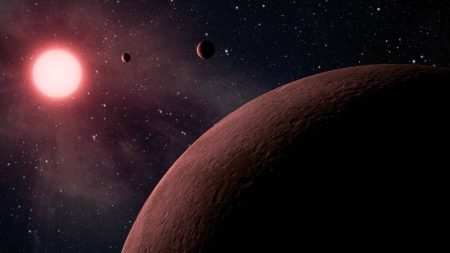
Lucky for us astronomers in Chile have discovered a new exoplanet designated GJ 1132b that we may have to call home. The planet is 39 light years away and appears to have an atmosphere.
States Dr. John Southworth, of Keele University, team leader of the discovery, “While this is not the detection of life on another planet, it’s an important step in the right direction: the detection of an atmosphere around the super-Earth GJ 1132b marks the first time that an atmosphere has been detected around an Earth-like planet other than Earth itself.”
Atmospheres around exoplanets do not guarantee suitability for human life. After all in our own Solar System we have two rocky planets other than Earth that have atmospheres. Venus is an inferno, and Mars is a dry freezer. And gas giants like the outer planets appear to be more atmosphere than solid.
GJ 1132b has 1.6 times the mass of Earth. Its radius is estimated to be 1.375 that of Earth, plus or minus 0.16. Researchers indicate the presence of silicates and iron in the planet’s rocky crust. Spectral examination of the light passing through the planet’s atmosphere indicates strong opacity probably from the presence of water or methane. The planet is also hotter than Earth and if a water world is probably hot enough for steam to erupt in the atmosphere.
Its star is smaller than the Sun, described as low mass. The discoverers don’t describe the star as a brown dwarf although they are among the most prevalent stars in the Milky Way and are defined as low-mass. And based on exoplanet discoveries to date, low-mass stars are proving to be great places to find lots of small rocky planets.
So Mr. Hawking may be able to let out a sigh of relief that we humans with a little geoengineering to cool the place down could have a new place to call home. A century is a long time in technological evolution. Who knows we may have warp drives and interstellar travel by then. Or maybe we will have the tools to fix our own home planet and won’t have to find an exoplanet safe haven for our species.
On a more serious note, when the James Webb telescope is launched next year, GK 1132b should be high on the viewing priority list.

]]>
But yesterday NASA appealed to our imaginations with an announcement that was given considerable fanfare in the run-up to it for several days. If I didn’t write about this discovery, I am sure, some of you would have wondered how I missed it considering how many postings appear here about space discoveries. But this media buzz that preceded the announcement was not typically NASA. The last one I remember like this concerned a discovery made by Curiosity back in 2012 that NASA scientists called “one for the history books.” That was about organic matter found in samples collected by the Martian rover.
So when NASA let everyone know it was holding a press conference on Thursday I speculated on what the announcement would be. I thought, did they discover oxygen in the atmosphere of an exoplanet? Or did Curiosity find more evidence of past life on Mars? Well, it was none of the above. It was about exoplanets but this time it was the revelation of a remote solar system associated with a red dwarf star. Now finding alien solar systems is nothing new. Exoplanet hunters have been discovering alien solar systems from the first exoplanet announcements. The current total stands at 2,688 with 603 having more than two planets orbiting a distant star. The current number of discovered exoplanets stands now at 3,583. Among that number are the 7 newly announced yesterday.
Now finding alien solar systems is nothing new. Exoplanet hunters have been discovering alien solar systems from the first exoplanet announcements. The current total stands at 2,688 with 603 having more than two planets orbiting a distant star. The current number of discovered exoplanets stands now at 3,583. Among that number are the 7 newly announced yesterday.
So what made NASA call in the world press about this latest discovery?
The 7 planets discovered are described as Earth-sized in the NASA press release. Earth-sized is nothing new. We’ve been finding many rocky exoplanets of late as we apply more sophisticated exoplanet discovery techniques that allow us to determine not only location, but size and specific gravity. But finding 7 all in the same solar system, with three in the Goldilocks Zone (where liquid water can occur on the planet’s surface) represents something never seen before. Compare that to our Solar System where we have 2 Earth-sized planets circling the Sun, Venus, and Earth. A third, Mars, barely Earth-sized, sits at the far edge of our Sun’s Goldilocks Zone making it barely inhabitable. Venus, on the other hand, is victim to a runaway greenhouse effect, turning the planet into an environment equivalent to our representations of hell.
But this new solar system, circling a star designated Trappist-1, a cool red dwarf, is the first to have so many planets similar to Earth in size, and so many situated within the definition of habitable. In fact, the NASA scientists told the press assembled and listening, that all 7 planets could have liquid water on their surfaces if atmospheres were present. Stated Thomas Zurbuchen, Associate Administrator, NASA Science Mission Directorate, “this discovery could be a significant piece in the puzzle of finding habitable environments, places that are conducive to life.”
Trappist-1 is 40 light-years from Earth. It is named for the Chilean telescope that first observed the exoplanets orbiting around it. Several other ground-based telescopes and the Spitzer space telescope confirmed the discovery shortly thereafter. Last Wednesday the results were published in the journal Nature. The article was entitled “Earth’s seven sisters.”

The Spitzer telescope was able to measure the precise size of each of the 7, developed estimates of their mass and density. The observations suggested all were rocky planets like Earth. From the innermost to the seventh, the Trappist-1 solar system appears to be far different from the one in which we reside. Trappist-1 is relatively cool when compared to the Sun. That means planets even in close proximity to it could be habitable. In fact, all 7 are closer to their star than Mercury is to our Sun (see illustration comparing the two solar systems below).

All 7 of Trappist-1’s planets are much closer to each other than those in our Solar System. Whatever life may inhabit one or more of them would, upon gazing into the night sky, see an endless array of objects about the size of our Moon as seen from Earth casting reflected light. If these planets had atmospheres and oceans the observer would see clouds and Trappist-1 starlight glittering off the water surfaces.
NASA scientists speculate that some of the planets may be tidally locked. The term tidally locked describes the phenomenon we observe with our own Moon. We always see the same Moon surface, never the opposite, which we call the dark side even though for every lunar cycle it is as equally lit as the side that presents itself to us. If some or all of Trappist-1’s planets are tidally locked, then one side will be in perpetual darkness, lit only by reflected light from its neighbours and starlight.
What has made the NASA announcement so inviting, that every newspaper and media outlet around the world, from Delhi to Moscow to Toronto, has put it on or near the front page of today’s papers, or made it a leading story in nightly newscasts?
Sean Carey, Manager of the Spitzer Science Center, Caltech/IPAC, thinks “this is the most exciting result I have seen in the 14 years of Spitzer operations.” There’s no doubt the discovery of an alien solar system with 7 rocky planets, 3 potentially habitable, is newsworthy. But for as much as we have discerned from Spitzer and Earth-based telescope observations, we still don’t know very much about the Trappist-1 solar system. So NASA is now creating time on the Hubble Space Telescope to do a closer examination. Initial Hubble observations indicate no evidence of any significant atmosphere on the innermost two exoplanets. Well that’s a bummer. But NASA spokespersons state that when the James Webb Space Telescope is launched in 2018, it too will turn its attention to Trappist-1 to learn more.

Postscript: If you are wondering how an Earth-based telescope could discover an alien solar system, the answer is, by observing, from our frame of reference, small changes in starlight over time. These perturbations in the amount of observed light indicate the presence of objects circling the star. Understand that this only works when an alien solar system’s plane approximates that of ours here in the Solar System so we can see these planetary crossings edge on. For the vast majority of alien solar systems yet to be discovered, we need different technology that sees exoplanets and alien solar systems on very different planes. When you consider we have found close to 2,700 already which are edge on to our point of view, imagine how many more there are in the Milky Way that, as of yet, we cannot see.
]]>The Search for Planet X May Have Found a Candidate
Astronomers from the late-19th century onward have always been puzzled by perturbations in the orbits of the two outer gas giants in our Solar System. In fact it was weird aspects of Uranus’ orbit that led to the discovery of Neptune in 1846. Then Neptune orbit irregularities led to a search for a ninth planet with Clyde Tombaugh identifying Pluto in 1930 as “Planet X.” But Pluto, as we know today, is a dwarf planet, not nearly massive enough to explain the anomalies in Neptune’s annual path around the Sun. So that’s why astronomers have continued to seek a gas giant or super Earth beyond Neptune.
In the last week astronomers at the ALMA radio telescope located in the Atacama Desert of Chile, detected what they believe may be a single incident view of Planet X or potentially two candidates lurking in the outer Solar System. Their research has been submitted to the the journal, Astronomy & Astrophysics subject to peer review.
The mysterious object appeared in proximity to Alpha Centauri in the night sky during an ALMA scan. Alpha Centauri is part of a suspected triple star system and second closest to us here in the Solar System. But identifying the object by location hasn’t given us distance location. In their paper the astronomers paint two likely scenarios:
The discoverers have called their finding Gna. Will further searches for this Planet X candidate provide proof? Let’s wait and see.
NASA has used the Wide-field Infrared Survey Explorer space telescope on sky surveys and found no signs of any gas giants equivalent to Jupiter in size lurking anywhere within three trillion kilometers of the Sun. And they have found nothing Saturn-sized within 1.5 trillion. That doesn’t rule out finding a super-Earth which Gna might be once others have corroborated the evidence from Atacama by making similar observations from other sites and instruments.

Goldilocks Planet Discovered 14 Light Years Away
University of New South Wales astronomers announced a new member of the habitable planet club found outside our Solar System. The planet is part of the Wolf 1061 star system, an M or red dwarf. The planet is one of three rocky planets orbiting the star and sits within the Goldilocks Zone where water can exist in liquid form on its surface. The planet, designated Wolf 1061c has a mass 4.3 times that of Earth and an annual orbit of a mere 18 days.
Why such a short orbit? Red dwarf stars are smaller and cooler than our Sun and hence for a planet to lie within a habitable zone it must be much closer to its star than Earth is to ours.
A paper outlining the discovery has been submitted to The Astrophysical Journal for peer review. Because of the star’s proximity to Earth astronomers should in years to come be able to study Wolf 1061c’s atmospheric composition. If we detect free oxygen in the atmosphere that would be the discovery of the century.

Jeremy Leconte, at the Canadian institute for Theoretical Astrophysics, University of Toronto, have developed a climate model for exoplanets that takes into consideration the influence of an atmosphere on the planet’s rotational spin. This is a new field of study. The model shows that in the presence of an atmosphere, even a thin one, more planets experience rotational day and night cycles similar to that found on Earth. The lack of discernible atmosphere, as in the Moon, impacts spin eventually creating a planet with permanent day and night sides. This condition is known as synchronous rotation. That means the face of the Moon that faces Earth is always the same. We never see what we call the dark side unless we view it by a satellite in orbit around it.
What Leconte and his associates believe is that a large number of the exoplanets already discovered with atmospheres present should exhibit similar asynchronous Earth spin with a resulting day and night cycles, allowing the light from the parent star to create a greater opportunity for habitability.
The rate of spin may vary. For example in our Solar System, Mars’ spin is almost identical to here on Earth. A Martian is about half-hour longer than ours. Venus, on the other hand experiences a day that is longer than its year. In addition its spin is retrograde, the opposite direction of all other planets in our system. Uranus, if it were an exoplanet, would be classified as a super Earth. It like Venus, exhibits a retrograde spin but one far more within planetary norms. One day lasts about 17 Earth hours. The other outer planets all rotate faster than Earth. Neptune’s day lasts under 16 Earth hours. Saturn’s is 10.65. And Jupiter’s day a mere 9.9.
But Leconte and his colleagues are particularly interested in terrestrial sized planets similar to Earth orbiting around lower-mass stars, ones even smaller than our Sun. These are likely the best candidates for habitability. So if we really screw up this planet and need a new home, if Leconte’s research is right, there is more than one out there in our galaxy waiting for us.
The picture below is an artists impression of the super-Earth exoplanet HD 85512 b. Its star is 35 light-years away. It’s looking pretty good based on spectral readings of its atmosphere. Surface temperatures are 25 Celsius (77 Fahrenheit) degrees. It’s bigger than Earth, about 3.6 times our mass. So all we need to do is develop faster-than-light drive technology like a warp engine and we can visit in the near future.

How did the scientists come up with the number? The paper’s authors, from Cornell, University of Texas at El Paso, University of Puerto Rico at Arecibo and Washington State University, surveyed more than 1,000 planets. They created a mathematical formula that incorporated planet density, temperature, chemistry, age and distance from a star, and whether the planet was largely liquid, solid or gas. From this they devised what they call the Biological Complexity Index (BCI).
Between 1 and 2% of the planets had a BCI rating greater than Jupiter’s moon, Europa. They then took the number of stars in the Milky Way and multiplied them by that percentage which gave them the 100 million number.
Maybe that’s why SETI scientists are convinced we will find intelligent life on an exoplanet within the next 25 years. It seems the odds are pretty good.

]]>

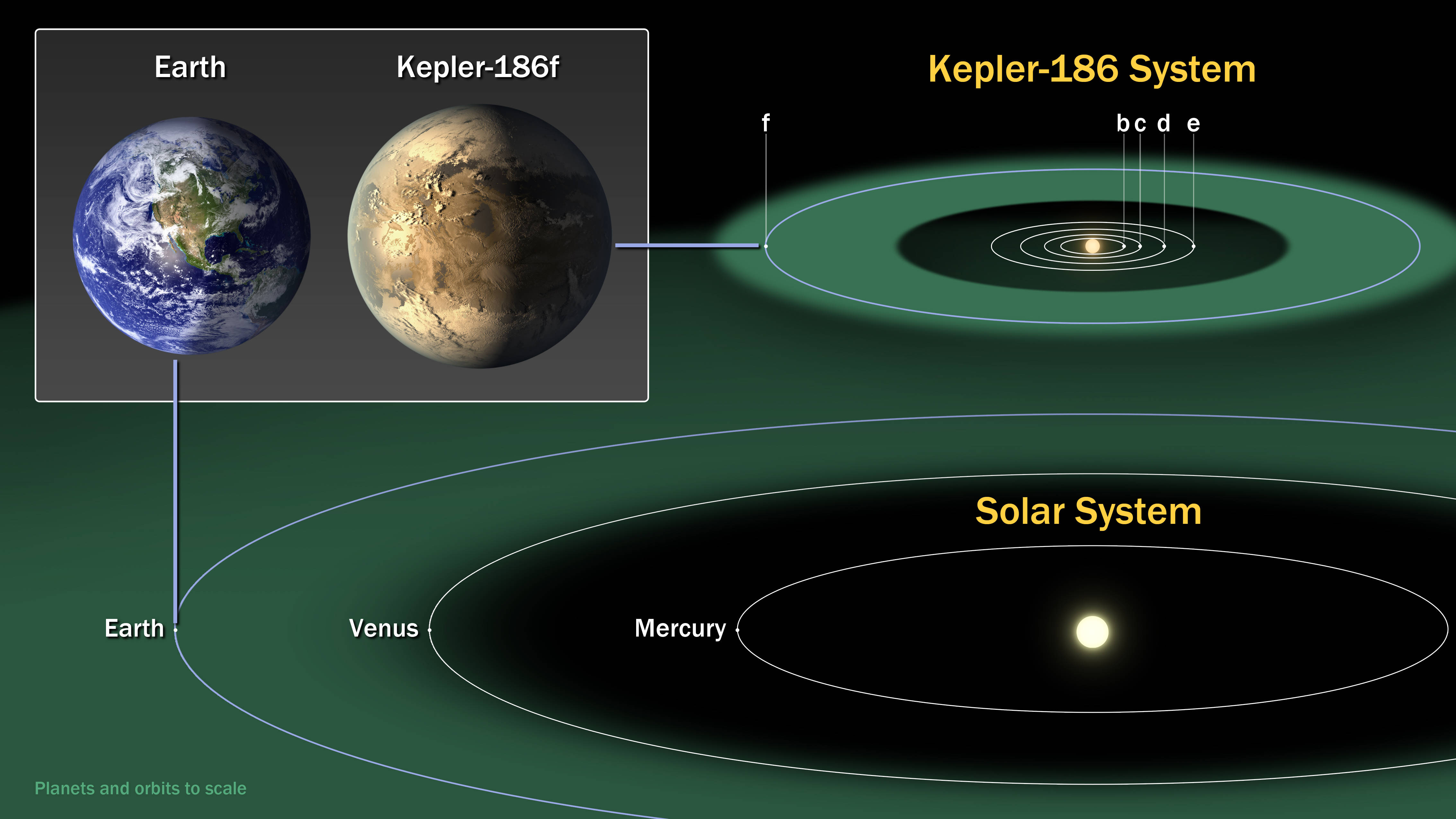
Dubbed Kepler-186f (gee I wish NASA would come up with a new naming convention for these exoplanets) it is the fifth planet in its solar system. The host star, Kepler-186, is a red dwarf and cooler than our Sun. The planet, which is the outermost of the five within the system, circles much closer to its star than us. As a result a year on Kepler-186f is a mere 130 days. So a human who arrives on Kepler-186f could live a life almost three times as long without changing diet or lifestyle.
Because the star is cooler the solar energy the planet receives is approximately 1/3 of that here on Earth. When you compare that to Mars which receives 44%, you can imagine that Kepler-186f must be cooler than our planet. But because its mass is greater than Mars it may retain a much more significant atmosphere with the attendant greenhouse affect.
The planet is too far away from us to allow our current technology to discern whether it has an atmosphere or not. All we know is at 10% larger it is the exoplanet that most closely resembles Earth. But unless we learn to bend space-time, we won’t be going there soon.

Of the more than 5,500 discovered to date, here is the top 20 list:
So those of you contemplating where your descendants may chose to live other than here on Earth, these are your current candidates. Meanwhile this month is a great time to watch Mars as it has its closest approach to Earth, less than 50 million kilometers away. The last two days I have watched it from my bedroom window, a pale orange object in the sky, the one place right now in our Solar System other than Earth where we suspect life may have existed.
To keep on top of newly discovered exoplanets that your descendants may voyage to, you can visit the Open Exoplanet Catalogue compiled under license from the Massachusetts Institute of Technology. It is an informative site.


