A Windwheel that is a Tourist Attraction
Meet the Dutch Windwheel seen in this artist concept below.

It combines two three-dimensional rings, one of them a frame for what is a bladeless windmill. The technology is known as EWICON which I first wrote about back in April of 2013. Steel tubes are laid in parallel across an inner circle. Each tube contains electrostatic wind energy converters. There are no moving parts and no noise. The prototype EWICON today sits in front of a building at Delft University. Two others have been built and reside atop a building in Rotterdam.
This Windwheel, however, will dwarf all previous builds. It will incorporate apartments, a luxury hotel, a panoramic restaurant and a ring of cabins rotating 360 degrees to provide a ferris wheel and rollercoaster-like experience for visitors. In addition the Windwheel will be self-sustaining incorporating solar photovoltaic panels embedded in a passive energy skin, a rainwater collection system, organic waste and grey water recycling, and biomass to biogas conversion.

If built its Delft University designers and partners believe it will become an instant world attraction for Rotterdam, and a potent symbol of The Netherlands’ 21st century leadership in sustainable design. No cost estimates have been provided.
Meet GE’s Latest Wind Turbine Design
It is called the ecoROTR and features a 9,000 kilogram (20,000 pound) aluminum dome bolted to the front of the rotor. It looks like someone attached an umbrella to the turbine blades. A spokesperson for the company describes the problem that ecoROTR is supposed to solve stating, “when wind hits the centre of the wind turbine where the blades are attached, it’s wasted. That’s because the blades are basically levers and the same wind generates more force further from the hub.”

How does ecoROTR work? The dome rotates along with the turbine blands redirecting wind from the centre to the blade’s outer edges and improving the efficiency and performance of the entire apparatus. A reconfigured turbine can increase blade size without increasing length.
The company is testing its first ecoROTR at a 1.7 Megawatt wind turbine located in California. A side view of the field test assembly is seen in the picture above. If the trial succeeds GE may be ready to bring ecoROTR to market within the next year producing dramatic improvements in energy yield.
]]>
100 Billion Earth-Like Planets?
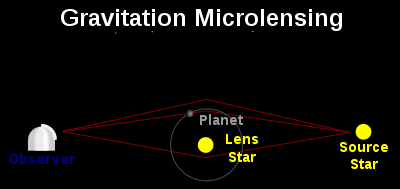
That number sounds impossibly large but so is the Milky Way, our galaxy. How have researchers at the University of Auckland in New Zealand arrived at this estimate? The technique they are employing is called gravitational microlensing.The researchers intend to combine their findings with data from the NASA Kepler mission which has already found thousands of planets.
From Kepler data astronomers have estimated 17 billion Earth-like planets in our galaxy. But Kepler’s method of capturing changes in the level of light emitted by a star when a planet crosses in front of it only catches a small number of the total potential planets out there. That’s because it can only detect planets on a similar orbital plane to ours.
But what about other planetary systems that orbit on a different plane? That’s where gravitational microlensing comes in with its ability to detect planets like Earth orbiting around a distant star when a background star’s light gets slightly deflected as it passes by the planetary system on its way to being viewed here on Earth. Add those Earth-like planets and the astronomers think the number is much closer to 100 billion.
A Bladeless Wind Energy Source
It is only a prototype at the moment but the structure you see in the image below is a windmill that generates electricity. It goes by the name EWICON which stands for Electrostatic WInd Energy CONverter. EWICON has no moving parts and therefore does not rely on a turbine to generate power. Instead it uses charged water droplets that get released into the air and as the wind blows creates an electric field that can send power to the grid or an individual building.
Mecanoo is the architectural firm responsible for the design of EWICON which has no moving parts and produces no noise. A prototype sits in front of the Faculty of Electrical Engineering, Mathematics and Computer Science at Delft University in the Netherlands. Two more are incorporated into a sign on top of a building in Rotterdam. You can watch an explanation of how EWICON works on YouTube. You might get a “charge” from viewing it.

Tiny Niagaras to Provide Hydroelectricity in the Developing World
Another energy story but this one takes you back to the days of water wheels as power sources.
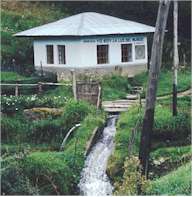
When we think of hydroelectricity we almost always picture big projects like the Three Gorges, Aswan or Niagara Falls. Not the picture seen in the image below. But to get rural electrification going in many parts of the world, particularly in hilly remote areas with many small streams and rivers, micro hydroelectricity is as viable as solar or wind as a source of renewable energy. And it may be even be cheaper and more reliable. A typical station generates between 25 and 50 Kilowatts of energy and can be connected to a local micro-grid providing power to a remote village.
Nepal and Afghanistan are leading the way with such projects replacing diesel generators that are subject to the availability of supply and cost of the fossil fuel. Today Nepal has almost 20 Megawatts of installed micro hydroelectric capacity.
A Steel Curtain Goes Up in New York After Hurricane Sandy
The Metropolitan Transportation Authority or MTA took a beating when Hurricane Sandy struck last fall. The storm surge and subsequent tides wiped out over 3 kilometers (2 miles) of track. To-date MTA service to Queens has yet to be fully restored months after the hurricane made landfall.
The MTA built a berm of rock and gravel as a temporary barrier but now they are spending $38 million on a marine steel wall capable of resisting saltwater corrosion for a century. Each steel piece is more than 12 meters (40 feet) tall. The project involves burying 10 meters (33 feet) under ground leaving 2 meters (almost 7 feet) visible. The wall should be complete by May 1st.
Is 10 meters down and 2 meters above ground enough to stop another storm surge? Time will tell.

NASA Invites Proposals on New Space Technology Initiatives from Universities in the United States
For NASA to continue to meet its human and robotic space mission goals it is creating initiatives with private industry and U.S. accredited universities for answers. In its latest announcement it is inviting proposals from academic institutions to provide better scientific instrumentation for orbiters and landers, advanced optics for a new generations of space telescopes, improved technologies to support long-duration space missions, and new ideas on systems to protect the planet from potential near-Earth asteroid strikes.
In the press conference announcing the initiative, Michael Gazanik, NASA’s associate administrator for the Space technology Mission Directorate, stated, “”NASA’s collaboration with the National Research Council and the agency’s recent Strategic Space Technology Investment Plan have helped us identify areas where new, cross-cutting space technologies are needed to enable our future missions. Now we’re reaching out to American universities to tap into the nation’s best and brightest minds to help solve these tough technology problems.”
NASA intends to provide ten awards by the fall each worth $250,000. NASA may provide continuous funding beyond the initial award based on progress beyond one year.
In 2012 NASA awarded innovation grants to ten universities for a variety of proposals including thermal management systems, new readout devices, radiation protection systems and more.

A Postscript
If you are a regular reader of Techso Mogro blog you may have noticed a few less postings in the last couple of weeks. Attending to deconstructing my home of the last 18 years is taking up some of my time. And with my daughter having just become engaged, my family is now also doing wedding planning. So life around here is pretty hectic. Nevertheless I will continue to endeavor to share with you what I find fascinating about our technological and scientific progress here in the 21st century and welcome you to join in the conversation. As always thank you for dropping by.
– Len Rosen
]]>