The post News Headlines from Mars – Organic Molecules and Water appeared first on Techso Mogro.
]]>The Perseverance rover continues to explore the Jezero Crater where scientists announced this week that organic molecules have been discovered. Organic compounds do not mean the existence of life because these types of molecules can form with non-biological chemical processes. It should be noted, however, that here on Earth the distribution of organics is intrinsically tied to biological sources.
What makes the discovery at Jezero even more interesting is that the compounds are being found inside drilled rocks. Similar organic compounds have been found by the Curiosity rover at Gale Crater where they were detected on the surface.
The difference in the finds is in the use of the technology Perseverance has that is more sophisticated in analyzing organic compounds both within rocks and in surface dust. The organics in rocks plus collected surrounding materials should allow scientists to better determine how these compounds formed. Scientists will get their chance because Perseverance is collecting and depositing samples in 43 different canisters that will be retrieved in the next decade in a Mars return to Earth robotic mission.
How the compounds formed is likely because of the presence of surface water at the Jezero site at an earlier time in the planet’s history.
Two separate discoveries of subsurface lakes containing liquid water have exobiologists intrigued. One of them is a few years old, mapped using the onboard radar from the European Space Agency (ESA) Mars Express. The second is more recent and discovered by another ESA spacecraft, the Trace Gas Orbiter or TGO.
The first liquid water lake discovery was announced back in 2018. It stretches 20 kilometres (12 miles) in width under the solid ice cap of the Martian South Pole. ESA scientists believe that the water remains in a liquid state because it contains dissolved salts and because of the pressure exerted from above by the polar ice cap. Since that 2018 discovery, three other subsurface lakes have been discovered.
The presence of underground lakes under frozen ice is duplicated here on Earth both by discoveries made on Greenland and in Antarctica. In Antarctica, a discovered subglacial lake cut off from the surface of the Earth for millions of years was drilled into by ice corers. Water samples brought to the surface contained living bacteria. Could this also be the case on Mars revealing biology that is billions of years old?
The second water discovery found on Mars was discovered in a region of the planet referred to as the Martian Grand Canyon. In fairness, Valles Marineris which straddles the Martian equator, makes the Grand Canyon in the United States look like a pipsqueak. A better comparison would be to East Africa’s Rift Valley stretching from Ethiopia through Kenya, Tanzania and Malawi.
Valles Marineris is more than 4,000 kilometres (almost 2,500 miles) long, 200 kilometres (120 miles) wide, and up to 7 kilometres (more than 4 miles) deep. In a central area of the canyon known as Candor Chaos, TGO detected high concentrations of hydrogen with the most likely explanation, the presence of frozen subsurface water similar to permafrost. The detected water lies within a metre (3.3 feet) of the surface which is unusual considering how quickly water evaporates on Mars.
States Igor Mitrofanov, from the Russian Academy of Sciences, (Russia is partnering with ESA on the TGO mission) author of a new study using the data collected by TGO, “assuming the hydrogen we see is bound into water molecules, as much as 40% of the near-surface material in this region appears to be water.” Mitrofanov further notes that this is far more water than expected and different from other Martian observations where the subsurface presence of water is a tiny fraction of this discovery.
What TGO has detected, likely ice, which in the area where discovered is considered unusual. That’s because temperature and pressure conditions in the Valles Marineris are so low that even water in subsurface ice would quickly evaporate. It is likely, therefore, that the detected subsurface ice is being continuously replenished by a liquid water underground lake.
The post News Headlines from Mars – Organic Molecules and Water appeared first on Techso Mogro.
]]>The post Europe’s Space Agency Develops a Way to Manufacture Oxygen from Moondust appeared first on Techso Mogro.
]]>In a January 17th press release ESA described a prototype oxygen generation technology developed at a research centre located in Noordwijk, the Netherlands. Using lunar regolith samples from the Apollo program, the researchers were able to create simulated moondust which contains 40 to 45% oxygen by weight, the single most abundant element bound up in the Moon’s surface.
The method to extract oxygen was developed by a UK company, Metalysis, and is called molten salt electrolysis. Metalysis’ process has been designed to extract tantalum and niobium from feedstocks. The oxygen produced is vented as a waste product because with more than 21% of our atmosphere made up of the gas we don’t need to harvest it.
In the Netherlands laboratory, the feedstock used is simulated moon dust to which calcium chloride salt is added. The mix is heated to 950 Celsius (1,742 Fahrenheit), then a current is passed through the material causing it to release oxygen which then is captured. The process also yields the metal alloys for which Metalysis designed its process. On the Moon, however, the captured oxygen is the critical end product of the process. The metal alloys are a nice bonus.
Taking the process out of the Dutch-based laboratory and turning it into a manufacturing plant that could operate on the Moon is ESA’s goal by the mid-2020s. The development of the technology would be crucial to supporting crewed missions to the Moon, and would probably be equally effective on Mars, which surface also contains large volumes of oxygen bound up in the regolith (hence the oxidized red colour of the planet).
Tommaso Ghidini, Head of ESA’s Structures, Mechanisms and Materials Division noted in his comments in the press release that sustained human presence on the Moon is just the first step. Mars is very much on the minds of these researchers in the development of their oxygen extraction process.
The metal alloys left behind after the process could also serve a lunar or Martian colony providing useful fabrication and construction materials. The question of how consistent is the content of the lunar regolith across the entire surface of the Moon has yet to be answered? If it turns out to be reasonably uniform it could lead to the development of a lunar regolith manufacturing industry that produces not just breathable air, but essential metals to support human colonies.
What would be equally interesting is to see if the technology could be adapted to harvest oxygen and metals from asteroids creating a space industry for self-sustaining Deep Space colonies neither bound to a remote planet, nor to one of its satellite moons.
So that gives us one down in terms of basic resources for human presence off-planet. We have oxygen. The next step is finding plentiful supplies of water off-Earth. It appears that may be the easier of the two resource challenges to solve with both Mars and the Moon showing the presence of water ice on or near the surface.

The post Europe’s Space Agency Develops a Way to Manufacture Oxygen from Moondust appeared first on Techso Mogro.
]]>The post Updated: SABRE Hybrid Hydrogen-Air Rocket Engine Takes One Step Closer to Becoming a Reality appeared first on Techso Mogro.
]]>The European Space Agency, ESA, and the United Kingdom Space Agency, UKSA, are jointly invested in SABRE technology development. The current three-year program backed up by money from both space agencies who have committed to continue working together even in the face of Brexit.
SABRE is an acronym standing for Synergetic Air-Breathing Rocket Engine. Truly a hybrid technology, it is complex and designed to handle the extreme heat built up during operation.

The engine is the propulsion system of the Skylon, the sleek black spaceplane that resembles the American-built SR-71, a jet aircraft used for high altitude surveillance that was retired from service a few years ago.
The Skylon, unlike the SR-71, is both a jet and rocket. The combination in a single engine has never been attempted before.
For a period of time during the development of the U.S. Shuttle, the plan was to include two propulsion systems, a rocket, and jet engine. For weight reasons, the latter mode of propulsion was dropped.
The Russian Buran space shuttle, on the other hand, a copy of the Shuttle, retained both modes of propulsion. But Buran flew unmanned only once before being mothballed while the Shuttle became NASA’s main vehicle for getting to and from space.
The Shuttle when de-orbiting and returning to the atmosphere flew as a glider. Skylon doesn’t because its SABRE engine makes switching between a rocket and jet engine seamless.
Skylon isn’t a reality as of yet, but its inventors believe it will be the first totally reusable spaceplane capable of flying cargo to destinations like the International Space Station, or for putting satellites into low-Earth orbit. It could be used for hypersonic flight in the atmosphere and in sub-orbital space to transport passengers and cargo around the planet in a fraction of the time commercial aircraft take today.
Development of different Skylon airframes all powered by SABRE technology could make plans for supersonic commercial aircraft redundant. And Reaction Engines, like SpaceX, has committed itself to reusability and sees the Skylon spaceplane powered by SABRE technology as the route to go to make access to space far cheaper than today while transforming spaceflight into something as routine as commercial airline service today.

Funding for the Skylon has dried up. The engineering research firm, Reaction Engines, has not been able to raise money to continue its operations.
SABRE was an air-breathing rocket engine that could take off from runways before switching into becoming a spaceplane running on liquid oxygen and travelling beyond the atmosphere into orbit.
It underwent extensive testing through to 2021. The UK Space Agency had given the company a £3.9 million ($5 million US) grant that year. The company was seeking £20 million ($25 million) from previous investors. But when asked to further fund the company the investors and the Space Agency declined.
The post Updated: SABRE Hybrid Hydrogen-Air Rocket Engine Takes One Step Closer to Becoming a Reality appeared first on Techso Mogro.
]]>The post NewSpace 2060 Moon Pitch Competition Gets Novel Proposal for the Building of a Lunar Base appeared first on Techso Mogro.
]]>The site chosen, a small crater near the Moon’s south pole. The regolith, acting as shielding and maintaining a stable internal environment for lunar inhabitants. And the regolith, also protecting the habitation from micro-meteorite strikes.
The idea would be to stack three inflatable modules atop one another with the one closest to the surface becoming the airlock, waste-treatment facility, and service bay for extravehicular missions. The middle one would serve as the research and communications centre. The lowest module would contain living quarters. Each would include a self-contained life support system. And the three would be connected by an elevator operating through a central tube.
The location chosen would be near other craters which could then serve as new places in which to place modules and bury them. The expanding village would be connected by tunnels.
The presenters led by Angelus Chrysovalantis Alfatzis, an architectural engineering student at the National Technical University of Athens, were answering the call by the European Space Agency (ESA), to develop plans for an International Lunar Village. When asked about the design, Alfatzis stated, “my focus is on using unprocessed lunar soil for construction and the architectural applications of this.” The submission took a multidisciplinary approach to designing the lunar village concept taking the best ideas from aerospace engineers and biologists who were part of the team.
ESA has been working on the idea of an International Lunar Village on the Moon for several years and has invited Russia’s Roscosmos, and NASA to join in the venture. China has also indicated its interest in establishing a permanent base on the Moon. The timetable for the European venture is by the end of the next decade.
The NewSpace 2060 competition awarded Alfatzis and his team a prize of 1,500 Euros (about $1,700 USD). I guess they weren’t in it for the money.

The post NewSpace 2060 Moon Pitch Competition Gets Novel Proposal for the Building of a Lunar Base appeared first on Techso Mogro.
]]>The post Europe’s Eyes on the Moon are Focused on 2025 – Why? appeared first on Techso Mogro.
]]>
January 22, 2019 – The European Space Agency (ESA) has contracted Arianespace, PTScientists, and Space Application Services, to put a robotic lunar lander on the Moon to begin drilling into the regolith to a depth of more than 3.65 meters (12 feet) in search of water ice for the production of oxygen, and hydrogen.
The lunar regolith contains iron oxide, clays, water ice, and other elements needed to sustain a human presence on the Moon, and ESA wants to be first to begin mining these resources. The contract calls for a mission that will go from launch to landing plus data collection on the results of the initial assay of materials found.
Stated Dr. David Parker, Director of Human and Robotic Exploration at ESA, “The use of space resources could be a key to sustainable lunar exploration and this study is part of ESA’s comprehensive plan to make Europe a partner in global exploration in the next decade.”
Arianespace and its parent the ArianeGroup will be the prime contractor. Stated André-Hubert Roussel, CEO of ArianeGroup, “This first contract is a milestone for ArianeGroup, which has for a long time been working on technological proposals for space logistics servicing.” Arianespace currently has the capacity to send payloads to the Moon of up to 8.5 metric tons using the Ariane 5 rocket. The Ariane 6, nearing completion, and variants like the Ariane 62 with solid-fuel strap-on boosters, will more than double payload capacity.
PTScientists, located in Berlin, Germany, will be responsible for the lander and its operation on the lunar surface. The company specializes in in-situ resource use (ISU) and is focused on extracting water and oxygen from the lunar regolith as a prerequisite to further resource development of the Moon.
Space Application Services, located in Belgium, will provide communications and logistics support for the mission planned for 2025.
ESA is one of a number of players in the new race to the Moon that appears to have been stimulated by the 50th anniversary of the first humans to land on the lunar surface. China in the last month landed Chang’e-4 to explore the far side of the Moon.
Russia and ESA are working on a joint project to place a lander near the Moon’s South Pole to study geology and search for water ice. This mission may be the first step towards putting a lunar base on the Moon’s surface.
An Israeli company has a lunar lander that is to be launched in an upcoming SpaceX mission in February. It is Israel’s entry for the now-defunct Google Lunar XPrize, a competition which ended last year without a winner.
India’s ISRO is also looking at the Moon as a destination for resource development. Chandrayaan-2 is scheduled for launch this year and will place the Vikram lander and robotic rover near the South Pole.
And then there is NASA with its multi-country project to place a space station in lunar orbit as a base for Moon exploration and potential resource exploitation. The Lunar Gateway project may involve Russia, Japan, ESA, and Canada as partners. Veterans of the Moon landings question the need for such a multi-billion dollar effort which may be the only reason for NASA’s continued investment in the heavy-lift Space Launch System, the successsor rocket to the Saturn V.
In a recent issue of Nature the following infographic appeared showing the timeline for scheduled, expected and speculated upon missions to the Moon in the 2020s and 30s.

The post Europe’s Eyes on the Moon are Focused on 2025 – Why? appeared first on Techso Mogro.
]]>The post Break an Arm on Mars and Watch a 3D Bioprinter Help Repair It appeared first on Techso Mogro.
]]>ESA has been working on health and survivability issues for astronauts going on Deep Space missions. Whereas an astronaut or cosmonaut on the International Space Station can return to Earth in the event of an onboard medical emergency, those undergoing long-duration missions to the Moon, Mars, or a future asteroid visit will be too far away for medical intervention in the face of a serious injury.
ESA is also looking at bioprinting and regenerative medicine as a means to counter the effects of prolonged exposure to cosmic radiation, and to the physiological impacts to the body in low-gravity environments such as Mars and the Moon. The idea is to be able to print skin, bones, and organs.
The missions ESA is evaluating for the use of bioprinting and regenerative technologies are long-duration including journeys to the Moon with stays lasting weeks or months, or an exploratory mission to Mars with human crews in interplanetary space for six months or more en route and on the surface of the planet for a month or more.
Among the materials that the ESA researchers are studying are hydrogels which are thermoplastic polyurethanes that can create scaffolding to repair and regenerate load-bearing soft tissues like cartilage, tendons, and blood vessels. Hydrogels are great for regenerative medicine because they can be easily extruded through a 3D printer, and are water friendly which makes them a perfect medium for restoring and regenerating soft tissues.
The use of 3D bioprinting today is still at the early stages of development. Today the best that 3D printers can do is manufacture prosthetics for legs and arms, create laboratory-generated tissues that have the characteristics of human organs on a minuscule scale, and build accurate models of bone and tissue that surgeons can study prior to doing complex procedures. These 3D printers get their data from diagnostic imaging technologies which render digital images and data that can be interpreted. But it takes considerable time to render the digital images into detailed printing instructions, sometimes days. So the next advancement to get to where ESA wants to go is to take computer-generated radiology images of bones, blood vessels, and organs and using software generate precise printing instructions in a matter of minutes once an injury has been assessed.
Of course, what ESA wants to deliver in Deep Space will have profound and meaningful use here on Earth. The field of replacement therapy and regenerative medicine using 3D bioprinting will alter how medicine is practiced. Imagine replacing a defective kidney with a healthy 3D printed one ending the need for dialysis. Or replacing defective hearts, lungs, livers, bladders, ovaries, uteruses, pancreases and other body parts eliminating much of what medicine has to treat today.
When will 3D bioprinting of replacement body tissue become a reality? Sometime within the next decade believe the experts in this very new technological field.

The post Break an Arm on Mars and Watch a 3D Bioprinter Help Repair It appeared first on Techso Mogro.
]]>The post NASA and ESA Agree on Mars Sample Return Mission appeared first on Techso Mogro.
]]>Called the Mars Sample Return (MSR) mission, it would give Earth-based scientists an opportunity to obtain surface samples from the Red Planet for study here on Earth. To date, Martian meteorites, and robotic sampling done by landers and rovers have been the only sources of detailed data about the composition of the planet’s surface.
What is envisioned for MSR?
A lander and rover combination could be the primary tool for sample collection. The lander would also include an ascent vehicle with sufficient payload capacity to break free of Martian gravity and head back to Earth where a descent module would be released to parachute down to Earth.
The announcement was made at the ILA Berlin Air and Space Show by Thomas Zurbuchen, NASA’s associate administrator for science. Both partners are open to other participants in this venture including national and commercial space program operators.
Of course, the hope is that evidence of past life on Mars will be unveiled in returned samples. This could be in the form of fossil microbes. Current Martian surface conditions are not likely to be amenable to any biological life form that we here on Earth know of. The levels of radiation bombarding the surface combined with a very thin atmosphere make it highly unlikely. But if the MSR has a tool able to do core sampling several meters into the subsurface, it may find an environment where Martian life may still thrive. That means any return samples from the MSR will be subject to the strictest quarantine regime.
In other Martian news, ESA has released the first images taken by its ExoMars Trace Gas Orbiter currently studying the Martian atmosphere. This orbiting spacecraft is equipped to detect small amounts of different gasses within the atmosphere. One of those is methane gas. On Earth methane has largely a biological origin. And because methane present today can only have produced in the recent past, finding it in the air of Mars is intriguing. This isn’t methane coming from extinct life but rather coming from a present or near-present source.
Speculation suggests that the methane may be coming from beneath the permanently frozen subsurface of Mars. This suggests that something is alive inside the Red Planet, microorganisms that produce methane as part of a metabolic process.
Another potential source of methane could be purely chemical in origin. The gas could be produced from the oxidation of iron in structures known as clathrate hydrates which can be found in association with terrestrial hot springs and volcanic vents here on Earth.
A third potential source could be metamorphosis of Martian rocks occurring in low-temperature states. In this case, olivine, which is found on Mars, could be reacting to subsurface water could form a mineral known as serpentine which when exposed to Mars’ carbon dioxide atmosphere and the presence of hydrogen, could produce methane. Those who put forward this explanation argue that subsurface hydrothermals on Mars may be the active agents in creating this chemical response.
As the ExoMars Trace Gas Orbiter circles the planet it will be looking for isotope ratios in the carbon and hydrogen, the two components of methane (CH4). Methane as an outgassing from life here on Earth tends to use Carbon-12 and 13 isotopes. If the orbiter spots the presence of these then the explanation may very well be that Mars has life.
That makes it even more important to ensure that any samples taken from Mars by the MSR be kept under the highest levels of quarantine ever put in place for space missions.
When will MSR happen? ESA and NASA both have rover missions planned for the early 2020s. MSR will probably not launch until the mid-2020s at the earliest.

The post NASA and ESA Agree on Mars Sample Return Mission appeared first on Techso Mogro.
]]>The post Detecting Oceans of Plastic from Space appeared first on Techso Mogro.
]]>

One of the satellites, Sentinel-3, includes instrumentation on board called an ocean-colour tracker, measuring subtle spectral changes from ocean surface imaging. ESA is deploying a program it calls OptiMAL which stands for Optical Method for Marine Litter Detection. Combining their global observations with work being done out of California to create aerial ocean surveys using high-spatial-resolution cameras on C-130 Hercules aircraft, and satellite bathymetric lidar, hyperspectral shortwave infrared imaging, it is the hope that accurate maps can be created. OptiMAL is capable of detecting a range of litter going from larger pieces to microplastics with diameters of less than 5 millimeters suspended in the upper layers of the ocean, as well as plastic debris found on shorelines.
States ESA’s Paolo Corradi, one of the program leads states, “Simulations are all well and good, but an image based on actual measurements would provide important insights to scientists and would hold greater power for the public and policymakers alike.”
Initial data results with maps were presented at the Sixth International Marine Debris Conference in San Diego, California held earlier this month.
Understanding the extent of marine plastic pollution requires hard evidence. The ideas presented at the San Diego conference represent a good start in attempting to address the problem on a global scale.
Ultimately solutions to roll back the tide of marine plastic debris will be needed to free the ocean from plastics of varying sizes found throughout the entire water column, from the seabed to the surface. States Corradi, “Monitoring is not a goal in itself, but a means to show the scale of the problem, and start to try and solve it.”

Interested in learning about solutions for collecting all that plastic in the ocean? Read about some of the novel inventions that may help us begin to put an end to marine plastic pollution including a marine robot drone capable of capturing microplastics in the depths of the ocean.
The post Detecting Oceans of Plastic from Space appeared first on Techso Mogro.
]]>The post European Space Agency Develops Air-Breathing Electric Thrusters for Low-Earth Orbiting Satellites appeared first on Techso Mogro.
]]>

It means that low-Earth orbiting satellites may no longer have to carry propellant on board to help maintain themselves in orbit. Air-breathing electric thrusters can fly in low-Earth orbit indefinitely using this new technology. The technology can also be deployed in satellites aimed at other planets. For example, in the case of Mars, carbon dioxide would be the fuel source.
The new thruster scoops up air molecules through an intake designed by QuinteScience, a Poland-based company. The molecules are given an electric charge and accelerated through the device at orbital speeds of 7.8 kilometers (4.86 miles) per second. There are no valves, just a simple passive process.
The result is an air-breathing electric propulsion system that has enormous implications for future satellite missions whether in the vicinity of Earth, Mars, Venus, or any other planet or moon with sufficient atmosphere to provide fuel.
The schematic below shows how the technology scoops up rare air molecules turning them into fuel.

The post European Space Agency Develops Air-Breathing Electric Thrusters for Low-Earth Orbiting Satellites appeared first on Techso Mogro.
]]>The post Re-usability Rocket Bug Infects European Space Programs appeared first on Techso Mogro.
]]>Blue Origin’s efforts to date or more modest. The company has demonstrated with its New Shepard single-stage rocket, controlled launch, descent, and reuse. It intends to further develop this technology for its next-generation launch vehicle, New Glenn, designed to put payloads into orbit.
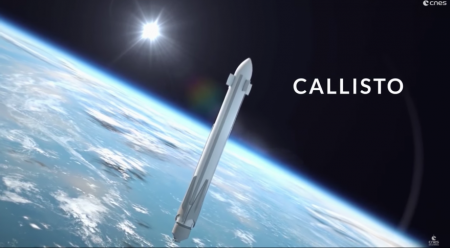
Joining the two now are two member nations within Europe’s space program: Germany and France. Their goal is to advance the Ariane program by developing a first stage rocket prototype dubbed Callisto. The timetable for Callisto’s first flight is 2020.
Callisto is being developed in parallel with a new engine designed for multiple firings and reuse. Called Prometheus, the engine is a joint venture by the French agency, CNES, and the German DLR. Initial funding is coming from the European Space Agency’s Ariane 6 budget. Each agency has its own expertise. The French are focused on the guidance system and flight software. The Germans are developing trajectory, aerodynamics, and aerothermodynamics systems. The engine will run on liquid hydrogen.
States Hansjörg Dittus, of DLR, “It’s not a copy of what SpaceX is doing. In some aspects we are also skeptical [about reusability as] the right path, but we will see what is best and then we can come up with ideas of how we proceed.” The two agencies are still working out whether the first stage rocket needs wings, the engine throttling functionality, and the final engine materials and design to ensure multiple reuse.
Marc Astorg, the head of CNES’s Launch Vehicles Directorate, is not concerned that SpaceX currently has a substantial lead. He believes it’s not always good to be first when creating a new paradigm. For example, he thinks that the use of kerosene as the fuel for SpaceX’s Merlin engines in their Falcon 9 program, is a dead end, whereas hydrogen or methane would be easier fuels to handle. SpaceX in its next generation of rockets is switching from kerosene to hydrogen.
When Callisto is ready to fly in 2020 it will not use Prometheus because the prototype will be too small for that engine. The test rocket will measure 13.5 meters (44 feet) in height and 1 meter (3 feet, 3 inches) in diameter. But first flight will be useful in proving that the design works and is flight stable. For Prometheus, a larger version of the rocket will need to be designed. That may end up being the Ariane 6 which is expected to see its first flight in 2020 and may incorporate the Prometheus engine. But for now, Ariane 6 is not being designed with re-usability in mind.
The post Re-usability Rocket Bug Infects European Space Programs appeared first on Techso Mogro.
]]>