When the Galileo mission first started circling Jupiter in 1995. It made eleven close flybys of Europa and magnetometer readings from one of those a mere 150 kilometers from the moon indicated something was erupting from the surface. This flyby approximated the location where Hubble first detected cryovolcanism. And coincidentally, the area where the plume was detected showed a thermal anomaly which indicates that what is emanating from the surface is warmer than what is found on its surface. The height of that plume is estimated to have reached 160 kilometers above the surface.
The implications of the existence of water beneath Europa’s crust that is warmer indicates that the moon has conditions that might be amicable to life.
Europa is considered to be a high-probability site for exobiology. That’s because liquid water is very close to the moon’s surface.
What causes Europa’s plumes?
The interaction of Jupiter and the neighbouring Jovian moon Io produces an incredible amount of energy in the form of tidal forces on Europa. And it is these tidal forces that planetary scientists believe is causing shifting in the icy surface and allowing for cryovolcanic eruptions.
What we still don’t know is the nature of Europa’s core. Is it solid or is the entire moon water? If solid, could the warming be caused by a hot core that features marine volcanoes erupting into the global ocean, transferring heat which is then leading to cryovolcanic activity at the surface?
Or are the plumes erupting from local warm spots, pockets of water in the crust that eventually reach the surface and escape into space?
NASA has planned a mission to Europa known as the Europa Clipper. It is planned for between 2022 and 2025. The Clipper will visit Europa at least 44 times in its mission and descend to heights above the surface as low as 25 kilometers. It is likely that cryovolcanic plumes will intersect with Clipper as it flies by.
Clipper will map the subsurface ocean. In addition, the instrumentation will be able to detect chemistry and constituent matter on the surface and within Europa’s plumes. Indirectly this may be able to tell us that microbial life exists on Europa.

]]>
Yesterday, researchers from Brown University, in Providence, Rhode Island, had their paper accepted for publication in the Journal of Geophysical Research. Entitled “Porosity and salt content determine if subduction can occur in Europa’s ice shell,” the paper tries to explain observed features on Europa seen in satellite, Hubble, and Earth-based telescope images. The moon bears surface scars that strongly resemble those found on Earth along the margins of continental and ocean plates. In running computer simulations of the moon’s surface features, the Brown researchers hypothesize that forces similar to plate tectonics are happening there. It’s not quite the same as what drives Earth’s plates, but the end result is the same.
Europa’s icy plates are moving and there is evidence of subduction zones where the moon’s surface ends up sinking into the ocean beneath. States Brandon Johnson, Assistant Professor, Department of Earth, Environmental and Planetary Sciences, and lead author of the paper, “If indeed there’s life in that ocean, subduction offers a way to supply the nutrients it would need.”
Tectonics on Earth results from the interaction between our lithosphere, consisting of pieces of the crust forming distinctive plates, and the viscous, hot mantle that lies beneath. As mantle currents cause upwellings we see eruptions occur along the plate edges. The eruptions add new material to the Earth’s surface and push apart the plate edges, while on other parts of the Earth pieces of the lithosphere get dragged beneath into the mantle in a process known as subduction.
On Europa, the equivalent to Earth’s lithosphere can be found on the surface containing an outer and inner layer of ice. The outer layer is very thin with the ice much colder than the layer beneath. It is this second layer which the researchers believe acts like Earth’s continental plates. But figuring out the mechanism is the unsolved mystery. What causes convection of the inner ice layer?
The researchers hypothesize that convection can be explained if the inner ice layer is saltier than the ocean beneath. And if saltier it must, therefore, be denser. The difference in density between ice and ocean then becomes the mechanism driving Europan tectonics with plates of ice akin to the continental plates that compose Earth’s lithosphere. And as on our planet, where subduction immerses pieces of the surface into the mantle, on Europa, a different chemistry and geology produce a similar effect.
The evidence for a denser, saltier ice surface is there states Johnson. Geyser-like plumes erupting from cryovolcanoes bring salt to the surface where it continuously accumulates creating these denser plates of ice and reinforcing the tectonic processes. Johnson notes that the ability to study plate tectonics on Europa may help us to better understand Earth’s plate tectonic processes and how they began in the early history of our planet. And even more exciting, is how this mechanism on Europa could provide the means by which life, if it exists there, can be sustained.
NASA scientists at the Jet Propulsion Laboratory in Pasadena, California, are hellbent on getting to Europa to further investigate it to determine if it could or is harboring life. A mission called the Europa Clipper is planned for as early as 2022. It will send a robotic spacecraft similar to Juno to enter into a series of long looping orbits around Jupiter aimed at repeated flybys of the moon. The instrument payload will include cameras and spectrometers to study the surface, and radar to map the subsurface ocean. A magnetometer will measure the moon’s magnetic field and help to determine the salinity and depth of the ocean. A thermal instrument will scan for cryovolcanic eruptions and other upwellings including water plumes first noted in 2012.
A future mission tentatively scheduled for the late 2020s proposes to put a lander on Europa’s surface in 2031 to search for evidence of life. It would have to touch down near cryovolcanoes or water plumes if it wants to find microbes or other evidence of life expelled onto the surface. Scientists speculate that life on Europa would be similar Earth life observed on our oceans’ floors in proximity to thermal vents called black smokers, or akin to the microbial life found in subsurface glacial lakes.

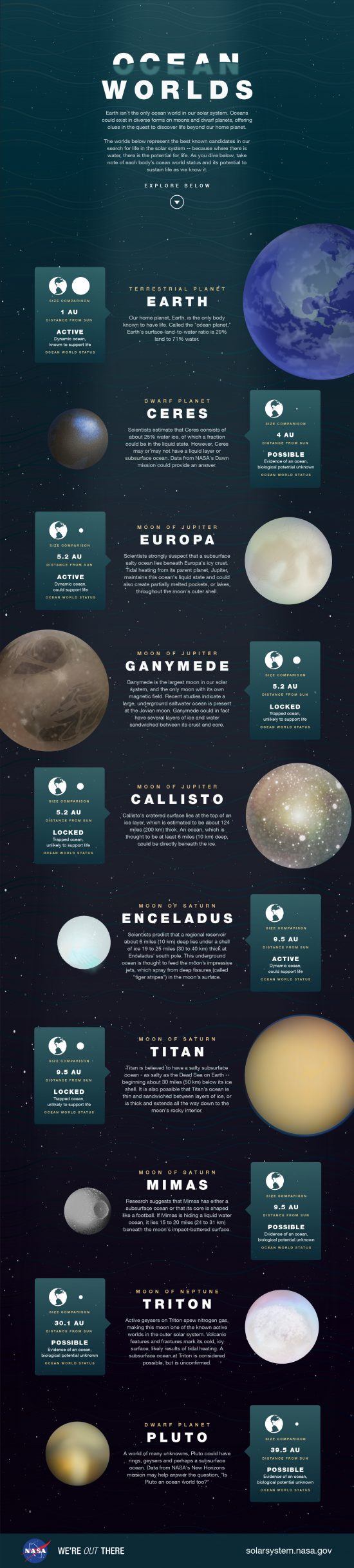
Arthur C. Clarke had speculated in his science fiction novels and short stories that we would discover life on a Jovian or Saturnian moon. And now the science has caught up with the fiction. Enceladus and Europa are considered the top targets for planetary exploration in the next two decades. Both feature an icy crust and a liquid ocean beneath. Both experience the tidal tugs of their host planets which generate the heat that keeps that water from freezing solid in the outer reaches of the Solar System. And with Pluto and Ceres we may find similar environments energized by their own internal heat, not by tidal forces.
The question is, with the presence of water on both, where life first emerged on Earth, can there be some form of life on these two moons and possibly on the two dwarf planets? We’re not talking about oxygen breathing life, but rather the type of life found at the bottom of our oceans today where deep sea vents pour out mineral-rich hot water that serves to be the elixir for a complex of life. This is life that feeds off methane, sulfur, phosphorus and other elements found in the hot water stream.
How do we know that something is going on in these ocean worlds?
Yesterday when NASA began describing its latest findings it focused on Enceladus and Europa, sharing what Cassini has learned about the former and the Hubble Space Telescope and the now-defunct Galileo Jovian orbiter about Europa. The information session didn’t touch on Ceres or Pluto, but it could have.
The evidence presented focused on observed plumes coming from both moon’s surfaces. Enceladus is a small moon. No one expected it to be dynamic before Cassini arrived in the Saturnian system. It was thought to be frozen solid, that is, until Cassini flew by, not once but several times, building a complex picture and data that unmistakably points to an active small world. Cassini’s cameras photographed plumes of vapour rising from Enceladus southern polar region. The onboard Ion and Neutral Mass Spectrometer sampled the plumes and found 98% water vapour, 1% hydrogen and the remainder a mix of carbon dioxide, methane and ammonia. The hydrogen was the big surprise because the element is so light scientists would expect there to be nothing emanating from the moon at this stage of its geological history. All should long ago have escaped into space. But the hydrogen could only exist mixed in with the water if there was something chemically active going on beneath the icy crust. On Earth, we observe hydrogen in the effluent coming from deep sea vents referred to as hydrothermals. These vents may have been where life first appeared on Earth before there was much in the way of free oxygen in our atmosphere. And hydrogen gets produced by a chemical reaction known as methanogenesis. And when found with methane, as has been discovered on Enceladus, it could mean the presence of amino acids. And where amino acids are found so is DNA here. So why not there?

The observations of Europa are similar but less definitive largely because we have no spacecraft in proximity to do intense science like we have in the neighbourhood of Saturn. Europa has a liquid ocean below its icy crust and there are hot spots in the crust mapped by Galileo, that align perfectly with Hubble Space Telescope observations showing plumes rising from the moon’s surface. Scientists, knowing what they have learned from Enceladus, are now comfortably convinced that Europa is likely generating water vapour, hydrogen, and traces of other gasses akin to the Saturnian moon. They want to take a closer look and have planned a mission they call the Europa Clipper to study the phenomenon up close. The mission also includes a lander to do a search for life traces on the icy surface.

So what about Ceres and Pluto?
The Dawn spacecraft which has been studying Ceres, the largest member of the Asteroid Belt, has observed the presence of water and organic compounds on the dwarf planet. The onboard Visible and InfraRed Mapping Spectrometer investigated one of Ceres’ craters and found methyl and methylene compounds similar to hydrocarbons found here on Earth. The existence of what has been described as a large reservoir of water ice, ammonia, salts and organics has fundamentally altered scientists’ views about the dwarf planet. The potential of a water ocean beneath the crust is now deemed highly likely.

And New Horizons’ visit to Pluto produced its own surprises. In observing the heart-shaped surface feature, the Tombaugh Regio and its alignment in tidal lock with the dwarf planet’s largest moon, Charon, scientists have become convinced that there is likely a viscous icy ocean of water underneath the dwarf planet’s surface and that Charon may have also harboured a subterannean ocean in the past. It is believed that Pluto may still be geologically active, not to the extent of Earth, but enough to allow for water to flow freely under its icy crust And where there is water, NASA scientists believe there is the opportunity for life to emerge.

These four candidates for alien life were never considered in the past. Today NASA knows that our Solar System has water showing up in lots of places. And not just water, but chemical compounds that point to some interesting additional places to look for life. Ganymede and Callisto, two other Jovian moons, Titan, Saturn’s largest moon joins Enceladus and Mimas as ice worlds. And Triton, Neptune’s largest moon, has observed active geysers also suggesting a subsurface ocean world. And note that we haven’t mentioned ice found at the poles of our own Moon, subsurface ice and polar ice caps on Mars, or water vapour in the swirling clouds of Jupiter. Nor have we talked about discoveries of water on exoplanets, a whole other topic to explore.
Now to the business at hand. In the movie, 2001: A Space Odyssey, based on an Arthur C. Clarke science fiction novel, the words appearing in this posting’s title are quoted near the film’s end. How Clarke could guess that Europa might be the likeliest place to find life in the Solar System other than here on Earth remains a mystery to me. The technology to glean such information from Earth-based observation was insufficient to draw such conclusions. So yesterday when NASA announced findings from pictures and video images taken by the Hubble Space Telescope of Jupiter’s moon, you had to expect that the media would pull out Clarke’s novel and quote those words.
What did NASA share with us?
Strong evidence of the existence of water vapour erupting from Europa’s surface. States Geoff Yoder, Acting Associate Administrator for NASA’s Science Mission Directorate, “Europa’s ocean is considered to be one of the most promising places that could potentially harbor life in the solar system.”
What ocean is he talking about?
Europa is covered by an icy crust under which astronomers have suspected the existence of an ocean of salty water greater in volume than all the oceans here on Earth. And where Jupiter’s gravitational pull causes fissures to occur in the icy Europan crust, water appears to be escaping to the surface.
Observations by a team from the Space Telescope Sciences Institute (STSci) in Baltimore announced they have observed plumes of water rising 200 kilometers (125 miles) above the moon’s surface.
How could they see these plumes?
States William Sparks of STSci “The atmosphere of an extrasolar planet blocks some of the starlight that is behind it….if there is a thin atmosphere around Europa, it has the potential to block some of the light of Jupiter, and we could see it as a silhouette. And so were were looking for absorption features around the limb of Europa as it transited the smooth face of Jupiter.”
What does this all mean?
Over 15 months on 10 separate occasions scientists at STSci observed 3 incidents of plume eruptions (see the image below and note the suspected plumes in the bottom part of the picture).
These new observations confirm those made in 2012 by the Southwest Research Institute in San Antonio, which detected water vapour eruptions in Europa’s south polar region. Those eruptions were estimated to reach 160 kilometers (100 miles) in height.
The latest results will be published in the September 29th issue of the Astrophysical Journal.

When the James Webb Space Telescope is launched in 2018, one of its immediate tasks will be to confirm the Hubble’s observations. But NASA scientists are seemingly convinced that the discovery of water vapour plumes justifies seeking funding for an orbital mission to Europa in the 2020s to observe the moon close up. No landing is planned and not because of Arthur C. Clarke’s prescient words, but because the orbital mission should be able to sample the ocean by flying through the plumes. What it may find could tell us that indeed, we are not the only place in the Universe where life exists.

And now NASA in its 2016 budget is proposing to mount an expedition to Europa, Jupiter’s sixth moon, one of the three believed to harbor water beneath their icy crusts. The other two, Ganymede and Callisto, don’t peak the same level of interest. That begs the question, “Why?” Why did Clarke pick Europa as this transformative “new Earth” in his novel?
Europa, seen below, is unique among the icy moons of the gas giant planets in our Solar System. Its surface is covered with strange markings and discolourations. It is the smoothest moon in the Solar System, displaying few craters on its surface. Instead of mountains and crater rings we see seams and cracks and a crust partially stained henna. The atmosphere, although tenuous, is largely composed of oxygen.
The gravitational pull of Jupiter exerts considerable tidal forces on the moon. It is believed that this is causing the visible plate tectonic activity recently reported. And it is also believed that these forces have heated the ice under the crust creating an ocean of water equivalent in volume to all found here on Earth. NASA has seen plumes of water escaping as icy geysers from Europa’s surface cracks. And recently NASA detected phyllosilicates on the surface, a clay-like mineral that on Earth is found in conjunction with organic matter. In other words, Europa may contain life.
Life on Europa was the idea behind the novel Clarke wrote back in 1982. He wasn’t around to witness the most recent discoveries that suggest his view was prescient. He had watched the NASA Grand Tour of the Solar System’s giant planets arrive at Jupiter in 1979 and wrote “2010: Space Odyssey Two” three years later. And he was convinced that if we did reach Europa and drill down through the ice we would discover an ecology unique to the Moon including creatures bigger than anything living in the geological record here on Earth.

So what is NASA contemplating? Called the “Europa Clipper,” the spacecraft would orbit Jupiter but like Cassini orbiting Saturn while studying Titan, would perform 45 flybys of the moon, some as close as 25 kilometers (16 miles) above its surface. On board would be ground-penetrating radar, an infrared spectrometer, magnetometers, and high-resolution imagers. It may even deploy cube micro-satellites which will be dropped into orbit around the moon. The science package would tell us the thickness of the surface crust, its composition, the temperature on its surface, and what lies beneath. The mission currently may use NASA’s Space Launch System (SLS), still in development, to shorten the voyage from Earth to Jupiter to under three years.
NASA isn’t alone in wanting to go to Europa. The European Space Agency (ESA) is also interested. They call their mission, JUICE, which stands for the Jupiter Icy Moons Explorer and plan to launch in 2022. Using Venus and Earth’s gravity to boost the spacecraft’s speed, it will take eight years to get to Jupiter, sometime in 2030. On board JUICE will be an instrumentation package similar to that contemplated for the Europa Clipper mission. But JUICE is not designed just to study Europa. Its mission includes a detailed study of Jupiter itself as well as Europa’s two sister ice moons, Callisto and Ganymede. In fact the mission’s final destination will be to go into orbit around Ganymede.
How interesting that both NASA and ESA have no plans to land on Europa. Are they heeding the words, “Attempt no landing there?”
]]>
With Jupiter our first destination, followed by Saturn, two members of the Asteroid Belt, and Pluto and Charon, these voyages straddled the end of the 20th and beginning of the 21st century. So let’s begin with our return to Jupiter on a spacecraft named Galileo and then discuss other missions in progress or planning and why we keep going back to this gas giant.
What compelled us to return to Jupiter after the successes of the Pioneer and Voyager missions? There were lots of unanswered questions about Jupiter, when it formed, where it formed whether it has a solid core and its structural composition, and which if any of its moons had liquid water and the ability to sustain life. We wanted to understand how one moon, Io, could be constantly going through the throws of reforming its crust with more active volcanoes than any other body in the Solar System including Venus.
Galileo – A Voyage of Discovery That Changed Our View of Jupiter and its Moons Forever
The Galileo mission was designed to address some of these questions. A spacecraft designed in the 1980s, it took nearly six years from its launch in 1989 to get to Jupiter. Its route took it first by Venus once and Earth twice before developing the gravity-assisted speed necessary to coast past Mars and through the Asteroid Belt to Jupiter.
While on route it rendezvoused with two asteroids, first Gaspra in 1991 and later Ida in 1993. While passing Ida it captured a picture of the asteroid and its accompanying moonlet named Dactyl. A year later on approach to Jupiter it bore first-hand witness to the destruction of Comet Shoemaker-Levy as it impacted the planet.
Galileo finally arrived at Jupiter in December 1995. It launched a companion atmospheric probe on July 13, 1995. The probe descended through 200 kilometers (124 miles) of the planet’s outer atmosphere collecting data on local weather conditions – for July 13, a dry day with a few clouds and distant lightning. As the probe descended further it experienced winds exceeding 720 kilometers (450 miles) per hour and finally vaporized in the intense heat of the atmosphere after 61 minutes of transmission.
Galileo’s path around Jupiter took it in long elongated orbits around the planet, each averaging about two months. The orbits allowed the spacecraft to sample Jupiter’s magnetosphere in different locations while performing close rendezvous with Jupiter’s many moons. After 35 of these orbits and almost eight years of operation in the planet’s vicinity Galileo was instructed to self-destruct in the Jovian atmosphere to avoid a potential contaminating impact with the moon Europa.
What answers did Galileo give us to the questions we had about Jupiter and the Jovian system?

Because of these discoveries and the many still unanswered and new questions that arose from Galileo’s mission, Jupiter is once again to be visited by a new spacecraft, Juno, that will focus on the planet exclusively. The Juno mission will be followed by a new robotic spacecraft, Juice, with a mission to study the Jovian system and in particular its ice moons.
Juno – Dissecting Jupiter to Understand How the Solar System Formed
Jupiter is the largest planet in the Solar System. Its mass is greater than all the other planets combined. Scientists theorize it was the first planet to form out of the nebula that condensed to form our proto-Sun and its planetary companions. What is not known is where Jupiter formed? The presence of large quantities of noble gases as found by Galileo suggests that Jupiter may have formed much further out than its present position as fifth planet from the Sun. Juno, the next mission to Jupiter may provide us with answers and help us learn more about the earliest period in the Solar System’s formation.
In returning to Jupiter with Juno the goal this time is to focus on the planet itself and not the larger Jovian system. Scientists hope to learn more about the origins of the Solar System by studying Jupiter, its composition, whether it has a solid core, and the mechanism behind its powerful magnetic field.

Juno is a very different spacecraft than Galileo. It is solar powered. Galileo was powered by a Radioisotope Thermal Generator (RTG). In choosing solar over RTG the spacecraft designers have built a significant solar array with three panels, each 2 meters (6 1/2 feet) wide and 9 meters (almost 30 feet) in length. The size of this array is significantly larger than any previous robotic spacecraft. Why? Because sunlight near Jupiter is 27 times weaker than sunlight near Earth.
In addition the spacecraft is designed to fly with its solar panels always sun facing to maximize its ability to power the instrumentation package on board (see image below).
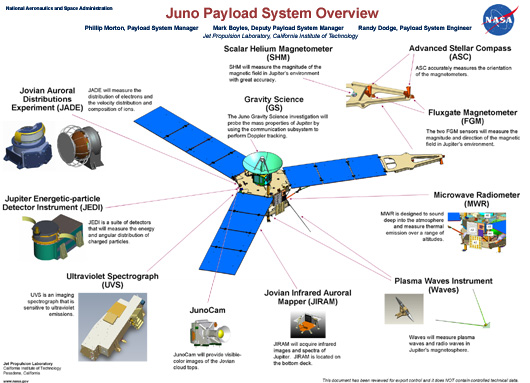
Upon its arrival in 2016 Juno will enter a close polar orbit around the planet taken it within 100 kilometers of the cloud tops. In this way Juno will be less exposed to the Jovian magnetosphere while it directs its scientific instruments at studying the planet below. After 32 to 33 orbits taking approximately one year the plan is to deorbit the spacecraft to burn up in the atmosphere in October 2017.
Juice – Europe’s Contribution to Exploring the Jovian System
The Juno mission is not our last visit to the vicinity of Jupiter. Other missions are planned including a lander with technology to drill into the surface of Europa to sample its subsurface ocean, and a new mission from the European Space Agency (ESA), named Juice, planned for a launch in 2022 with arrival at Jupiter by 2030.
Juice stands for Jupiter Icy Moons Explorer. The mission will study Europa, Ganymede and Callisto. The spacecraft will make several flybys of these moons while doing further studies of Jupiter’s atmosphere and magnetosphere and how the latter interacts with its moons. The plan includes a final rendezvous with Ganymede with Juice entering into orbit around that moon in 2032.
In choosing Ganymede as its final destination Juice will study its atmosphere, icy surface, internal structure and subsurface ocean as well as its unique magnetosphere.
Our next stop in our exploration of the outer planets – Saturn.
]]>