Austria in 2027.
Belgium in 2026.
Denmark in 2030, and an end date for hybrids in 2035.
Egypt to go 100% electric by 2040.
France in 2040.
Germany in 2030.
Iceland with the capital, Reykjavik planning to cut gasoline fueling stations by half by 2025, and a ban in 2030.
India to go 100% EV beginning in 2030, and plans to eliminate gasoline-powered 2 and 3-wheeled vehicles beginning in 2025.
Ireland in 2030.
Israel in 2030.
Japan in 2035.
Korea (South) in 2025.
The Netherlands in 2030 with Amsterdam banning all fossil-fuel-powered vehicles from its streets by 2030.
Norway in 2025 and the current leader with 60% of all new car sales being EVs.
Portugal in 2040.
Slovenia in 2030.
Spain in 2040.
Sri Lanka in 2040.
Sweden in 2030.
Taiwan in 2040.
Thailand in 2040.
The United Kingdom, not including Scotland, in 2030 and with the city of Bristol looking at restricting the operation of diesel-powered vehicles in the very near future.
In the United States, the States of Washington and New York have set 2030 and 2035 respectively as the end dates for the sale of fossil-fuel-powered vehicles.
But California, the first jurisdiction to pass emission and mileage standards on vehicles in the past, had not leaped into the banning of gasoline-powered vehicles camp until today. The California Air Resources Board announced that 100% of all new cars being sold in the state will be non-fossil-fuel-burning. Currently, the target is 12%. By 2026 it will rise to 35%. And by 2030 to 68%.
California is the largest market for new vehicle sales in the U.S., so these targets will have a significant impact on the automotive industry in the country and abroad. And California’s influence is expected to affect five other U.S. states almost immediately and seven more ti follow thereafter in enacting similar targets. These 13 states in total represent a third of U.S. automobile sales.
There is another distinction between California’s latest announcement and those made by other jurisdictions. None of the others have laid out milestone dates and targets this specific. The mandates for most, Norway the exception, are aspirational at the moment.
And California is expected in parallel with its emission-free targets to up the mileage and pollution standards which will likely lead to the Environmental Protection Agency (EPA) following in lockstep for the entire country in 2023.
These aggressive moves come just a week after the signing of The Inflation Reduction Act with hundreds of billions earmarked for nationwide climate change mitigation and adaptation programs and projects.
No doubt, there will be court challenges to California and the federal government’s policy announcements. But American opinion is shifting related to tackling climate change issues. In a July 2022 poll taken before the Supreme Court ruled that the EPA was exceeding its jurisdictional authority on emissions coming from coal-fired power plants, Americans expressed interesting views on climate change issues such as the one related to the banning of new sales of gasoline-powered vehicles. The polling results that follow represent a national snapshot before a sudden spike in gasoline and diesel fuel prices.
The New York Times today, in announcing the new California policy along with the latest federal legislation, noted that the combination of the two will likely represent an important milestone in the U.S. effort to eliminate carbon emissions.
And because of California’s larger impact, both nationally and globally will also influence many other jurisdictions to accelerate efforts to move away from gasoline and diesel-powered transportation and into EVs and other zero-emission options.
What remains to be addressed, however, are the security of supply around the materials needed to support the manufacturing of EVs in even greater numbers, and a rapid buildout of fast charging networks in the U.S. and around the world.
And finally, the automotive industry has to address the issue of affordability. EV models today without government subsidies are unaffordable to the majority of Americans and families in other countries.
With Gen Y and Z wanting access to vehicles more than ownership, the industry needs to explore new ways of getting people into EVs.
Recently, I wrote about transportation-as-a-service being considered as a way to reduce EV costs for consumers. And in another posting, I described a company starting to offer Tesla EVs by subscription.
]]>The goal of the Plan which I described on Sunday as Draconian to some, “Big Coal” and shale gas producers, is to drop emissions by 32% from 2005 levels by the year 2030 by emphasizing renewable power and energy conservation.
By doing this the government states the country will derive significant benefits including:

The Plan creates a partnership between the U.S. Environmental Protection Agency (EPA) and states, territories and aboriginal communities. CO2 emission reduction targets are established for coal, oil and natural-gas fired power plants. The measure the EPA is using as its standard is pounds of CO2 per megawatt hour (lb/MWh). Every partner is asked to implement a plan to ensure operating power plants within each’s jurisdiction achieves CO2 emission reductions commensurate with overall goals.
To achieve the strategy the EPA is using the demonstrated best system of emissions reduction (BSER) as a model for each type of power plant to make improvements that include:
The EPA has divided the country into three regions, Eastern, Western and Texas and set achievable rates based on the existing mix of energy sources at present and what can be achieved between now and 2030. Left out of the equation for the moment are Alaska, Hawaii, Guam and Puerto Rico. The reason for the omission of the latter four is insufficient data to create a future standard.
Every state other than Alaska and Hawaii is asked to develop and implement a power plant plan with interim goals between the present and 2030. There are two plan types to choose from:
States are encouraged to adopt multi-state cooperative approaches including cap-and-trade emissions trading so that they can meet GHG emission reduction targets in the interim period up to 2030. States are also encouraged to create programs to spur private investment in renewable energy and energy efficiency for businesses within their jurisdictions.
The cap-and-trade system as a market-based policy tool is seen by the Plan to be the most effective way to:
The Plan also includes measures to ensure a continuous, reliable supply of energy for the nation throughout the transition to a lower carbon footprint. The compliance periods are long implemented in three multi-year phases for flexibility in planning and investment. The Plan also includes a mechanism whereby a state can revise its plan because of unforeseen challenges arising.
Initial state submissions are required by September 6, 2016. Final plans must be submitted by September 6, 2018. To encourage the states to get on board early the EPA has created a Clean Energy Incentive Program (CEIP) that rewards wind and solar, and energy conservation and efficiency projects that deliver significant carbon reduction results by 2020 and 2021.
Throughout the implementation of the plan the EPA plans for public engagement to encourage continued participation by all partners. This includes avenues of communication to receive local input on strategies to help achieve the total carbon reduction goal.
In today’s Financial Times, Barney Jopson writes that “U.S. shale gas in the unexpected loser” in this announcement, that the “early rush to gas is eliminated” in favor of hydro, wind and solar power and energy conservation. Gina McCarthy, head of the EPA is cited as stating that the shift to renewables in the past year is “happening faster than anybody anticipated.”

Of course the Republican Party leadership in the United States including most of its presidential candidates are opposed to the Clean Power Plan, as are a number of state governors, almost all Republican, with a number of them preparing lawsuits to challenge the EPA’s authority.
To be expected “Big Coal” represented by the American Coalition for Clean Coal Electricity has pushed back describing the plan as “illegal” and stating: “The president’s relentless climate crusade cannot be put ahead of the priorities of hard-working Americans who will pay the ultimate price of staggering electricity bills and lost jobs.”
McCarthy’s response, “some special interest critics will tell you that it can’t be done…but they are wrong.”

]]>
In a report issued this last week by the Environmental Protection Agency focused on the issue it was confirmed that fracking has been contaminating some drinking water wells. The problem isn’t widespread but there are enough occurrences to warrant environmental concern.

The industry has been arguing from the get go that well water contamination documentaries like Gasland and Gasland 2 are inflammatory when they show images of tap water that can be lit and when numerous stories are told about how the oil industry is “contaminating democracy.” The industry has mounted a public relations campaign to debunk these conclusions, but it appears that Josh Fox who wrote and created the films has gotten some of his facts right.

The EPA 998-page draft report documents 151 cases in 11 states where fracking operations caused chemical spills where the fluids may or may not have leached into groundwater. It also confirmed that fracking operations in parts of the country are actually tapping into freshwater aquifers where the hydrocarbons are also present. The industry in the past has denied this.
Fracking operators use water and chemical solvents, called fracking fluid, to separate tight-gas and oil from shale rock formations. The EPA identified 1,076 different chemicals in fracking fluid and that, for the most part, it was impossible to know which chemicals were being used even within a single company. The most commonly used chemicals include methanol, hydrotreated light petroleum distillates and hydrochloric acid. The volume of fracking fluid injected into exploratory wells varied from a few liters to tens of thousands.

The EPA also noted that the majority of chemicals being used in fracking operations were soluble in water and when introduced into soil and organic material could persist in the environment for a long time. Some of the chemicals used were found to be carcinogenic. Some were deemed cardio and neurotoxic. Some could compromise the immune system and alter blood chemistry. The exposure was generally deemed low when spread across the nation but in areas where fracking was concentrated, these chemicals in the environment could be considered potentially hazardous.
The EPA specifically looked at how wells used to provide freshwater could become contaminated by fracking operations. They noted that in some cases deficiencies in the cement casings used to isolate the fracking fluids from the surrounding environment were not placed deep enough to extend below the aquifers being used as drinking water sources. This appeared in 3% of all wells drilled in 2009 and 2010. That’s 600 out of 23,000. The EPA also found cases where the cement casings failed leading to natural gas seeping into local drinking water. The EPA also expressed concern about older well sites becoming sources for groundwater contamination.
And specifically the EPA found that “not all hydraulic fracturing is performed in zones that are deep below drinking water resources” citing wells drilled in Illinois, Indiana and Kentucky.
In the conclusions the EPA authors state:
The industry claims the report validates their position that fracking poses no threat to those living nearby who rely on groundwater for cooking, cleaning and drinking. The Heartland Institute, in its read of the draft report emphasized, “hydraulic fracturing,…does not create widespread or systemic pollution of drinking water.” They along with many other fossil fuel energy advocates are focused on the words “widespread” and “systemic” as justification for current industry practices. But they are wrong in that as many as 20% of the wells drilled by fracking companies for more than a decade according to the EPA do pose a threat to groundwater sources and that some operators continue to not follow industry best practices and therefore pose a threat to local water supplies.
The public is getting the opportunity to read the draft report now and above I have provided a link to it in this posting.

So what did the President announce? What are called a series of executive actions focused on preparing Americans for climate change impacts while setting national carbon pollution limits by reducing CO2 emissions from existing power plants across the United States. These are Environmental Protection Agency guidelines (contained in a 645 page EPA document) to be administered and monitored in every American state. They govern existing fossil-fuel-fired power plants. The guidelines will receive hearings this summer giving the public and industry stakeholders the opportunity to provide comments and data in response to the stated targets.
The objective is to reduce America’s greenhouse gas (GHG) emissions, primarily CO2 coming from power plants by 30% from 2005 levels. Today, 32% of all GHG emissions come from power generation and 82% of what is produced in CO2. With these reduction targets to be met by 2030 the net benefit calculated by the EPA for both climate and health will be worth worth between $48 and $82 billion U.S. annually.
Does this mean the end of coal-based energy production? No. The EPA believes that by 2030 30% of U.S. power will still come from coal.In 2013 that number was close to 40%. How is it possible then to reduce CO2 with so much energy production still coming from coal? The EPA believes that lower-emitting technologies deployed in these power plants, upgrades to existing electricity infrastructure, more efficient use of electricity by industry and consumers, conservation and carbon sequestration projects will make it possible to still use coal while achieving the overall reduction goal.
States are to receive individual emission reduction targets reflecting the fuel mix used within the existing power generation infrastructure. But no state is specifically told how to meet its goal. That is up to state planning “consistent with the EPA guidelines” which are laid out for the states to use in creating compliance strategies. States can go it alone or collaborate with others.
Why are power plants the target of this executive action? Because as the executive action guidelines state, fossil fuel power plants are “by far, the largest emitters of GHGs, primarily in the form of CO2, among stationary sources in the U.S.” As proof, just last week I wrote about two of those producers, AEP and Duke, who collectively contribute over 275 million tons of CO2 to the atmosphere annually.
Targeting coal-fired power plants recognizes that these facilities are sites that by 2025 will average 49 years in age. About 20% of them will exceed 60 years in age. So making plans to phase them out, upgrade their technology or rebuild them entirely seems logical.
As in the acid rain programs developed in the 1990s compliance with GHG “can be monetized such that it is factored into power sector economic decision making in ways that reduce the cost of controlling pollution.” Does that mean a carbon tax or a carbon trading market? It certainly puts a price on carbon but we will see what falls out from the public and stakeholder discussions in the coming weeks.
It is good to read in these guidelines words like “state plans must establish standards of performance that reflect the degree of emission limitation.” I state this because guidelines is not a word I associate with enforceable compliance. A framework of components for each state plan is provided. In addition to achieve emission reduction the EPA offers a number of “building blocks” for power generators to implement:
With state oversight and policies conducive to help the utilities achieve these blocks the EPA believes the reduction objective of 30% can be achieved in 2030. In preparation for the announcement today President Obama released a video on Saturday, May 31st that you can watch here. It talks about the impact of carbon pollution on children’s health as well as the most recent reports that show that climate change is impacting the United States now.

]]>
AEP supplies power to customers in Ohio, Illinois, Kentucky, Indiana, Michigan, Pennsylvania, West Virginia, Virginia, Tennessee, New Jersey, Maryland, Delaware, Texas and the District of Columbia. The company’s sustainability plans state a goal to reduce reliance on coal to 49% by 2026. If you take into consideration that AEP intends to increase its power generating capacity during the next 12 years you can bet that carbon emissions aren’t about to decline and probably will continue to rise.
Duke Energy admits as the largest electric utility company that carbon emissions represent a significant challenge. In their statement on sustainability and climate change the company talks about reducing GHG emissions from generating electricity by 50% by 2030. How? The Vision 2030 Plan which talks about reduced emissions through the retirement of inefficient coal-fired power plants, developing carbon sequestration technology, introducing integrated coal gasification combined cycle technology to create synthetic gas (a technology developed by Germany in the 1930s under the Nazis and one that South Africa relied on under apartheid), and increasing the use of natural gas to generate electricity.
It is interesting that neither company talks about conservation in their vision to address carbon emissions. That is a topic that is sent downstream to the customer who is encouraged to conserve energy. Meanwhile both companies continue to build capacity for anticipated increases in America’s energy needs.
These are just two of many energy producing companies that in their vision show a lack thereof. But on Monday of the coming week President Obama intends to announce rules to curb carbon emissions from the energy generators in the United States. You can bet that the rules will focus on coal-fired power generators largely to restrict the building of any new plants. But will the rules put in place address the 275 million tons of carbon AEP and Duke emitted in 2012 and are probably still emitting annually? And who will police the coal-fired plants? The federal government? The state governments? You can bet that whatever is announced will not change the behavior of AEP or Duke, or impact them in any significant way. These companies will continue to pollute and contribute GHGs to the atmosphere on an enormous scale.
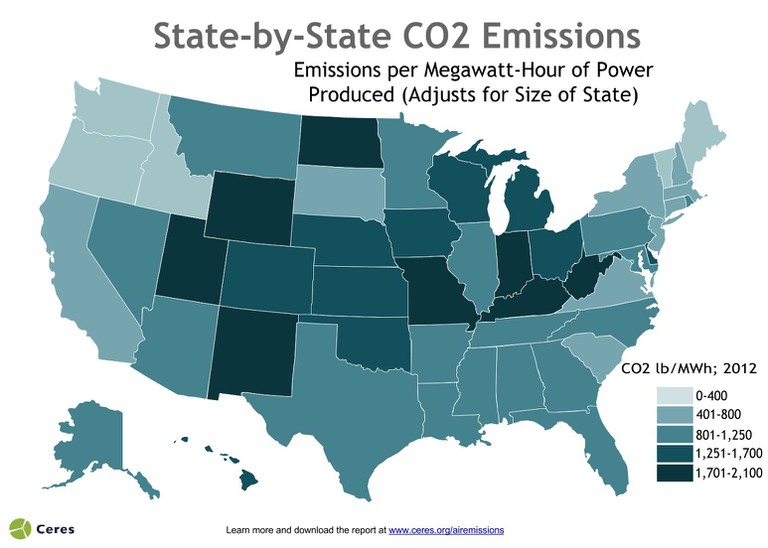
Take a look at the map below. The Environmental Protection Agency in the United States has its work cut out for it if it hopes to address carbon emissions now and in the future. And with the type of initiatives and regulations the President plans to announce on Monday, reducing CO2 produced by the power companies won’t be easy. In fact I strongly believe they won’t work but the sound bites will resonate.
]]>
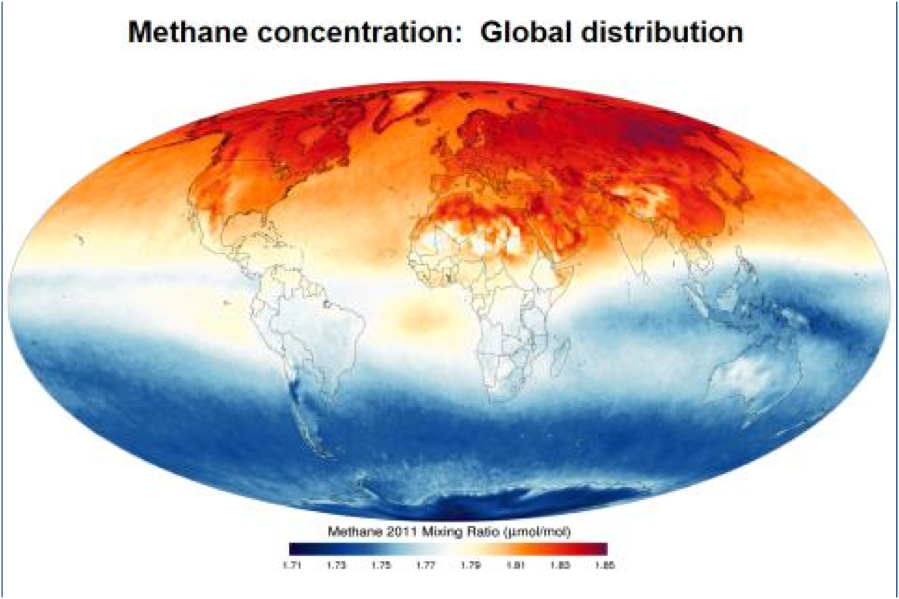
Anthropogenic (that is human produced) methane comes from many sources. These include the mining and burning of fossil fuels, farming, and gases emitted by garbage at landfill sites. It is estimated that 60% of all methane in our atmosphere is derived from human activities.
Methane tends to dissipate much faster than CO2. An average molecule lasts eight to nine years before it oxidizes. That makes methane harder to measure and that’s why methane tends to be measured at the source rather than the way we measure CO2. But are we accurate in our measure? And do we truly understand methane’s contribution to global warming?
The Environmental Protection Agency (EPA) of the United States, which calculates the amount of methane released through human activity, is being called on the carpet by a recent university study that appeared in a November 2013 issue of the Proceedings of the National Academy of Sciences. It appears that the EPA has seriously underestimated the amount of methane released through human activity in the United States. In fact total amounts appear to be between 1.5 and 1.7 times higher than EPA figures.
The miscalculation may be the result of different methods used to collect data on the GHG. The study summarily dismisses EPA data and that provided by the European Commission’s Emissions Database for Global Atmospheric Research, known in short as EDGAR. The data the EPA and EDGAR provide look at source emitters of methane. For example they have a calculation for the average yield of methane from rumination per head of cattle, or the average amount of aerated gas from oil and natural gas wellheads, or the amount emitted from coal mine operations or landfill sites. The study results do not approach the measure of methane this way. Instead the approach is top down, measuring the total concentration of methane in the atmosphere in similar fashion to how we measure CO2. But because methane oxidizes in a short period of time the amounts vary by year considerably.
If both U.S. and European oversight have got it wrong, what about the rest of us studying methane on the planet? What other countries and continents are taking measure of methane output? How consistent is the methodology?
Well it appears that some countries are very much aware of the methane contribution of their dairy and non-dairy cattle. Some are measuring methane output as well from pig farms. Others are measuring methane from fracking wellheads. Some are collecting methane captured from landfill sites. But it appears the measure of methane seems largely dependent on national or institutional preference.
How about the remaining 40% that is not human produced? Most of that methane comes from plant decay from natural wetlands. But even more of the gas is trapped in permanently frozen soils in the sub-arctic of Canada, Alaska and Siberia. This permafrost may not be so permanent after all. Trending to more significant warming in the Arctic may eventually lead to significant amounts of methane release over the coming decades. And although methane does not have the staying power of CO2 it will further destabilize our climate.
The global community, therefore, needs to understand just how much methane we humans are producing and find ways to lessen those amounts. We know that methane has increased in the industrial age. We know this increase is anthropogenic. And we know there are ways we can reduce methane release. Some of these are:
Addressing the natural release from permafrost, however, is a much tougher assignment for which there appear to be no easy solutions. And if we should start mining methane hydrates from the ocean floor we could be opening a Pandora’s Box.

An average home in the United States consumes about 12.25 Megawatt hours of electricity per year. In 2011 the United States had 116.17 million homes. In total they consumed 1,424 billion Kilowatt-hours of electricity. In announcing these reduction targets McCarthy, therefore, is setting the bar for an average American home to reduce its carbon footprint from 7,262 kilograms (16,010 pounds) to 6,112 kilograms (13,475 pounds) of CO2 per year, a drop of 16%. When you put it that way the announced reductions are not as significant as they need to be to really tackle the problem of overall greenhouse gas emissions. But at least with the multiplier effect of all those homes, the targets will reduce total emissions coming from residential sources.
]]>The reason it does has nothing to do with accessibility to other fuel sources. It is the coal lobby in Congress and the Senate that has instituted this practice even though numerous plans have been proposed to convert the plant to natural gas.
The plant began operations in 1910. Its output provides steam and chilled water, not electricity. The Environmental Protection Agency (EPA) which has been established to monitor the Clean Air Act, is not involved at this time in looking at Capitol Power’s output. So the plant continues to spew significant amounts of nitrous dioxide, sulphur dioxide and ozone in addition to CO2 into the air of Washington, DC.
A proposal has been made by the EPA to begin the process of establishing PAL levels at Capital Power. PAL stands for Plantwide Applicability Limit, an agreed to emissions allowance looking at all sources of pollutants. But that means measuring baseline actual emissions for an extended period of time to create the PAL.
Congress remains indifferent to the plant and its impact on the District of Columbia. No money has been allocated to overhaul the plant. No ban on using coal. Just total lack of interest.
What a wonderful example for the United States and what a statement about the federal government’s commitment to address CO2, air pollution and the implications for climate change.
I’m not an American and this has me seething. Why isn’t raising red flags in congressional districts across the entire country? And why aren’t the people who live in Washington, DC, up in arms about such an abdication of responsibility by those in Congress who are breathing the same air?

]]>
Biomedicine Update: New Insertable Robot to Enhance Minimally Invasive Surgical Procedures
The Insertable Robotic Effector Platform, IREP for short, seen in the picture below, has been licensed to Titan Medical, a Canadian company focused on advancing robotic surgical technologies. An invention coming out of a collaboration between Columbia and Vanderbilt Universities in the United States, the IREP is the world’s smallest single-port surgical robotic device capable of performing laparoscopic procedures. IREP has two arms, a 3D vision system that has two controllable miniature cameras that provide real-time visual feedback for surgeons. The robot arms look like miniature snakes and the device can be easily mounted in a surgical suite because it is much smaller than other surgical robotic tools.

Energy Update: Is Shale Gas Production a Bubble Ready to Burst?
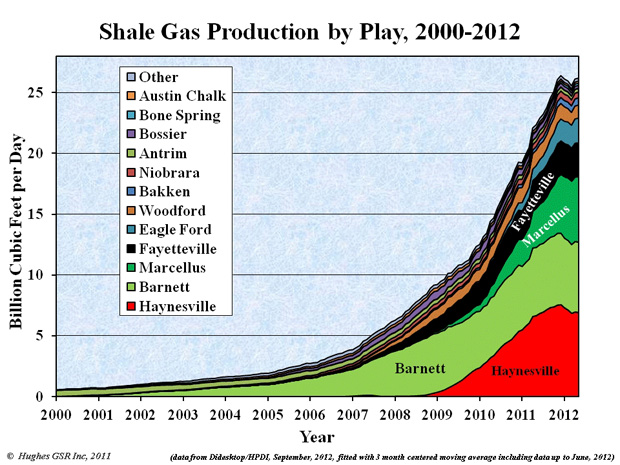
One of the knocks on fracking has always been the quick depletion that seems to happen soon after a new gas or oil well is drilled. In the U.S. it seems that shale gas has reached a plateau and that the 100-year supply may prove to be an inaccurate assessment of what can be forced out of the ground through fracking. The U.S. today uses 24 trillion cubic feet of natural gas per year. Based on current proven reserves including fracked fields there may be less than 20 years of reserves if consumption remains flat. Shale gas production in the U.S. earlier this year was at 27 billion cubic feet per day. But that production has leveled even with new fields coming on stream. Part of the problem goes back to my first comment. Shale gas well production tends to drop by 50% or more after the first year. As fossil fuels go, gas is the cleanest, but the United States may not have the grace period it has been talking about if these fields continue to encounter significant production drops. Either the technology improves to bump up yields or alternatives will have to be found to meet future energy demands.
Energy Update: Solar Costs Going Down
How much has solar energy technology gone down in cost? In the last two years solar has gotten 60% cheaper. Compare that to wind which has seen the technology reduce its costs per Kilowatt by 15-20%. Why is solar getting cheaper? Because the cost of solar panels continues to drop while the conversion efficiency of photovoltaics continues to improve. That means smaller panels can yield more energy. In August, residents in Boston were told they will pay less for electricity produced from solar than from other sources under a program called Solarize Massachusetts. Is cheaper solar rates a reflection of the drop in the cost of solar technology? Yes and No! Massachusetts is implementing cheaper solar electricity rates to encourage more clean energy investment in the industry. What is surprising is the cost of producing solar is appearing to be competitive with non-renewable alternatives.

Mining Update: Ending Mountaintop Mining for Coal a Priority of the EPA
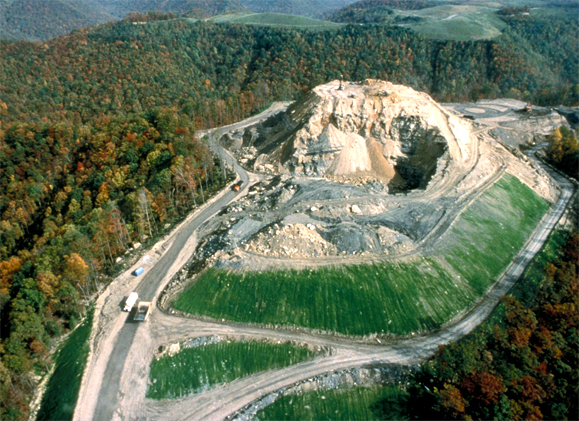
Of all mining practices in Appalachia mountaintop mining is the most environmentally destructive. Yet the coal industry continues to push to get permits to blow off the tops of mountains to expose seams for excavation. What mountaintop mining continues to do is destroy natural habitats and wildlife, change the course of mountain stream and the quality of water in them, pollute valley bottoms with tons of debris, and introduce chemical toxins into wells and drinking water sources. That is why the Environmental Protection Agency in the United States is trying to reverse a permit originally awarded to Mingo Logan in 2007, a subsidiary of the second largest coal producer in the U.S., Arch Coal. It is interesting when you visit the Arch Coal website and read the page on “How We Mine” you don’t see any examples of mountaintop mining practices. I guess it wouldn’t give them an environmentally responsible look. And when you read the company’s vision although they use the phrase “environmental stewardship” it takes on a whole new meaning when you see one of their mountaintop mines in operation or look at the level of selenium in local water supplies.
Space Update: India Joins the Space Race with an Ambitious Set of Missions
In 2008 India successfully launched its first unmanned lunar probe, Chandrayaan-1, placing a satellite in lunar orbit and hard landing a probe on the Moon’s surface. It received very little notice here in North America but it established India as a space faring nation. Today the Indian Space Research Organisation, or ISRO, is expanding its exploration of near-Earth and deep space with 58 space missions planned for the next decade and beyond. Missions include sending robot to land and explore the moon, an Indian-made global positioning satellite network called IRNSS, new satellites for communication, Earth observation and imaging, solar observation, studies of extra-solar objects, all to be launched with a new family of rockets capable of deeper space missions and heavier payloads. In 2013 India will launch its first mission to orbit Mars. And last but not least, India intends to join the U.S., Russia and China with its own human space flight program. “Baaharee duniaayaa” is Hindi for “outer space” and India intends to take a leadership role in the 21st century.

A Postscript
Once again I have to thank the many thousands who continue to visit Techso Mogro each month. Lots of you have become subscribers which is great. Keep on sending me your questions and comments. They inspire me to investigate and report back with even greater diligence. Let me know if there is a topic, not yet covered by Techso Mogro blog that you would like to see. If you have written an article that fits within the themes of this blog then let me know. Guest articles are welcome! And thank you again for continuing to drop by.
– Len Rosen
]]>


