No it’s not climate change.
No it’s not hackers shutting down the grid.
No it’s not declining freshwater resources.
No it’s not the anti-nuclear movement.
No it’s not the shutting down of coal-fired power plants.
Nor is it increasing energy demand.
Instead it’s the rapid expansion of residential rooftop solar panels.
Huh????
Yes, folks….that is the existential threat as described by David K. Owens, Executive Vice President, Business Operations, at the Edison Electric Institute. In a 164-page document that is both a call to arms and an instruction manual for disrupting the move to solar by homeowners, Owens argues that distributed power generation, that is power produced by individual customers, will push utilities into obsolescence unless they fight back.
From Owens’ perspective the rise in local distributed power generation is an unanticipated paradigm shift. The utilities that currently face the shuttering of their coal-fired power plants within the next two decades must now look at how they cope with energy being produced by their customers rather than energy they send to them. This means a rebuild of the grid to make it bi-directional. That is just one of many cost factors that are making rooftop solar a disruptive game changer.
Hence the dire warnings of Owens. For the industry local power generation by customers means less revenue for the utility. It means energy companies have to buy the excess power produced from residential solar installations at regulated rates. It means having to raise the cost of energy they produce to offset the lost revenue further driving customers to consider solar to offset the increases. This is a death spiral for the power companies and hence they are enlisting governments and agencies to allow them to impose surcharges. The rationale is simple. Pay us to keep the grid up-to-date or else. Through a surcharge collected from residential solar power generators, the utility can offset their losses from net metering, the current billing mechanism that gives customers the means to receive credits when the excess energy they produce gets added to the grid.

Many utilities have been reluctant to hook up bidirectional metering when solar panels are installed on residential homes. Many have felt the force of government regulation enforcing the installation of the necessary bidirectional technology.
From the utility’s perspective they feel they are caught in a Catch-22. They must continue to produce power for all customers. They must continue to maintain the grid. They must buy what residential solar capacity produces in excess. And they must accept lower revenue from those who produce this energy.
But it’s not a Catch-22. The energy companies have had a virtual monopoly on local power generation for more than a century. The threat of climate change, first described in the 1950s, has done little to modify their behaviour and business practices. They continue to use greenhouse gas generating fossil fuels to produce power. They continue to receive protection on pricing that ensures their profits. Their investments in the grid have declined over the years and the consequences of their neglect is reflected in the toll on transmission lines and other essential infrastructure threatened by recent extreme weather events associated with climate change.
The Owens’ document provides an implicit warning. Either the energy companies recover the lost revenue from solar-power generating customers, or pass the costs of maintaining the grid to those customers who cannot afford to put panels on their roofs. In other words, make energy more expensive for those who are the poorest. After all the real challenge in Owens’ argument is “how do you grow earnings in this environment?” It’s not “how to modernize power generation in light of climate change and the move to distributed energy power generation where utilities are partners in a new energy paradigm?”
The call to action is to lobby and line the pockets of legislators and regulators to enlist their help in stopping the transition to residential solar.

The CRVT blueprint contains 5 built-in scenarios that can be adjusted to reflect specific energy company data. These 5 cover potential futures that include:
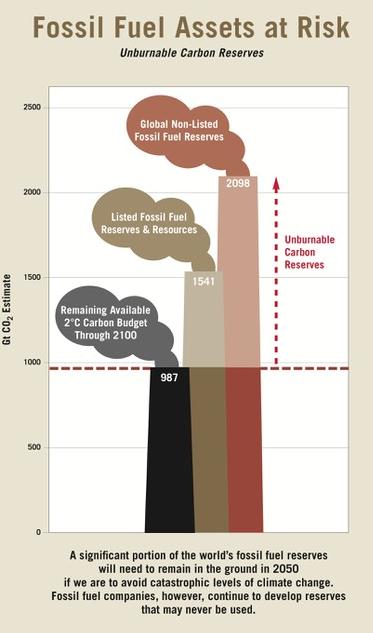
The CRVT defines unburnable carbon assets as “stranded.” These are assets that need to be devalued or converted to liabilities. The tool allows the investor to build an income and cash flow for a company and then apply discounted cash flows from the write down of stranded assets.
The above scenarios are based on governments heeding scientists about climate change and applying decarbonization policies. The assumption under such terms is that oil prices will fall as demand decreases. This would impact top-line revenue and bottom-line earnings. At the same time the costs of extraction will remain the same. At some point the cost of extraction would exceed the selling price leading to the end of production.
CRVT also looks at how energy companies expend their capital and determines when it becomes a waste of money because exploring for new finds no longer makes economic sense.
The CRVT also looks at how climate change regulation would impact the price of carbon emissions and how that would negatively impact corporate earnings.
And finally it looks at harder to reach carbon assets like the oil sands and how such carbon-intensive extraction technologies could further impact costs and net earnings after applying regulatory penalties.
The CRVT published study looks at the biggest market cap energy companies and then applies its various scenarios to them. These include:
Not surprisingly last-ditch decarbonization has the least impact on the energy companies while the $50 oil price per barrel beginning in 2020 yields to the worst results with shares declining by 58%.
The authors of the CRVT admit to some limitations in their model. For example they use average pricing for determining the cost of extraction which penalizes companies that may have multiple extractive processes in operation, some less expensive and some more. In such cases the company could stop producing at fields that were no longer cost viable. The model also doesn’t consider other avenues that an energy company might explore because of changing regulation around extracting and emitting carbon.

In the letter it states, “we would like to understand BP’s reserve exposure to the risks associated with current and probable future policies for reducing GHG emissions by 80% by 2050 to achieve the 2 degrees Celsius goal, and the risks to its operations as well as the economy as a whole of increasing extreme weather associated with the world’s current path to a warming of 3.6 degrees Celsius or more. We would also like to understand what options there are for BP to manage these risks by, for example, reducing the carbon intensity of its assets, divesting its most carbon-intensive assets, diversifying its business by investing in lower-carbon energy sources, or returning capital to shareholders.”
In addition the letter states, “Under a carbon-constrained scenario….40 to 60% of their market value could be lost because a portion of their proven reserves would become stranded assets.” It further questions the “creditworthiness of oil and gas companies, particularly those that have large exposure to high cost unconventional oil and production such as oil sands.”
The letter goes on to ask BP to review and disclose its risk assessment plans pointing out that BP’s “business-as-usual scenario such as that used in….current reporting” appears to be seriously flawed. The signators asked that this re-assessment evaluate “potential GHG emissions associated with the production of all unproduced reserves.”
This is an unprecedented request by investors who are asking not just BP but 44 other fossil fuel energy companies to come clean about their futures in light of the latest IPCC report on climate change. It’s no wonder that companies like Exxon fund disinformation campaigns like the one recently launched by the Heartland Institute in anticipation of the release of the IPCC interim report.
What these 70 investors are stating for the first time is that fossil fuel companies need to come clean about climate change and how they intend to address it. These investors are questioning the value of “unburnable” carbon reserves currently considered assets on fossil fuel company books. If these fossil fuel assets are unburnable then all the fossil fuel companies need to adjust their books to reflect real value, or they must diversify into non-carbon energy technologies or other businesses to retain the confidence of the shareholders these investors represent. But BP has been demonstrating the exact opposite strategy in some of their most recent moves.
For example, in 2011 BP divested itself of its solar business stating “the continuing global economic challenges have significantly impacted the solar industry, making it difficult to sustain long-term returns for the company.” In 2012 the company got out of the wind power business stating the move as “a continuing effort to become a more focused oil and gas company and re-position the company for sustainable growth into the future.” I wonder if the writers of the letter of September 9 saw these BP executive statements before composing their missive to the company and other fossil fuel giants?
]]>


