The mission to Saturn may be over in terms of the spacecraft itself, but the data continues to reveal incredible findings more than two years after Cassini’s demise. Cassini had observed plumes of water shooting out into space from Enceladus on flybys. On one the spacecraft flew right through the plumes, sampling their contents.
What did they find?
Organic compounds were being shot into space originating from deep inside the moon. The compounds contained organic molecules composed partially of nitrogen and oxygen dissolved in the water plumes. The discovery is documented in the November 2019 issue of the journal of the Royal Astronomical Society, Monthly Notices.
In the article, it states “Enceladus is erupting a plume of gas and ice grains…linked directly to the moon’s subsurface global ocean.” The ejected material is believed to come from the bottom of the ocean where hydrothermal vents are suspected to exist similar to the black smokers observed deep in Earth’s oceans. The compositional analysis using Cassini’s onboard Ion and Neutral Mass Spectrometer “indicate low-mass organic compounds” including dimethylamine, carbonyls. It further states these “compounds could be ideal precursors for mineral-catalyzed….hydrothermal synthesis of biologically relevant organic compounds in the warm depths of Enceladus’ ocean.”
The idea that such a small icy moon in the outer Solar System could be geologically active was the first startling discovery Cassini made when it flew by Enceladus. But now we have evidence that it could be an inhabited world which makes what is being discovered at Enceladus even more exciting.
Enceladus is sixth in the size hierarchy of Saturn’s moons. About 500 kilometers (310 miles) in diameter, its surface is covered by what appears to be fresh ice interspersed by cracks. It is so white in appearance that it is one of the most highly reflective celestial bodies in the Solar System. With peak surface temperature of −198 Celsius (-324 Fahrenheit), it is hard to imagine anything could be alive on or below its surface. But as Cassini unraveled its secrets, through repeated flybys, evidence of a subsurface ocean became abundant. Then came the visual evidence of water plumes erupting from cracks in the surface near the south pole where an ocean of water 10 kilometers (6 miles) deep was discovered. The plumes erupting from this ocean of water were warmer than Enceladus’ surface suggesting a geothermal energy source.
What that source turned out to be explains why Enceladus isn’t cold and dead. Tidal forces are pushing and pulling on the moon as it circles Saturn. These forces are further amplified by Enceladus’ neighbour, the moon Dione, in orbit close enough to exert an additional tidal pull on the moon’s surface. That’s why Enceladus is not just geologically active, but potentially biologically active as well.
States Nozair Khawaja, leader of the research team which published the article, “If the conditions are right, these molecules coming from the deep ocean of Enceladus could be on the same reaction pathway as we see here on Earth. We don’t yet know if amino acids are needed for life beyond Earth, but finding the molecules that form amino acids is an important piece of the puzzle.”

Arthur C. Clarke had speculated in his science fiction novels and short stories that we would discover life on a Jovian or Saturnian moon. And now the science has caught up with the fiction. Enceladus and Europa are considered the top targets for planetary exploration in the next two decades. Both feature an icy crust and a liquid ocean beneath. Both experience the tidal tugs of their host planets which generate the heat that keeps that water from freezing solid in the outer reaches of the Solar System. And with Pluto and Ceres we may find similar environments energized by their own internal heat, not by tidal forces.
The question is, with the presence of water on both, where life first emerged on Earth, can there be some form of life on these two moons and possibly on the two dwarf planets? We’re not talking about oxygen breathing life, but rather the type of life found at the bottom of our oceans today where deep sea vents pour out mineral-rich hot water that serves to be the elixir for a complex of life. This is life that feeds off methane, sulfur, phosphorus and other elements found in the hot water stream.
How do we know that something is going on in these ocean worlds?
Yesterday when NASA began describing its latest findings it focused on Enceladus and Europa, sharing what Cassini has learned about the former and the Hubble Space Telescope and the now-defunct Galileo Jovian orbiter about Europa. The information session didn’t touch on Ceres or Pluto, but it could have.
The evidence presented focused on observed plumes coming from both moon’s surfaces. Enceladus is a small moon. No one expected it to be dynamic before Cassini arrived in the Saturnian system. It was thought to be frozen solid, that is, until Cassini flew by, not once but several times, building a complex picture and data that unmistakably points to an active small world. Cassini’s cameras photographed plumes of vapour rising from Enceladus southern polar region. The onboard Ion and Neutral Mass Spectrometer sampled the plumes and found 98% water vapour, 1% hydrogen and the remainder a mix of carbon dioxide, methane and ammonia. The hydrogen was the big surprise because the element is so light scientists would expect there to be nothing emanating from the moon at this stage of its geological history. All should long ago have escaped into space. But the hydrogen could only exist mixed in with the water if there was something chemically active going on beneath the icy crust. On Earth, we observe hydrogen in the effluent coming from deep sea vents referred to as hydrothermals. These vents may have been where life first appeared on Earth before there was much in the way of free oxygen in our atmosphere. And hydrogen gets produced by a chemical reaction known as methanogenesis. And when found with methane, as has been discovered on Enceladus, it could mean the presence of amino acids. And where amino acids are found so is DNA here. So why not there?

The observations of Europa are similar but less definitive largely because we have no spacecraft in proximity to do intense science like we have in the neighbourhood of Saturn. Europa has a liquid ocean below its icy crust and there are hot spots in the crust mapped by Galileo, that align perfectly with Hubble Space Telescope observations showing plumes rising from the moon’s surface. Scientists, knowing what they have learned from Enceladus, are now comfortably convinced that Europa is likely generating water vapour, hydrogen, and traces of other gasses akin to the Saturnian moon. They want to take a closer look and have planned a mission they call the Europa Clipper to study the phenomenon up close. The mission also includes a lander to do a search for life traces on the icy surface.

So what about Ceres and Pluto?
The Dawn spacecraft which has been studying Ceres, the largest member of the Asteroid Belt, has observed the presence of water and organic compounds on the dwarf planet. The onboard Visible and InfraRed Mapping Spectrometer investigated one of Ceres’ craters and found methyl and methylene compounds similar to hydrocarbons found here on Earth. The existence of what has been described as a large reservoir of water ice, ammonia, salts and organics has fundamentally altered scientists’ views about the dwarf planet. The potential of a water ocean beneath the crust is now deemed highly likely.

And New Horizons’ visit to Pluto produced its own surprises. In observing the heart-shaped surface feature, the Tombaugh Regio and its alignment in tidal lock with the dwarf planet’s largest moon, Charon, scientists have become convinced that there is likely a viscous icy ocean of water underneath the dwarf planet’s surface and that Charon may have also harboured a subterannean ocean in the past. It is believed that Pluto may still be geologically active, not to the extent of Earth, but enough to allow for water to flow freely under its icy crust And where there is water, NASA scientists believe there is the opportunity for life to emerge.

These four candidates for alien life were never considered in the past. Today NASA knows that our Solar System has water showing up in lots of places. And not just water, but chemical compounds that point to some interesting additional places to look for life. Ganymede and Callisto, two other Jovian moons, Titan, Saturn’s largest moon joins Enceladus and Mimas as ice worlds. And Triton, Neptune’s largest moon, has observed active geysers also suggesting a subsurface ocean world. And note that we haven’t mentioned ice found at the poles of our own Moon, subsurface ice and polar ice caps on Mars, or water vapour in the swirling clouds of Jupiter. Nor have we talked about discoveries of water on exoplanets, a whole other topic to explore.

When Juno arrived at Jupiter in the last week we were told that the mission to the Solar System’s largest planet was designed to avoid crashing into Europa because scientists didn’t want to contaminate that moon potentially introducing Earth microorganisms into an alien ecology. NASA hopes in a future mission to Europa to uncover the mysteries of its subsurface ocean and hopefully identify alien life there.
Evidence for life on Mars remains a question mark. Tangential evidence from the early Viking biochemistry experiments, the discovery of water ice by the Phoenix lander, evidence of water both in the past and present detected by orbiters and the two working rovers, Opportunity and Curiosity, and occasional whiffs of methane point to a likely biological source. But we won’t know for certain until we send further robotic landers and eventually human crews to the planet’s surface.
Most intriguing are two recent reports gleaned from the Cassini spacecraft continuing to study Saturn and its mini-solar system of moons. Cassini discoveries have included a subsurface water source under the icy crust of Enceladus. Cassini has flown through the icy particles ejected from the moon’s surface spewing water into space. The existence of a subsurface ocean similar to Europa is highly likely on Enceladus. And where there is water here on Earth we have life. So why not elsewhere in the solar system?
On the issue of how life could exist on Enceladus, Chris McKay, planetary scientist at NASA, states “You’re not just searching for life, you’re searching for an understanding of the nature of that life, and how it compares to life on Earth.” For example if we find life on Enceladus and it resembles Earth life then we may surmise that life originated in the Universe elsewhere and has spread to lots of places. But if the life we may find on Enceladus differs biochemically from Earth then we are looking at separate and independent life origins which has entirely different implications.
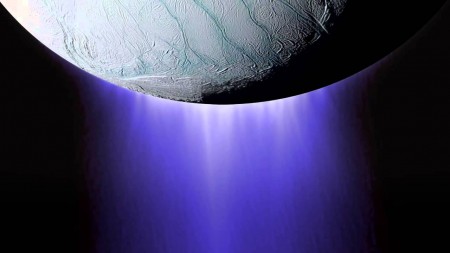
Today we know that Enceladus has more than 90 geysers (see image above) spewing salty water containing organic compounds into space. A mission to the moon doesn’t need to land there to discover if life exists. It just needs to fly through the geyser plumes and sample what it finds. The theory is that the geysers may produce bubbles of organic material including exotic biology that concentrate on the surface and get ejected when the subsurface water erupts. Any probe sent to Enceladus would have to include a biological laboratory capable of discerning proteins, amino acids and lipids in water samples. In finding this kind of evidence it would be definitive proof that Enceladus supports living organisms. Most scientists believe it would much harder to find the actual organisms themselves although some hope to devise technology that will capture images of Enceladus’ microbes.
Even more exotic would be the discovery of life on Titan, Saturn’s largest moon. Ever since Cassini and the Huygens lander gave us images of the landscape and lakes of Titan scientists have been speculating on whether a very different type of life could exist there in the extreme cold. A new study has focused on the presence of hydrogen cyanide (HCN) molecules in Titan’s atmosphere as evidence of life formed from polymers.
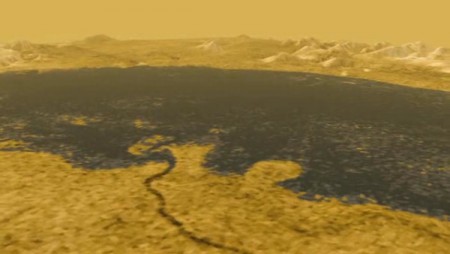
One of those polymers, polyimine is capable of creating complex molecules in the presence of light in a low temperature environment. Now consider that Titan’s surface is covered by lakes, rivers and substantial seas of methane (see image below) and you have an exotic chemistry for a different type of life, not water based as here on Earth, and capable of thriving at -180 Celsius (-292 Fahrenheit) degrees.
A probe landing on Titan would carry on board a chemistry lab that would be seeking evidence of a very different type of biology. And should it discover the building blocks of that life it will tell us that the Universe is far richer and more diverse in life than we ever imagined.
]]>
For whatever the reason the voyage of the joint mission of Cassini and its companion Titan probe, Huygens, continues to amaze us with imagery and telemetry on the Saturnian system. NASA, the European Space Agency and the Italian Space Agency developed the technology that was launched in October of 1997. Seven years later the spacecraft arrived at Saturn entering into orbit around the planet. In 2005 the Huygens probe landed on Titan’s surface. Huygens transmitted images and data from the surface for a short period before falling silent. In its descent and landing we gained a great deal of knowledge about Titan.
Today Cassini continues to operate its cameras, spectrometers, magnetometers and analyzers as it swings around the planet visiting the moons and giving us spectacular images of the entire system including Saturn’s amazing rings.
The Challenge of Getting to Saturn
The technique deployed by Cassini to get to Saturn involved gravity assisted acceleration. In the diagram below you can see the indirect route taken. It involved a Venus flyby in 1998 and then Venus, a second time, followed by Earth in 1999. Next was a close encounter with Jupiter in 2000 and from there it travelled to Saturn arriving in 2004. Each planetary flyby provided a gravity assist to Cassini gaining speed with each pass. Total flight distance equalled 3.5 billion kilometers. This method allowed Cassini to save fuel and made it possible to keep its launch weight under six metric tons. Without gravity assist the spacecraft would have required a much larger compliment of fuel.

Designing a Spacecraft for Long Distance Communication and Survival
Cassini had to be designed to operate with a high degree of autonomy. On average it takes one hour and 24 minutes for a transmission from Earth to reach it. That means a 3-hour round trip between Earth and Saturn. The images Cassini transmits back to Earth give scientists a visual means of understanding the orientation of the spacecraft and its location within the Saturnian system. Instructions are then sent from Earth to orient the spacecraft’s instruments for whatever the planned objective whether a moon, the rings or the planet itself.
With the Cassini mission planned to continue for another five years until 2017, power and fuel consumption are paramount concerns. Cassini relies on three plutonium fuelled RTGs for power and heat in the extreme cold near Saturn. As the plutonium decays Cassini slowly loses power. But it has sufficient capacity to keeps its instrumentation in operation for the foreseeable future.
Propellants are another matter. Cassini is fuelled with two types of propellants, a mono-propellant and a bi-propellant. The mono-propellant, hydrazine, is used to do small maneuvers such as positioning and alignment. The bi-propellant, a mono-methyl hydrazine with nitrogen tetroxide has been used for course correction and other large maneuvers. When Cassini started out it had 132 kilograms of hydrazine, 1,131 kilograms of mono-methyl hydrazine and 1,869 kilograms of nitrogen tetroxide on board. Much of the fuel was spent getting to Saturn and for orbital insertion. The remainder is seldom used and as a result the spacecraft even with less than 10% of its original bi-propellant remaining can continue to fly.
What We Have Learned So Far About Saturn and its Moons
How do you sum up what we have learned from Cassini? The science and discoveries have been incredible. Here are some highlights:
With Cassini, we are not done yet but once the mission is over expect a return to Saturn’s neighbourhood with missions that will land and explore Titan and Enceladus.
