Milton Keynes is one of the U.K’s New Towns, a planned community, inaugurated in the late 1960s. Located northwest of London off the M1, it is most famous as the location of Bletchley Park, where British mathematicians unscrambled Nazi Germany’s coded messages in World War Two.
But now the city is about to introduce its first batch of 20 podcars in 2015 which will initially operate on a designated right-of-way between the city’s railway station and its centre. If all goes well the program will expand to 100 podcars by 2017 and eventually will begin to operate on regular city streets.
Designed for two passengers, the Milton Keynes podcars will be restricted to speeds of 20 kilometers (12 miles) per hour. Passengers will be able to relax and sit back, checking email, reading their newspapers and generally enjoying the freedom of not having to watch the road.
Where are podcars running today? At Heathrow Airport’s Terminal 5 to the west of London where driverless podcars have been operating since May 2011. At Heathrow the vehicle is the Ultra Global PRT, (see image below on the right) 4-passenger, battery-powered and operating on its own right-of-way. The Ultra Global can also be found on location in Amritsar, India.
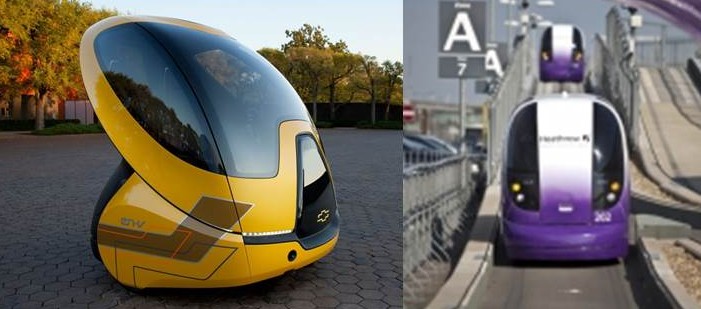
]]>
Name technologies that have been instrumental sources of innovation throughout the 20th and 21st century? I’m betting that you’ll immediately think about space, computing, and telecommunications. You probably won’t say the automobile. But the automobile has been and continues to be a technology innovator.
Automobile Technology as Inspired Innovator
The invention of the automobile has introduced innovation in many ways. Here are just some:
1. Mass Production
When Ford Motor Company started out in 1903 it took 3 workers a full day to assemble 3 automobiles. In a previous blog we talked about the innovations Ford brought to mass production. By 1913 Ford was building thousands of vehicles each week using an automated manufacturing process that made it possible to assemble each vehicle in a mere 93 minutes. The mass production technology used standardized parts, a moving belt upon which vehicles came to workers specifically trained to add a single part to the assembly, and readily available parts manufactured in close proximity. By 1927 mass production was churning out 15 million vehicles at Ford every year.
Ford was responding to the demand for the automobile. Keeping up with this demand forced innovation.
2. Motors
Motors and automobiles go hand-in-hand. The internal combustion engine (ICE) is a product of the automobile age. In a recent blog we talked about the history and future of ICE, a technology that has been with us for well over a century.
New motive technologies owe their origins to early 20th century experiments with automobiles. The electric car, hybrid technology, energy recovery from braking , and experimentation with alternate fuels all owe their development to engineers and scientists seeking answers to questions posed by the automotive industry. Hydrogen fuel cell technology may have been pioneered for space travel but practical commercial potential has been driven by the automobile. Toyota, Japan’s largest car maker and the leader in hybrid systems plans to sell hydrogen-powered vehicles in major markets by 2013.
Battery and super capacitor evolution owes much to the inspirationally driven ideas of automobile engineers seeking new ways of generating motive power.
3. Materials Science
The automotive industry in its search to conserve energy without impeding performance has had a revolutionary impact on engineering materials. In a recent blog we talk about the evolution of metals, plastics, polymers and ceramics, all driven by scientists seeking ways to make automobiles lighter and safer.
4. Industrial Robotics
Manufacturing of automobiles inspired robotics. We have discussed the development of robotics for automotive assembly in a previous blog. Robots are ubiquitous to manufacturing with 90% of robots currently in use for that purpose. More than half of the world’s robots today are dedicated to automobile production. The automotive industry plays a significant part in driving innovation in industrial robotics as a result. Today more automobile assembly processes are managed by robots than by humans.
5. Electronics
The automobile has inspired a world of consumer innovation in the field of electronics. Today’s automobiles are largely governed by electronic control systems. Name a function, the engine, the brakes, the radio, the air conditioning system, all contain electronic components. A quick survey of automobile manufacturers current models describe:
6. Artificial Intelligence
Self-parking and auto-braking are two recent innovations in the industry. As sophisticated as these enhanced technologies appear to be, they represent just the beginning of a very new type of automotive experience. In the two primitive cars that are attached to my family, both offer cruise control and antilock brakes. Both offer traction and stability control to detect changes in driving behaviour and road conditions. Both have air bags that automatically inflate on collision. They don’t have features for instance that detect rain and automatically turn on the windshield wipers. They do alert me when I’m running low on gas and tell me my rate of gas consumption. One of them, the 2-year old, rates my gas consumption driving performance, tells me the outside temperature, and can even estimate time to destination based on my driving speed. The other, which is 5 years old is less sophisticated. I can track trip mileage and play with the 6-CD system with surround sound, automated electronic door openers and a few other gadgets. But for the most part these are dumb cars.
There is a next generation of vehicles that is showing just how far artificial intelligence can be built into the current automotive experience. I recently visited the Mercedes-Benz website to read about the S550 Luxury Sedan.

The options are truly amazing, reading like a good science fiction novel. They include:
Modern automobiles, even my 2 and 5-year old, are computer controlled. For example the Chevy Volt runs on 10 million lines of software code. Compare that to the Boeing 787 Dreamliner with 7 million or Lockheed Martin’s F-35 Joint Strike Fighter with a mere 6 million.
Software and electronic sensors combine to replace most of the anlaog and many of the mechanical systems that have been automobile features for close to a century. By-wire technology is used in braking and steering leading to the kinds of innovation described in the options on the S550.
To be fair to the theme of this article that the automobile is a major technology innovator, by-wire technology owes its origins to the avionics industry and an airplane that flew in 1958 but never made it into mass production, the Avro Arrow.

Urban congestion is a driving force behind yet another application of artificial intelligence as applied to automobiles. If you have experienced driving a Segway, then you can truly appreciate that sophistication can come in very small packages. The EN-V, standing for “Environmental Vehicle” is a joint venture between Segway and General Motors.
The EN-V is electric with a single charge drive range of about 40 kilometers. It looks like a space-age pod. It is designed as a 2-passenger urban vehicle, about one-third the size of a small car. Like the Segway it is easy and intuitive to operate.

EN-Vs can exhibit flocking behaviour, that is they can cooperate collectively when in traffic to literally join up and run in swarms. They can do this because they use Global Positioning System (GPS), vehicle-to-vehicle communications and distance-sensing technologies along with many of the safety technology options that we described when we looked at the Mercedes-Benz S550. Swarming behaviour means less traffic congestion. Autonomy means the EN-V can find the best way between the start of a trip and the end destination using its real-time traffic monitoring communication.
The EN-V is just one of many innovative concepts deploying vehicle-to-vehicle and vehicle-to-infrastructure communication. The result should be a reduction in automobile accidents, fewer deaths from fatal crashes, reduced congestion, a lower carbon footprint, cleaner air and a far more pleasant transportation experience.
]]>