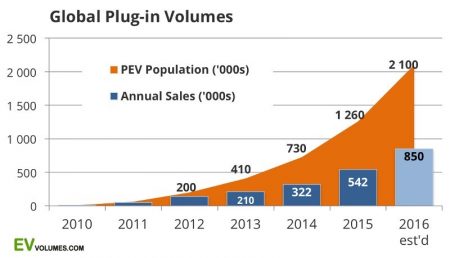
To prove the point this week the United States designated 48 national electric vehicle charging corridors covering over 40,000 kilometers (25,000 miles) of highways in 35 states and ensuring that a charge station will be available within every 80 kilometers (50 miles). Other supporting actions from U.S. states, Department of Energy (DOE), businesses, universities and utilities include:
The end goal is the build out of an zero-emission coast-to-coast infrastructure.
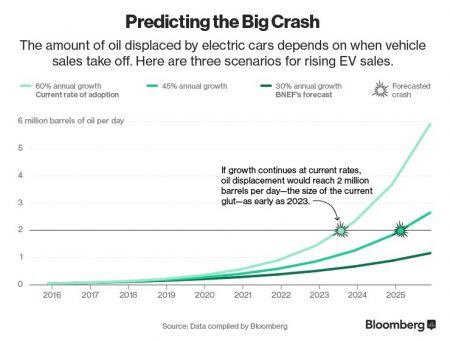
For investors Bloomberg New Energy Finance points to the recent growth rate of EVs displacing as much as 2 million barrels of oil per day demand as early as 2023. The current compound annual growth rate is expected to slow but the offset drop in EV prices as more models enter the marketplace will create an oil shock, not once, but many times, as more EVs appear on roads. The Bloomberg study which produced the line graphs with a number of scenarios showing the points in time where oil shocks will occur concludes, “someone will be left holding the barrel.” It goes on to say the smart money generally moves sooner than later and that moving away from oil-based stocks is inevitable.
So what are the fossil fuel companies doing about a technological power revolution that is rapidly approaching?
Just four years ago executives and BP and ExxonMobil were predicting that EVs would make up no more than 5% of vehicles on the road between 2030 and 2040. In its 2040 energy outlook, ExxonMobil, that year confidently predicted no impact on the fossil fuel industry. But it appears that oil companies have changed their minds of late. It is no longer the case that EVs will be a minor segment of the market and that oil and natural gas will remain the dominant forms of energy on the planet. They are beginning to realize that electricity is the energy of the 21st century and that clean energy is critical to their long-term success and to the confidence held by shareholders about their business models.
So Shell has recently established a New Energies division with a $200 million initial budget, a modest start. But Total, France’s largest oil and gas company, has put over one billion Euros into a battery storage company. And Statoil in Norway has invested big money in German wind farms. While even ExxonMobil, as I posted yesterday, has hedged its bets by investing in carbonic fuel cell technology being deployed in thermal-energy power plants to sequester carbon.
The latter is the same company that allegedly buried the scientific evidence it discovered back in the 1970s for climate change caused by human industrial activity. In a recent statement the company acknowledged that “the risk of climate change is clear and the risk warrants action.” It goes to state “increasing carbon emissions in the atmosphere are having a warming effect. There is broad scientific and policy consensus that action must be taken to further quantify and asses the risks.” In its acknowledgement, ExxonMobil pledges to reduce emissions in its operations as well as help consumers reduce their emissions.
]]>
That is all about to change as EV manufacturers recognize that their future success and profitability requires an infrastructure that makes recharging as convenient as finding a gas station when your vehicle’s tank is near empty. In fact, for EVs it should be even simpler. They should be able to park and recharge. That means building EVs that can use standardized means to recharge whether hooked up by wire or through the use of wireless infrastructure.
Who is Building the Recharging Infrastructure of Today and Tomorrow?
We know that Tesla Motors has been investing in building a recharging infrastructure. Back in September 2012 I wrote about the unveiling of 6 recharging stations in California to service the Tesla Model S sedan. But Tesla’s recharging stations don’t work with Tesla’s first EV and are incompatible with any third-party EV. So Tesla’s foray into building infrastructure for EVs is proprietary. That’s not the kind of solution that will make EVs replace vehicles running on internal combustion engines (ICEs).
Another company that is building an EV infrastructure is ABB, the company mentioned in last week’s headlines because of its work in developing high-voltage DC circuit breakers. ABB, on its website offers four fast charge stations capable of recharging EVs that use the CHAdeMO standard charging interface. Instead of needing 6-10 hours ABB’s technology can recharge a compatible EV in 15-30 minutes. Today there are 1,881 CHAdeMO quick charge installations worldwide, the bulk of them in Japan. You can find a listing of all the companies building fast charge technology that meets the CHAdeMO standard here as well as a list of the EV vehicles that are compatible to use the standard. Probably the only one you know on this list is the Nissan Leaf. But an infrastructure of 1,881 stations doesn’t cut it if EVs are to displace ICE technology with its 121,446 gas stations in the United States alone based on current U.S. Census Bureau statistics.

The real answer to building an EV alternative to automobiles based on ICE involves the development of wireless recharging technology. Ideally this would be technology that would use an internationally accepted standard for transmission and would be made available to all EV manufacturers either through open source initiatives or through a shared-licensing arrangement. But, unfortunately, to date, nothing yet has emerged.
One company, however, Evatran has plans to bring its Plugless Power alternative to the market in 2013. Currently the company has after-market agreements with two manufacturers, General Motors, for the Chevrolet Volt and Nissan for the Leaf. A Plugless Power option is planned for future model versions of these automobiles. Plugless Power uses a combination of a parking pad device using inductive power transfer to an on board vehicle adapter. Inductive power is technology that has been around for a century (demonstrated by Tesla in 1891) and uses electromagnetic fields to transfer electricity between two coils, one in the pad, the other mounted in the automobile. The vehicle parks within proximity of the pad to begin receiving a charge automatically. Plugless Power, however, is no faster than home recharging systems using power cables. That means 6-10 hours to recharge your EV.

Imagining The EV Infrastructure of 2030
Wireless, fast and ubiquitous, that is the world of EV recharging stations. But we have a long way to go. We can imagine the Tesla recharging model expanding outside of California as more EVs appear on the road, but stations will have to be capable of quick recharge cycles for any EV vehicle that pulls up and parks.
But limiting the technology to service stations means delays for any EV owner as they wait the 30 minutes or so that it would take to get their vehicle recharged to at least 80%. Companies like NEC are planning smart charging technology placement that would be located almost anywhere including service centres. Recharging stations would be made available at metered parking facilities, transportation hubs like airport terminals, hotels, convenience and grocery stores as well as at company employee parking lots. NEC calls the technology the Smart Network Project. It envisions using high-output EV fast chargers based on CHAdeMO and capable of receiving an 80% charge in 30 minutes or less. NEC announced its firs field trials in 2010.

Qualcomm Halo Double “D” Quadrature (DDQ) wireless charging technology goes one step beyond NEC by delivering a charge using inductive power transfer, like Plugless Power, but distributing the technology over a grid to eliminate the need for EVs to use cables. There are no charging posts. The technology is buried and not affected by snow, rain or ice. Qualcomm Halo is engineered to deliver a range of power depending on the vehicle it is recharging. It can deliver a slow recharge or rapid charge depending on location.
Qualcomm Halo provides additional advantages. Current EVs are either plug-in hybrids, or have large, weighty and expensive battery packs on board to attain driving ranges that are considered reasonable. With Qualcomm Halo technology located almost anywhere, the need for large on board battery storage on EVs lessens. Anywhere an EV goes it can constantly be kept recharged. Ultimately, Qualcomm sees its charging infrastructure embedded in roads and highways making it possible for any EV to drive continuously for hundreds of kilometers constantly maintaining the same level of charge. This is the world unfolding for EV technology and a future we will see first in cities and then spreading throughout highways across countries, the promise of what 2030 will bring.

]]>