The post Headlines at Techso Mogro for December 21, 2012 appeared first on Techso Mogro.
]]>
Revolutionary Display Technology to Alter Gaming and Augmented Reality
The first 3D picture I saw was Avatar. I enjoyed it but I think I would have with or without 3D. Today’s 3D gives depth to two-dimensional images on the big screen and on television, but what if you could move your head and look at a projected object from the side or from below. Wouldn’t that be incredible?
That’s exactly what Infinite Z, a California company, has created with zSpace, a revolutionary, immersive, interactive 3D environment it describes as virtual holographic 3D. zSpace combines computer hardware and software to create this true 3D user experience where it it is impossible to differentiate between virtual objects and real ones just like the experience on the Holodeck in StarTrek.
Participants using zSpace technology wear very lightweight eye wear and manipulate a stylus to move and examine 3D objects. To get the zSpace display and software you pay $3,995 U.S. unless you are developer. Joining the developer’s program brings the cost down to $1,500.

Wastewater Disposal After Fracking Causing Earthquakes
Hydraulic fracturing or fracking is unlocking vast amounts of natural gas and oil tightly bonded with shale rock formations. Fracking has altered the energy balance on the planet opening up vast new reserves for an energy hungry world. But there are unforeseen consequences that are now being realized. One of them is earthquakes. Where fracking is happening so is a rising number of seismic events. That’s because fracking involves injecting water and chemicals into rock to get the gas and oil out. A typical operation can produce up to 3.8 million liters (one million gallons) of wastewater discharge in the first thirty days of operation. All that wastewater needs to be disposed of and the industry’s method of choice to date involves injecting it into the ground using deep wells.
At this year’s meeting in San Francisco of the American Geophysical Union, scientists reported a correlation between earthquakes dating back to 2001 with fracking wastewater injection. Quakes ranged from 3.0 to 5.7 on the Richter scale and were felt from New Mexico and Texas to the Dakotas to Ohio. This is not the first time human underground activity has been associated with earthquakes. Back in the 1960s the Army Corps of Engineers triggered an earthquake that caused damage to buildings and homes in Denver.
Are there alternatives for fracking wastewater disposal ? Osorb, a nanomaterial, recently discovered by researchers at Wooster College in Ohio, may prove to be a solution for treating wastewater from fracking. In trials so far it has shown that it can absorb oil and surfactants from the wastewater expanding up to eight times its original size. The Osorb can then be drained and reused.

Seeding the Ocean with Iron – Not a Carbon Sequestration Solution After All
Back in October I wrote about Russ George dumping 100 tons of iron sulphate off the British Columbia coast and the 10,000 square kilometer (3,861 square mile) algae bloom that his actions created. Why did Mr. George do it? As a way to manipulate climate through geo-engineering of the gases in the Earth’s atmosphere. There theory was that iron would encourage phytoplankton to bloom and all that algae would absorb CO2. When the plankton died it would sink to the bottom of the ocean and with it would go the trapped carbon.
Well a researcher at the University of Sydney in Australia worked out the cost benefit of iron dumping and it turns out to be more expensive than carbon capture and storage (CCS). Why? Because the cost of making the iron and delivering it is high and the carbon burned in the manufacture and transportation offsets the benefit that may be derived. In fact iron fertilization of the ocean may turn out to contribute more to greenhouse gases than what is sequestered.

A Microscale Actuator with Muscle
Actuators are motors that move or control devices or systems. Micro-scale actuators are nano size, smaller than a human hair but a thousand times more powerful than an equivalent human muscle or cell by weight. The Berkeley Lab at the University of California, are the inventors. Their micro-actuator is composed of vanadium dioxide and chromium and responds to a small electric charge or laser light which bends its tiny arms like little fingers. Fine motor control is possible making this a suitable technology for doing medical applications such as drug delivery.
The degree of flex displayed by the micro-actuator is much greater than anything current and as a result the Berkeley team believes the tiny motor will find its way into the development of artificial muscles and micro-robotics. A promising and immediate opportunity has been identified to use the micro-actuator for radiation-detection in hazardous environments.

3D Printing, Software and Medicine are Combining in Partnership to Build Replacement Parts
Organovo Holdings makes human tissue using its NovoGen MMX Bioprinter. Now with Autodesk, the software computer-aided design and drawing company best known for AutoCad, the two are combining forces to develop bio printing of three dimensional biological structures.
The premise is, if an organ and its infrastructure of capillaries, nerves and blood vessels can be plotted using CAD software tools, then using a 3D printer and stem cells as raw material, livers, kidneys, hearts, lungs and other body parts can be manufactured. The Bio/Nano/Programmable Matter Group at Autodesk wants to be able to create a design paradigm for programmable matter. Carlos Olguin, its head states, “Biological printing involves the self-assembly of things like stem cells. It’s a different design paradigm that could have a big effect on things like massive prototyping.”
The partnership expects results within the decade.

A Postscript
This is our second last weekly headline for 2012 and barring any catastrophic outcome based on the so called end of the world Mayan calendar myth I trust you will be back reading these postings while I continue to write them as 2013 unfolds. I thank all of you who visit and encourage you to let others know about this blog site. After all we are all collectively on a voyage to the future.
I wish you, my readers, the best of the Holiday Season.
– Len Rosen
The post Headlines at Techso Mogro for December 21, 2012 appeared first on Techso Mogro.
]]>The post Energy Update: Hydraulic Fracturing Science and Technology – What We Know and What We Don’t appeared first on Techso Mogro.
]]>
Fracking technology works as follows:
So what we know about fracking is the potential polluting effect of the process. Safeguards to address the hazardous chemicals that are byproducts of the process can be monitored and regulated.
But two consequences of fracking that are little understood keep on cropping up. They are:
Contaminated Drinking Water
When fracking releases oil and natural gas from bituminous sedimentary rocks it also releases other bounded chemicals. In the process of extraction, however, there are numerous complaints about toxic chemicals and methane entering local wells even though they are drawing water from much higher underground sources than those targeted by fracking. In the movie, Gasland, a documentary looking at hydraulic fracturing, the film shows dramatic images of tap water laced with methane that can be lit with a match. Although the fracking industry denies the claim there are numerous cited examples of drinking water contamination in areas where drilling has occurred.
The industry claims that any water pollution evidence comes from variability in fracking methodology around cementing the casing and lining of the well bores. In areas where the bituminous layers are well below the aquifer that water wells draw upon, and sedimentary limestone layers act as barriers to seepage, the industry claims that occurrences of chemicals in drinking water have nothing to do with fracking.
Earthquakes Linked to Fracking
In a 2011 report entitled, Are Seismicity Rate Changes in the Midcontinent Natural or Manmade?, a U.S. Geological Survey team writes that since 2001 there has been a six-fold increase in the average number of earthquakes occurring in the mid-continent. The rate of increase is unprecedented in recorded history and the authors believe the cause is primarily from the well-site injection of fluid used in hydraulic fracturing.
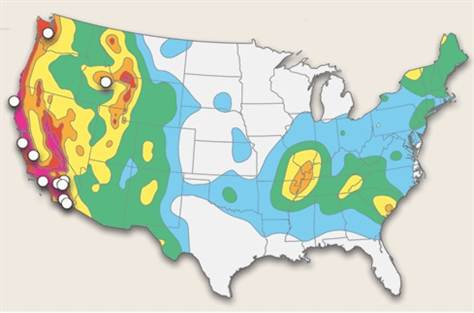
Recent earthquakes in Ohio have resulted in lawmakers temporarily banning fracking in the state. On New Year’s Eve of 2012 a 4.0-magnitude quake was attributed to a fracking process in which waste water collected during drilling was disposed of by injecting back underground for disposal. Previously thought to be a safe practice, geologists and seismologists now believe that this particular practice should be banned.
In November 2011, Oklahoma experienced a 5.6-magnitude earthquake damaging 14 homes. The quake was followed by a number of aftershocks. Oklahoma is normally seismically stable averaging about 50 small quakes annually. But since 2009 that number has suddenly spiked to 1,047. What has been the big change in Oklahoma? Experts point to hydraulic fracturing. Although experts believe the large quake may have nothing to do with fracking, the enormous increase in minor quakes is too coincident with drilling and injection well activity within the State. Oklahoma is home to 185,000 drilling wells and hundreds of injection wells. Waste water injection is considered the primary culprit in this state as well.
Is there a smoking gun to absolutely prove the causal link? Not yet, but there sure are a lot of bullet casings on and underground to suggest a correlation.
The post Energy Update: Hydraulic Fracturing Science and Technology – What We Know and What We Don’t appeared first on Techso Mogro.
]]>