Why?
Because in the face of the COVID-19 pandemic, schools across the globe were shutting down, and children and their parents were being asked to isolate themselves in their homes. One cannot imagine a better moment in time to expand the ability to learn online.
Since 2007 I have been interested in using the online world to help children learn.
And in my most recent volunteer work with the Liberal Party of Canada for the riding in which I reside, I head up a committee focused on policy with one of the proposals we are drafting focused on this subject. In the preamble of our policy resolution, it states “Canada and its people are vulnerable to potential environmental disruptions such as pandemics and extreme weather events that can negatively impact formal learning in bricks and mortar institutions.” It goes further to propose the development of a comprehensive online resource for free open education to allow learning from anywhere, everywhere.
In Demetrius’ posting, he addresses the need for accessibility to learning resources and the development of digital online educational assets. I will be interested in receiving comments from readers about this content and the accompanying infographic, and encourage you to add your ideas to this conversation.
With so many of you, my readers, in different states of lockdown and social isolation, a medium like Techso Mogro can be a great way to reach out to others over the Internet. More important, sharing information and education about COVID-19 that helps our children to understand what is going on through this traumatic time, will serve them well.
For all my readers and subscribers, practice social distancing, wash your hands, try not to touch your face and be well.
Here is Demetrius’ contribution.

Learning should be accessible to all, regardless of a student’s ability to attend school. That’s something we have been taking for granted, that is until COVID-19 changed everything. As of March 18, 2020, at the time of this writing, more than 862 million students were affected by the virus as 119 countries shuttered schools.
Although the concept of open education is still relatively new, it is right now the only thing bridging the educational gap. Online learning, also known as distance learning, however, presents some challenges. What are these?
During a state of quarantine, both of the children represented in these two statistics are, therefore, shut out from using open education or e-learning software.
What can be done?
In the United States where 30 million children rely on school lunches subsidized by government, the money currently not being used, could be repurposed to provide funding for inexpensive laptop computers and Internet access.
What’s good about e-learning?
What’s the e-learning feedback so far?
Students are loving the opportunity to learn from home with 60% reporting that online education is helping them improve soft skills like time management, critical thinking, and writing ability.
The COVID-19 pandemic wasn’t in the e-learning playbook when the market forecasted growth in the industry to reach $300 billion US by 2025. My guess is that number will be far higher because of the current global experience.
To learn more check out the accompanying infographic which outlines the future of open education and distance learning.
—

]]>
Schools today are not too dissimilar to schools back in the mid-19th century. There is a standard curriculum, required books, a teacher at the head of the class, and students sitting in rows at desks. There are new wrinkles. Students use computers. They do group projects and group problem-solving. But there are still exams and tests, and students still bring home report cards several times a year with grades and teacher comments. This is an industrial factory education model. We put students in and twelve or thirteen years later with minds expanded they come out the other end.
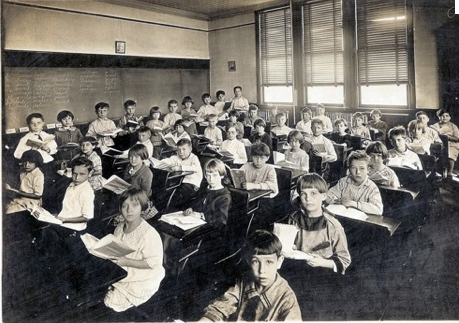
Meanwhile, knowledge is expanding explosively, harboured on computers and servers across the planet. Access to it comes from the Cloud. And applications like Google Search, Bing, Wolfram Alpha and others deliver information once only found in textbooks and encyclopedias and now appearing on our smartphones, tablets and computer screens.
To make sense of this information explosion it would seem young people need an entirely new set of skills. These include:
Where does rote learning fit in this set of skills? It doesn’t……Yes, I’m glad I memorized by multiplication tables back in Grade 3 and 4. They served me well. And I am glad I learned the “rule of 9” and how to do rounding. Now when I go grocery shopping I can figure out my bill within a dollar or two before I go to pay for it. But the invention of inexpensive digital calculators has made such skills anachronistic. There is no need to crowd those precious grey cells with multiplication tables anymore. You can save your grey matter to serve a higher purpose – questioning, hypothesizing, experimentation, discovery and innovation.
When I spoke today to a conference called “Jamaica 2030: A View of the Future Today,” I described what is in the cards for education over the next two decades.
I stated that technology is changing the teaching and learning paradigm forever, that it is disruptive to teachers, bricks and mortar schools, and traditional libraries and librarians.
I stated that life before “Google” is now being replaced by a continuous learning model with smartphones and connectivity making learning and collective wisdom accessible to all.
I talked about how digital literacy, the ability to use technology, is replacing academic literacy as a prime skill.
I remarked that game-based learning will move to the forefront as education becomes more self-directed and continuous for life.
What does this mean for the bricks-and-mortar school? In two or three decades my guess is these institutions will be far different than the ones you see today because virtual schools and online learning will be their replacements.
As for libraries, they too will become avenues to knowledge but not necessarily book repositories. I must admit I still use my local library to borrow physical books. The ones I usually get are history and science books. These are books I pour over and don’t necessarily read from page one to the end.
But my e-reader and tablet are filled with mystery, science fiction and light genre reading. And my library lets me borrow e-books. So at age 65 it would seem I have already become a digital citizen.
And what will come of college degrees? With learning ubiquitous (I occasionally audit free courses online offered by MIT and other universities, not for credit, but for the knowledge imparted) what new measures will we use to recognize achievement in learning?
When I was in high school there were a few teachers who inspired me to learn. When I got to university I found professors who occasionally kindled that same enthusiasm for discovery in me. So I believe there will always be the need for an inspiring teacher to provide the right stimuli to students. But education will more and more be something we take on individuallyfueled by access to a universal source of information all at our fingertips.
So no more pencils, no more books, no more teachers’ dirty looks…..welcome to the 21st century.


I grew up in a world of books. It is reflected in the thousands of books that line the shelves in my home to this day. And when I couldn’t get a teaching job upon graduating from university in 1973 I naturally gravitated to the publishing industry where I became, first a seller of textbooks and then eventually an editor who worked on new product acquisition and development. As an editor I learned to build what were called managed books, textbooks that reflected local curriculum demand. A managed book had a guaranteed audience because the content was written to the requirements of those instructors who would eventually recommend the text to students. It was a sure fire method for publishing success and I got pretty good at pushing out new product to schools across the country. It also taught me about shaping content to the learner.
I saw a change coming in publishing with printed words giving way to the digital age as the personal computer made its entry on the scene. And when I was asked to present my ideas on the future of textbook in publishing to to industry executives in 1980 I talked about the impact of the digital revolution on publishing. What I described as the industry’s future was knowledge databases with contributions by authors, each an expert in particular subject matter. I stated that instructors in the future would mine these databases and assemble the content they wanted for their students. Publishers would have to put a value on not whole textbooks but on chapters, or novel research and develop new royalty and accounting models to manage the new paradigm. Would publishers continue to print books? I thought not. Instead the assembled content picked by the instructor would be downloaded electronically and printed at local print shops associated with the university textbook store. Did I get the model right? No. I didn’t anticipate in 1980 what truly disruptive technology was about to impact the world, the dawn of the Internet, the development of Google Search, and the knowledge revolution created by the worldwide web.
The age of the textbook as I remember it is truly coming to an end. Educational publishers can feel the heat if they are not already out of business. That’s because educational publishers have never adapted to the way learning has changed because knowledge delivered is no longer the way young people learn.
So it was interesting for me in my online search this week to uncover Principles of Science, Textbooks for the 21st Century. Published by the journal Nature in association with Scientific American, the goal of this series is:
Provide research-oriented, interactive learning
The first “book” in the series is Principles of Biology, containing 196 customizable modules covering chemistry, cell biology, genetics, evolution, animal and plant physiology, ecology and biodiversity. Each module is designed to be self-contained with instructional text, self-tests, interactive exercises and of course formal testing. The text is electronic, accessible from the cloud, downloadable to a tablet or computer in digital version, compatible with Linux, Windows and Macintosh systems, and printable in full colour. It remains current and constantly changing as new research gets published. For teachers the textbook comes with 100 current research papers from journals, a test bank containing 1,000 questions, an instructor’s guide, and electronic slides containing all of the text’s artwork. The electronic edition is listed at $49 U.S. As one reviewer states that makes it not just affordable, but lightweight and it never goes out of date because it constantly gets enhanced and updated through its interactive web content. In a sense the textbook give students and instructors a license to lifetime learning on the subject matter.
Learning in the Age of the Internet Has Changed

Principles of Biology has taken the first step in understanding the nature of how learning has changed in the age of the Internet. A few years ago I read a paper entitled Textbook Publishing in the 21st Century: Changing the Higher Education System. Written in 2008, the authors state that for publishers to succeed in the 21st century they have to discard the old learning model their textbooks were designed to support – the lecture and test methodology, that is, learning delivered and regurgitated. They go on further to state that learning needs to be learner-centered and problem-based, and that the classroom becomes a place to apply basic knowledge to advance learning, no longer a place for instructors to stand and deliver.
Are the publishers of Principles of Biology alone in understanding the implications of learning in the age of Wikipedia and Google Search? In my recent research I found very few of the traditional publishers who have recognized the changed learning paradigm. I have taken note of one, McGraw-Hill, an old rival of mine when I was in the industry. They have launched the first all-digital, cloud-based textbook series for the elementary and high school market. Called the CINCH Project, this new learning model was released in 2011. It embraces all the methodologies described in the paper I referred to in the previous paragraph. Will McGraw carry this approach beyond high school publishing? Only time will tell.
For textbook publishers survival in the 21st century, let alone within the decade, will require much more than publishing electronic versions of their standard print books. Sites like CourseSmart today offer all kinds of e-textbooks. But these are largely designed to support the stand and deliver lecture and test learning model, a methodology that has little traction for today’s learners with their exposure to social media, unlimited web search and Wikipedia. Will these old-school, traditional publishers survive disruptive technological and methodological change? Not many I fear.
]]>