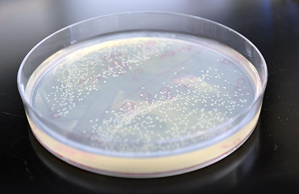
What purpose can a semi-synthetic organism serve? The researchers believe that creating a synthetic single-celled organism will help in the development of new cures for disease impacting natural organisms like us.
The original research dates back to 2014 when the Scripps modified E. coli to hold two additional base pairs, but at the time they couldn’t successfully get the natural bacteria to replicate the DNA code change indefinitely. The X and Y kept getting dropped when the E. coli replicated.
Professor Floyd Romesberg of the Scripps states, “Your genome isn’t just stable for a day….Your genome has to be stable for the scale of your lifetime. If the semisynthetic organism is going to really be an organism, it has to be able to stably maintain that information.” Getting a single-celled organism to retain artificial base pairs, therefore, presented a challenge. That meant experimenting with different enzymes that the organisms recognized as compatible. Then the researchers used CRISPR-Cas9, the genome-editing tool.
Using CRISPR-Cas9 They modified the bacteria to accept the X and Y base pairs as natural constituents of the genome, rejecting any occurrence where the X and Y didn’t occur. That meant any cells that replicated without the X and Y were seen as foreign and marked for destruction. That left only organisms with 6 base pairs, a new normal, which continued to replicate through 60 divisions without dropping the synthetic additions. States Romesberg, “That suggests that all of life processes can be subject to manipulation.”
The researchers now plan to study how they can manipulate the genetic code of RNA. RNA in cells receives instructions from DNA and executes them to maintain life.
Inevitably, by adding new base pairs to DNA, we may see applications that include biological computing. Why? Because new base pairs mean more information can be stored in DNA. So why stop at just 6?

In an article published yesterday in Nature Communications, a team of researchers at the Institute for Bioscience and Biotechnology Research, University of Maryland, describe “the utility of using biologically relevant redox molecules in translating electronic signals to changes in engineered bacterial gene expression.”
What does that mean?
That they can genetically induce bacteria to communicate using electronic controls to influence behaviour. This is biomolecular information transfer and is bringing the science fiction future close to a 21st century reality. Not only does it demonstrate the potential to create bio-neural gel packs that can be integrated with silicon or quantum computing devices, it also means we are discovering a way to communicate with the very cells within our bodies and developing tools to potentially manipulate them. The latter has significant implications for curing diseases.
Why redox molecules?
Also known as redox signaling molecules, they are manipulated by the mitochondria within our cells. When mitochondria are healthy and functioning properly redox molecules get produced. They come in two forms, one creates oxidation and the other reduction. The oxidation removes electrons. The reduction delivers electrons. Sounds like an electronic circuit in the making.
The research team at University of Maryland used E. coli to demonstrate the potential of this discovery. They submerged an electrode into a liquid containing E.coli. Applying a positive charge triggered redox molecules and oxidation. The genetic mechanism for the reaction was then isolated so that the researchers could then engineer the bacteria to automatically produce a consistent response to an electronic stimuli. When exposed to electrical input these re-engineered E. coli could be induced to swim or flouresce. The bacteria was also induced to create a signal molecule to transmit to neighbouring E. coli which then responded similarly to electronic inputs. This demonstrated the effectiveness of the process for inducing a group response.
With a little genetic rewiring this research demonstrates that bacteria can be used to both collect and deliver information. It can communicate with diseased and cancerous cells. The bacteria can deliver a message in the form of a drug or molecular kill switch. And maybe very soon E. coli and other bacteria can form those biological circuits science fiction has described.

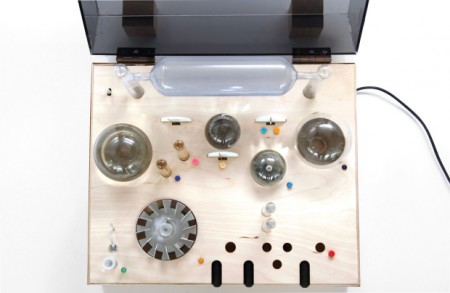
In a recent Indiegogo crowdfunding exercise, the inventors of Amino raised over $30,000 US, 229% above their target request. Described as a counter-top sized bio-lab, the kit comes with projects to grow living cells, create fragrances, flavors, new medicines and more. It is, in effect, the equivalent of a professional biological laboratory made simple. It describes itself as “a small and simple-to-use hardware system that enables anyone to grow and take care of living cells….the world’s first publicly available bioengineering platform that can be used at home, in labs or in schools.”
The creators description likens DNA to software and living cells to mini DNA factories with Amino providing the means for cells to be cultured outside their normal environments using the medium and tools within the kit. You get a bacterial culture, pipettes, incubator, agar plates and sensors built into a color-coded dashboard. Amino is genetic engineering and synthetic biology “accessible to everyone.”
The first Amino One kits come in two flavors. Amino Glow and Amino Explorer. Amino Glow turns E. coli into a living night light. Amino Explorer allows users to work with DNA to optimize violacein production, an anti-cancer, anti-parasitic research compound. Both kits come with automated cleaning systems so your cultures can’t accidentally get loose in your home or school.
Future planned Amino Apps will be priced between $150 and $400 depending on the DNA program and components. Food refills are also available to keep your cell cultures growing and in the case of E. coli, glowing.
Xylem is the porous tissue that conducts fluids throughout plants. You see it when you peel back bark on a healthy tree, that somewhat spongy wood that lies just inside the bark. It is called sapwood because when deciduous trees emerge from hibernation each winter, the sap travels from the roots to the budding leaves by this route. And although conifers don’t lose their needles during the winter, much of the sap within them is channeled to the roots for storage.
In an experiment the scientists at MIT chose xylem from white pine trees to create an effective water filter.They took sapwood from trees and stuffed it into a tube. They sealed all gaps with epoxy. Then they added water and pressure equivalent to that which trees experience from gravity. The fluid filtered through the 1 centimeter square filter at a flow rate of approximately 4 liters per day, enough drinking water to sustain one person. The water that came through filtered out particles and bacteria including E-coli.
When they examined the filters they found out that a 3 millimeter length was all that was needed to effectively remove suspended particles of a size 100 nanometers or greater. So viruses can get through but when you consider the worst waterborne infectious diseases are largely of bacterial origin, this easy to manufacture filter that is cheap to produce and biodegradable, could clean up 99% of the contaminants in water that make us sick. This includes salmonella, cholera, giardia and E-coli.

A team at UCLA led by James Liao, a professor of chemical engineering, and Igor Bogorad, a graduate student in the biomolecular engineering department, went about to see if they could increase the efficiency of glycolysis. They genetically engineered an E. coli bacteria to maximize the sugar conversion process beating what occurs in nature by 50%.
Bogorad states, “We rerouted the most central metabolic pathway and found a way to increase the production of acetyl-CoA.” If you don’t know acetyl-CoA it is also known as activated acetate. It’s a molecule that is a key to metabolism in living things and is composed of two carbon atoms. In humans acetyl-CoA is oxidized in our mitochondria, the little engine within the our cells. Our bodies then convert the acetyl-CoA to adenosine triphosphate (ATP) which pretty much powers up every part of us. So this is pretty essential stuff.
Natural glycolysis involves 6 carbon atoms of glucose and loses 2 of those during the conversion. But what Liao, Bogorad and their team discovered was a way to not lose those 2, demonstrating complete carbon conversion. And that means much higher yields of biofuel. States Bogorad, “We envision….wide reaching applications and…many new possibilities because of the way we conserve carbon.”
The discovery can work with many different sugars to produce 100% conversion to acetyl-CoA, and that means much greater yields of cellulosic ethanol. It also means biorefineries no longer have to use large amounts of natural gas to extract the hydrogen used in current biofuel production. Nor will they be a source of CO2 emissions, a byproduct of current production processes.
The discovery also means a wider range of biomass can be used to create ethanol. So rather than corn and sugarcane, biofuel producers can source non-food crops such as switchgrass, corn stover, and forestry waste materials for biorefineries. This means less food land tied up for biofuel production.
In 2007 the world produced 54 billion liters of biofuel. Biofuel production was credited with driving up grain and soybean prices globally. So improved efficiencies cannot come too soon. What’s left to do? The UCLA team needs to scale up its discovery from a petri dish to full production and minimize the conflict within agriculture on whether to grow crops for food or fuel.