JT Vaughn, the manager of Industrial Heat stated when asked about the acquisition, “The world needs a new, clean and efficient energy source. Such a technology would raise the standard of living in developing countries and reduce the environmental impact of producing energy.”
Vaughn cited two multi-day tests by European scientists as evidence that Rossi’s E-Cat device actually works. In two tests, one in December 2012 and another in March 2013 independent researchers investigated E-Cat technology at Rossi’s own lab (see image of the testing below). The investigators charged reactor tubes with hydrogen, nickel powder and some other additives. The E-Cat required 360 Watts of power input per hour. Energy output was measured by calculating the thermal output which was determined to be equivalent to 2,034 Watts in the December test and even higher in the subsequent test in March. For December the power output to input ratio was 5.65:1.
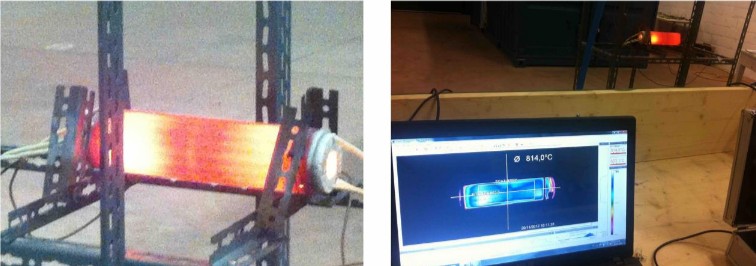
The authors of the study have concluded that E-Cat energy output is a “magnitude greater than conventional energy sources.” So that led me to ask what are conventional energy source ratios or EROIs?
Data from different sources has given me a range of figures which I am sharing here with you:
Based on this data I question the statement made by the E-Cat testers.
Nevertheless Vaughn’s company intends to support the cold fusion technology and has started preparing patent applications for submission, something that Rossi was unsuccessful at doing in the past.
Vaughn is the founder of Cherokee McDonough Challenge, an environmental start up incubator working out of the Research Triangle Park area. And Industrial Heat has found private equity investors focused on environmental plays who see a future for E-Cat.
As I have often stated about cold fusion technology – there continues to be more talk than substance. I will be most interested to see if Industrial Heat can successfully commercialize Rossi’s invention and prove that my many doubts were unfounded. Apparently Chinese officials have expressed interest in E-Cat but have yet to make an investment. I guess like me they are waiting for further proof.
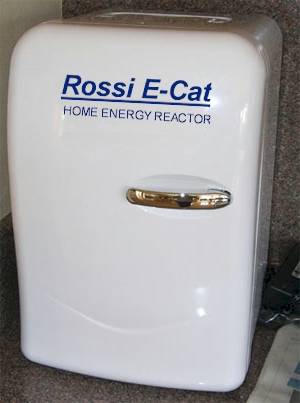
The E-Cat he is delivering combines 106 small LENR units similar to ones that Rossi has demonstrated in the past. The 106 are contained in a 6 meter (20 foot) long container (see image below) and are hooked together in parallel. Each E-Cat features three cold fusion reactors measuring 20 x 20 x 1 centimeter (approximately 8 square inches and less than 0.5 inch in height). The reactors combine treated nickel powder and pressurized hydrogen gas and after receiving a jolt of electricity begin to generate the heat that has been called cold fusion.
The 106 LENRs contained in this E-Cat require a feed of 200 kilowatts of power at start up and continuously to sustain the cold fusion reaction. The claimed energy yield at 1 megawatt is 500% over the energy input. Of course what the plant is actually generating anomalous heat, not electricity. It is that heat that becomes the energy source to drive a steam turbine connected to a generator.
If you order online today expect delivery in approximately 4 months.
I don’t want to throw cold water on this but with plans to ship in four months isn’t it about time that Rossi made his E-Cat unit available for independent review? That’s one of many reasons that I remain a skeptic. RAnd I am still waiting to hear from the Australian company that was going to make a 10 kilowatt home version of the E-Cat available to its customers over a year ago.
The ExtremeTech site asks the question will we finally know if what Rossi has created is real or “snake oil?”


For those of you who have been reading my previous postings on cold fusion this independent study represents a very interesting cold fusion development. But some of you who are new to this blog site may be unfamiliar with the subject matter. So here is a quick explanation.
Cold fusion the way Rossi is doing it is a process that involves infusing hydrogen into nickel. This causes a reaction in which electrons from the nickel combine with hydrogen to produce neutrons which then get absorbed by the nickel converting it into copper. This process is called transmutation and a great deal of energy is one of its byproducts. It is that energy that the E-Cat can then use to power devices.

The benefit of cold fusion over hot fusion reactors such as the ITER Tokamak, is relative safety. Cold fusion happens slowly. Hot fusion is fast. Cold fusion produces little if any ionizing radiation. Hot fusion produces a ton.
In this most recent development and because of Rossi’s past reputation t is hard to know whether we are being conned or that the report is the real deal. But the results announced come from seven scientists, two from Bologna University, four from Uppsala University and one from the Royal Institute of Technology in Sweden. These scientists state:
“Measurement of the produced heat was performed with high-resolution thermal imaging cameras, recording data every second from the hot reactor tube. The measurements of electrical power input were performed with a large bandwidth three-phase power analyzer. Data were collected in two experimental runs lasting 96 and 116 hours, respectively. An anomalous heat production was indicated in both experiments. The 116-hour experiment also included a calibration of the experimental set-up without the active charge present in the E-Cat HT.”
But there is another comment in the report that puzzles me. The authors state at one point “no extra heat was generated beyond the expected heat from the electric input.” Does that mean that input equaled output? So are we not seeing a net gain in energy derived from the interaction of the elements within the E-Cat? A final comment, however, states: “Even by the most conservative assumptions as to the errors in the measurements, the result is still one order of magnitude greater than conventional energy sources.” And by conventional they mean fossil fuel derivatives like gasoline.
So has Rossi with his E-Cat produced a commercial cold fusion reactor? Are we witnessing the beginning of a revolution in energy production?
The Martin Fleischmann Memorial Project, a web site dedicated to verifying Fleischmann and Pons’ cold fusion discovery raise some interesting questions about this latest finding. On their website they state the following:
“We …. on behalf of the global population, call on the authors and Andrea Rossi to make the raw data and more detailed instrumentation details for the entire test available for verification of calculations made from the data. We are willing to host the data and help stimulate the analysis of it, or simply be another participant re-analyzing it.”
I think Rossi should take up this offer. After all if cold fusion proves viable it can be an incredible energy source and Rossi would be a leader in producing a commercial cold fusion reactor. But without independent verification to validate his claims, Rossi’s past and current secretiveness and obfuscations continue to make any of his pronouncements on cold fusion sound dubious.

]]>
Enter Andrea Rossi, an Italian inventor of E-Cat, the energy catalyzer. In a headline dated July 16, 2012, a new Australian company, E-Cat Australia announced that it was taking orders for a 10-Kilowatt home unit and 1-Megawatt industrial unit with delivery promised by mid-2013.

On the website the cost of the home unit is estimated between $2,000 and $2,500 Australian dollars as posted. Refill cartridges of which you will need one every 6 months, are priced at $150. The lifetime operational estimate for each unit is 20 years. The website promises an 80% saving on electricity and gas bills. Homeowners can sign up to be on a wait list.

The E-Cat industrial unit is priced starting at $1.5 million U.S. with a promise of delivery in 3 to 4 months. Buyers are asked to place a down payment of $500,000 on the 1 Megawatt unit and more on higher output units. The company offers a 100% money-back guarantee should the unit not perform as specified.
Is this flimflammery? Are the people running E-Cat Australia bag men? The general scientific community are total skeptics about the claims Rossi makes about E-Cat technology. So how does it work and why are scientists in general calling this a load of hooey?
E-Cat uses powdered nickel and hydrogen to generate an exothermic reaction, namely heat. The heat is then used to produce energy. The device infuses the heated hydrogen into the nickel powder causing transmutation of the nickel to copper with the byproduct as much as 100 times the energy input in the form of heat.
When Rossi applied for an international patent it was rejected by the issuers as offending the generally accepted laws of physics. Although demonstrated to academics, Rossi’s E-Cat has never been independently tested and the only papers on the subject appear on his own blog site which he has given the very official name, Journal of Nuclear Physics.
At this site you can find a journal-styled article complete with mathematical formulae and posted in March 2010 called “A new energy source from nuclear fusion.” The article provides experimental results from what is referenced as “a process and apparatus not described here in detail and protected by patent in 90 countries.” It goes on to state the the process produces heat output up to 100 times the energy input through the interaction of the nickel and heated hydrogen.
When I first heard the word transmutation in documents on the E-Cat site my thoughts went back to my boy scientist days reading about alchemists who always tried to turn base metals like lead into gold.
Transmutation can happen. There is no doubt about that. You can turn lead into gold but you need an enormous amount of energy to do it and the energy you use would cost more than the value of gold that would result. Today we transmute elements all the time using particle accelerators like the Large Hadron Collider.
So I leave this question with you, is Dr. Rossi a bag man out to swindle a whole bunch of Aussie home and business owners not to say the rest of the world with his promise of cheap and clean energy? What do you think?

]]>


