It seems that religion is not the only field where there is vociferous debate around definitions. Why? Because once more we are finding scientists questioning the definition of “planet.” It was not too long ago that Pluto lost that designation because we started discovering objects beyond Pluto in the region of the Kuiper Belt that were similar in size and that exhibited eccentric orbits just like our former ninth Solar System planet. At the same time we started discovering planets circling other stars. That meant we needed to come up with a whole new set of terms.
In the last week the Harvard-Smithsonian Center for Astrophysics decided to raise the question of Pluto and its planetary status once again. The 2006 decision to turn Pluto from a planet to a dwarf planet was reexamined. Three planetary scientists deemed expert in the field presented their arguments. Two argued that Pluto was a planet and one argued against. In the end the audience voted overwhelmingly to reinstate Pluto as one of nine in our Solar System.
For those of you who care, the definition of what constitutes a planet follows:
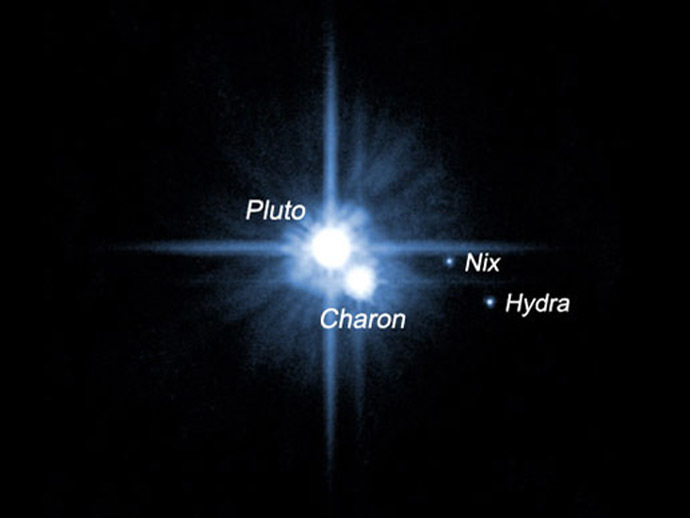
In the splitting hairs battle for definition supremacy it is interesting to reexamine why the International Astronomical Union decided back in 2006 to demote poor Pluto to dwarf planet. At the time 424 astronomers meeting in Prague voted. They represented a mere 5% of the world’s astronomers but they were the ones in attendance and so they examined Pluto as a planet and concluded it failed to meet the defitinion. Their reasoning was that Pluto is part of the Kuiper Belt and therefore doesn’t meet the third requirement. But in fact we now know that Pluto has cleared the area of space around it. It not only has Charon as a companion moon, but recently four new moons were discovered – Styx, Kerberos, Nix and Hydra. And with New Horizons, the NASA robotic spacecraft doing a flyby in 2015 we will finally get a close up view of this remote “planetary” system.
Yes you heard me! I’m voting for Pluto as a planet seen in the picture below taken by the Hubble Space Telescope. All this dwarf planet nonsense is just confusing. So we’re back to nine planets in our Solar System, that is, until the next astronomical powwow gets all huffy and decides to vote Pluto “off the island.”
Of course we now must reconsider the definition of some of those other Kuiper Belt objects. What to do with UB313, also known as Eris, three times further from the Sun than Pluto and 1.5 times larger? It has its own moon, Dysnomia. And what about Ceres, the Queen of the asteroid belt, clearly spherical and exhibiting its own atmosphere? Or Haumea, another Kuiper Belt discovery with two moons circling it? Or Sedna, Orcus, Quaoar and Makemake?
So much for orthodoxy!

2012 VP113 is approximately 450 kilometers (280 miles) in diameter. Its orbit takes it to its closest approach to the Sun at a distance of 80 AUs. That’s 4 AUs further out than Sedna. Unfamiliar with AU? It stands for astronomical unit of which one equals the distance from Earth to the Sun. When compared to Pluto which orbits at a distance of 29 AUs you get a real sense of just how remote is this new discovery.
The inner edge of the Oort Cloud is about equivalent to where 2012 VP113 lies. With it and Sedna already discovered astronomers are convinced that it is only a matter of time before many more Oort objects are discovered at these and further distances from the Sun. Speculation is there may be hundreds if not thousands in the outer reaches of our near space environment with some as large as Mars or even Earth. One recent survey indicates 900 have been identified with some speculating that one may be an even larger planet circling the Sun from beyond the Oort Cloud, either ejected from the inner Solar System, or a rogue captured by our Sun as it drifted by.
The findings appear in the international weekly journal of science, Nature. In the image below, the red, green and blue dots represent the track of this new dwarf planet. The picture is a combination of three separate images taken of the same night sky over a two-hour period. The visible stars and galaxies in the combined image are static. But 2012 VP113 can be seen to be moving from the red position to the green and then the blue.


