In her latest newsletter, she is tackling the subject of fluoride in drinking water, a recent topic of this blog site and one that the incoming Trump regime intends to dismantle because Robert F. Kennedy, Jr., who will head up the federal health portfolio, considers a poison.
I felt it was important enough to bring the topic back in light of what is likely to happen in the United States with Kennedy in charge of health. I suspect he and those he appoints to lead his goal of disrupting existing health norms by spreading disinformation about fluoride in drinking water.
With Katelyn’s information, you can separate the disinformation from the science and become better informed.
Fluoride is a naturally occurring mineral found in water, soil, air, and some foods. Our bodies need minerals for many things, including strengthening our bones and teeth. Just like our bones need enough calcium, our teeth benefit from getting enough fluoride. Specifically, fluoride strengthens enamel—the thin, hard layer that covers our teeth—which helps prevent bacteria from causing cavities. Preventing cavities is good for many things, including cardiovascular health.
The value of fluoride isn’t controversial—it’s good for our teeth. This is why toothpaste contains fluoride, and dentists apply it directly to teeth. The question being debated is whether we should add it to our public water supplies.
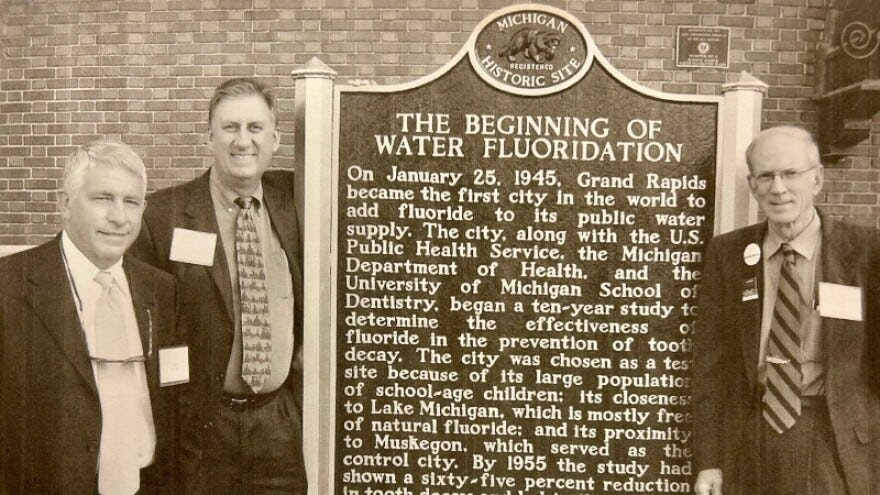
Since 1945, local communities have been putting fluoride in drinking water [Editorial Note: This is true in Canada as well.] Currently, about 3 in 4 Americans receive fluoridated water. This is largely a hyperlocal decision—your city or county decides—but some states, like Hawaii, have banned it.
 |
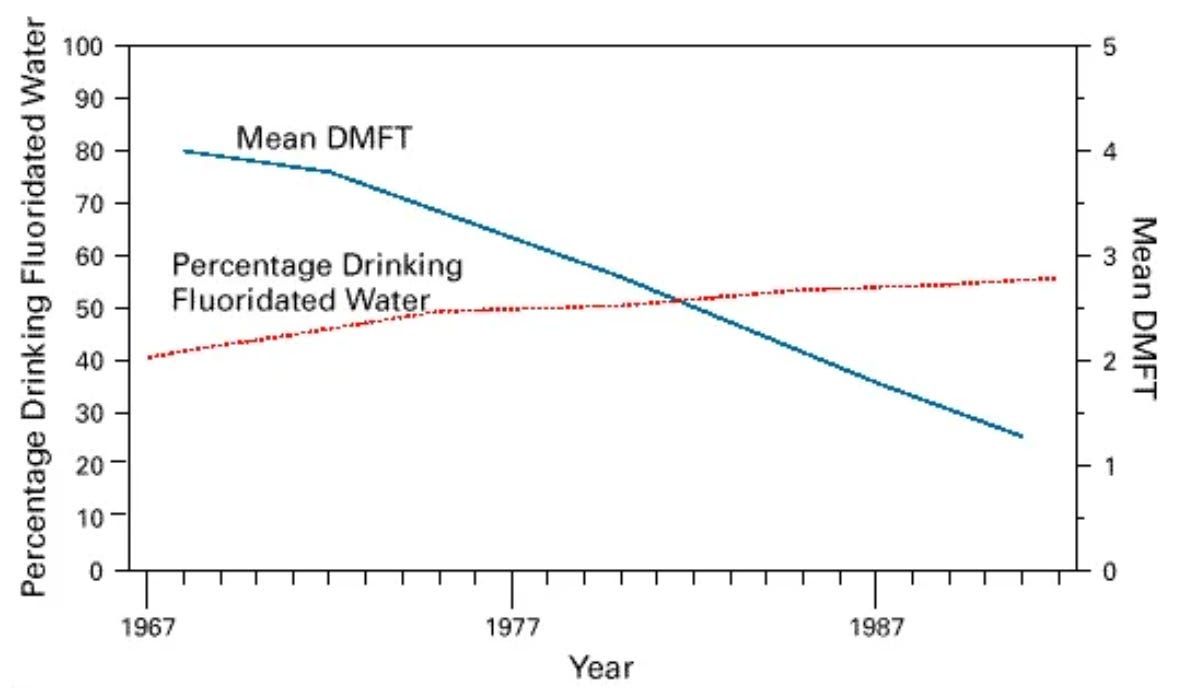
Water fluoridation has been an effective population-level intervention to reduce tooth decay. As the chart below shows, fluoride was added to water supplies in the mid-1940s, and tooth decay declined. It also has an impressive return on investment—for every dollar spent on fluoridation, $20 is saved in preventing dental procedures.
 |
Of course, correlation doesn’t equal causation. So scientists have studied what happens once we remove fluoride in water. Tooth decay increases across the population. For example:
The benefit from fluoridated water became more modest when we added fluoride to toothpaste. A 2024 Cochrane review—the gold standard of medical reviews that pooled 21 studies—found studies conducted earlier than 1975 showed a clear and important effect on preventing tooth decay in children. After 1975, there may be less robust benefits.
Because the public water system reaches everyone equally, fluoridation mitigates the impact of disparities in access to dental care in the United States [Canada as well]. This is one of the beauties of public health—a mainly invisible population intervention, helping the most vulnerable.
Lower-income families still struggle to find dentists who take their insurance. In 2023, the American Dental Society found that only one in three dentists nationally accept Medicaid. This helps explain the CDC report that children in lower-income families have nearly three times higher rates of untreated cavities than children in higher-income families.
The impact of this goes well beyond preventing cavities. Poor dentition can be an important source of stigma and shame for a child and can serve as a visible sign of poverty. Studies show that children with poor dentition are more likely to withdraw from social participation, hide their smiles, and have higher rates of school absenteeism. These early life experiences can be a barrier to a sense of confidence and social belonging that can have lifelong effects.
The U.S. Public Health Service recommends a fluoride concentration of 0.7 parts per million in drinking water, a level carefully chosen to prevent cavities. However, some places in the U.S. (~0.6% of the total population) have natural fluoride in their water that reaches up to 1.5 parts per million.
Very high levels of fluoride can be dangerous. Fluoride toxicity first impacts the skeletal bones, beginning at an exposure of 5 mg/kg of body weight per day. If we do the math, the average child (40 kg) must drink 286 litres of fluoridated water daily to reach toxicity. At that point, they would die from water overconsumption.
Rumours have also circulated about a link between fluoride and thyroid function. But again, the dose makes the poison. A meta-analysis—pooling 27 studies on this topic—found that hormone levels started increasing at fluoride levels of 2.5 parts per million—about 3.5 times higher than what is added to our water systems.
In the past five years, a few studies have questioned whether safety signals exist in children’s cognitive development. However, the studies have important limitations that call into question their applicability:
Some, including RFK Jr., have also raised concerns about a link between fluoride and osteosarcoma (a rare bone cancer) in childhood and adolescence. While a rat study suggested a link, several human studies refuted this, as they did not find a link (here, here). In 2022, the American Cancer Society conducted an extensive review and concluded that there was “no strong evidence.”
While it is important to follow ongoing safety carefully, several factors need to be considered to establish causality that we don’t have in the case of fluoridated drinking water in the U.S. These include biological plausibility (there is no real mechanism to link fluoride to IQ), the relationship between fluoride dose in U.S. water and observed human health effects (called dose-response relationships), and whether we see consistency across many human studies and different populations, particularly at the exposure levels that we see in America.
Most Western European countries have ended public water fluoridation. There are a few reasons why:
Water fluoridation is one of the century’s top 10 public health achievements and is still supported by organizations like the American Dental Association and the American Academy of Pediatrics. While the benefit now may be more modest, thanks to toothpaste, it’s important to consider the benefits to all Americans, including our neighbours with fewer financial resources.
]]>