Yesterday, the two were awarded the Millennium Technology Prize for 2020 (delayed by COVID-19), sponsored by the Technology Academy Finland (TAF). Shankar Balasubramanian and David Klenerman not only received the award but also one million Euros.
Their technology provides for fast, accurate, low-cost and large-scale genome sequencing, human or otherwise which has already begun to have a transformative impact on the fields of genomics, biology and medicine. It represents a million-fold improvement in speed and cost when compared to the first sequencing of the human genome which back in 2000 took more than 10 years at a cost of one billion dollars. Today’s cost amounts to one thousand dollars, one ten-thousandth the price.
How does their invention work?
Called NGS, it involves fragmenting DNA samples into hundreds of small pieces that are then decoded on a chip using fluorescently coloured nucleotides. A fluorescence detector identified the colour-coded nucleotides to determine the DNA sequence of all of the pieces to create an entire genome which is assembled using a sophisticated computer program. The technology can sequence billions of pieces in parallel fashion which makes for a very accurate and cost efficient operation.
The technology today is being used to track the changes to the genome of COVID-19 variants and thus is helping to advance the creation of booster vaccines to supplement those already created. NGS should help us to find cures for future pandemics as researchers speed up their ability to decode viral genomes.
The technology also allows researchers to identify why individual immune responses to COVID-19 are different, identifying why some people are far more adversely affected by the virus. This should help in treating infected patients who experience exaggerated inflammatory responses to the infection.
The technology is also revolutionizing both biological and biomedical research. It is being used in cancer, rare diseases, infectious medicine, and sequencing-based non-invasive prenatal testing. It can rapidly define the genetic risk genes in patients with rare diseases, and is helping to define new drug targets as well antibody and gene therapies. Because the technology gives us a better picture of the specific genetic bases for many cancers it has become the defacto standard in personalized therapeutic treatments of the disease.
And in biological fields like agriculture, ecology and the study of biodiversity, NGS is giving us a rapid way to document the genome of tens of thousands of organisms.
The awarding of this, the tenth prize since it was first offered, is unique in the fact that it is the first time two recipients have been honoured. States Marja Makarow, Chair of the Technology Academy of Finland, “Collaboration is an essential part of ensuring positive change for the future. Next-Generation Sequencing is the perfect example of what can be achieved through teamwork and individuals from different scientific backgrounds coming together to solve a problem.” She continues, “The technology pioneered by Professor Balasubramanian and Professor Klenerman has also played a key role in helping discover the coronavirus’s sequence, which in turn enabled the creation of the vaccines – itself a triumph for cross-border collaboration – and helped identify new variants of COVID-19.”
A final interesting note, of the nine previous winners of the Millennium Technology Prize, three have gone on to win a Nobel Prize.

States co-founder Poornima Parameswaran, “we’ve done a lot of validation around the diseases that growers already know are affecting yield and quality of their produce.” This is helping farmers to understand the underlying flora within the soil that impacts what is grown. For Trace Genomics the sampling gives them a growing database of soil profiles that can be further analyzed to see larger agricultural challenges.
Parameswaran’s co-founder, Diane Wu, points out that identifying pathogenic microbes is critical to farmers. Wu and Parameswaran met in graduate school at Stanford University. Wu’s expertise is computational biology. Parameswaran is a molecular biologist.
In keeping with the locale of the company, much of the work being done to date is with farmers in California. Parameswaran identifies what crops are associated with the soil samples they receive: lettuce, strawberries, nuts, orchards, vineyards, corn, soybeans and wheat.
What do farmers want to know?
Farmers can see when one field on their property produces better results than another but they often don’t know why. Sampling the soil gives them answers they have never seen before. A good example occurred in the Salinas, California area, where samples from lettuce growers experiencing Fusarium wilt when analyzed yielded the first diagnostic test for the disease.
Trace Genomics tests look at the microbial content of soil extracting DNA samples which are then sequenced and analyzed. Farmers receive results within 2 to 3 weeks. In assembling soil profiles into a comprehensive database Wu and Parameswaran hope to not only identify pathogens but also microbes that improve crop growth. In the little over a year-and-a-half since the company was founded, Wu notes that initial customers have used the data to “evaluate techniques they’ve been using and see what’s changing the presence of diseases in soil.”
Trace Genomics offers three different reports.
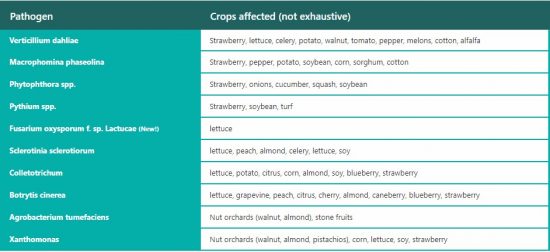
The table below gives a sample of the pathogens Trace Genomics currently screens for and some of the crops they impact.
]]>
Automobile Insurance
Today your vehicle insurance company can offer you a sensor that when installed in your car tracks driving behavior and rewards you with lower rates if you are good, and warns you if you are bad. Allstate calls their system Drivewise. Each time you get behind the wheel it collects data on speed and braking. The company says it will never raise your rates based on Drivewise data and hopes that the feedback helps to improve your driving behavior.
But what will happen to insurance when autonomous vehicles take to the road?
The driverless car is already legal in a number of American states and is in pilot mode in a number of European countries. Companies like Google, Tesla and Mercedes have announced prototypes that inevitably will become mass consumer market products.
In a recent column appearing in The Telegraph, author Sophie Jamieson describes the arrival of driverless vehicles within the decade. She writes “if the idea of traveling at 70 miles per hour (113 kilometers) in a vehicle controlled by a computer, rather than a person, scares you, it shouldn’t. An estimated 90 percent of road accidents are the result of driver error. Eliminate the driver, and you eliminate the error…”
The industry is already being disrupted by safety features that are dramatically reducing low speed accidents. Autonomous emergency braking has reduced these types of collisions in the United Kingdom by 20%. Lower accident rates means lower premiums. Lower premiums means less profit. Does that mean the end of car insurance?
With the upcoming crop of autonomous vehicles there will still be a driver sitting behind a steering wheel. But that driver will no longer be piloting the car. Liability will remain with him or her. But what happens when the next generation of self-driving vehicles arrive with no steering wheel. Then who is liable in the event of an accident involving two or more autonomous vehicles? Will the insurance be for the driver or the car? Will liability lie with the manufacturer?
If an owner doesn’t accept the latest software download and the vehicle gets into an accident who will be to blame? Will it be the owner or the software provider? And if vehicles largely operate using software updated and downloaded regularly through a service provider, if hacked, will liability for any ensuing accident rest with them or the manufacturer?
Anyway you look at it the insurance industry will need to adapt.
Health and Life Insurance
DNA sequencing is getting dirt cheap. Today for less than $1,000 you can get a picture of your entire DNA. Known as Personal Genetic Sequencing or PGS, anyone can complete map their genome identify both the bad and the good sequences and as a result provide themselves with a life map. What does this mean for health and life insurance companies? Disruptive change.
Insurers today in Canada, in many European Community countries and even in the United States under Obamacare cannot deny coverage to anyone for identified prior conditions. The Genetic Information Nondiscrimination Act (GINA) passed in 2008 by the U.S. Congress ensures that no employer or insurer can practice genetic discrimination. The existence of PGS information that indicates potential future diseases therefore cannot lead to denial of claims or to loss of employment. Prior knowledge in fact could lead to early intervention and prevention and inevitably better medical outcomes.
But there is another side to PGS. What if your DNA profile shows that you are low risk? Shouldn’t you get a price break on health and life coverage? And in fact if you show low risk why do you need to go to a company to buy coverage? Why can’t you create an online profile and invite other folks with healthy DNA to create a social pool of the self-insured? Friendsurance and Guevara are two examples of social-media pooled insurance services that bypass traditional insurers. Although currently not offering health coverage it is only a matter time before PGS makes self-insured online communities possible.
Of course PGS could be a Pandora’s Box with insurers paying for frequent and unnecessary tests based on genetic analysis that is ambiguous. In a Time article that appeared in an October 2012 issue, author Bonnie Rochman described the results of a doctor survey in which 1 in 5 physicians thought PGS would lower health costs but more than half predicted the technology would lead to inevitable cost increases.
For the insurance industry technology disruption will lead to a flurry of new products and offerings, greater personalization, and a changing bottom line. It will be interesting to see which companies survive the shakeout.

The first is the announcement by President Obama to enlist one million Americans as volunteers in providing their genetic profiles. The second involves breeding new strains of mosquitoes and introducing them into the wild to stop malaria, dengue and chikungunya fevers. The third involves researchers uncovering the relationship between mitochondrial DNA and our immune response. And the final one involves the invention of a micro-printing method for creating fine vascular blood vessels.
President Obama Announces One Million DNA Profile Project
In a shift away from blanket prescriptive cures to disease, a one trick pony that has dominated medical practice since the dawn of antibiotics, the President’s initiative will lead to treatments tailored to specific genetic profiles. For cancer, autoimmune and other diseases that continue to defy cures, this represents a game changer.
The initiative is looking for volunteers and doesn’t need a million because there are already many large population DNA studies already being done in a number of universities and biomedical research companies. Once accumulated the million DNA profiles will lead to what is being called precision medicine, tailored to specific profiles and capable of better outcomes in dealing with intractable diseases and cancer.

Mosquitoes Being Harnessed to Fight Disease
Plasmodium falciparium is the bacteria responsible for malaria. Mosquitoes host the bacteria and transfer it to humans when they bite. In trying to develop a malaria vaccine the challenge has come from the nature of the bacteria to rapidly evolve new strains. So scientists are always one step behind the bug. But now researchers are harnessing the mosquitoes themselves to fight not only malaria but dengue and chikungunya, two other diseases spread by the flying insect.
In the case of malaria and dengue, scientists discovered Chromobacterium sp (Csp_P), a bacteria found in the natural habitat of mosquitoes which also seems to act as an antibiotic for the insect. When mosquito populations were fed Csp_P cultured in a sugar solution a large number of them died. But those that survived were no longer infected with Plasmodium or dengue and therefore, no longer transmitters.
And that’s not the only research that is harnessing mosquitoes to help fight the diseases they normally spread. A new research initiative with promising preliminary results is about to be tried in the Florida Keys. Millions of genetically modified mosquitoes will be introduced into the wild to fight the spread of dengue fever and the newest tropical disease threat, chikungunya. The mutated mosquitoes, all male are programmed to self-destruct. When mating with the existing wild female population no offspring will result. In the Cayman Islands and Brazil where genetically modified mosquitoes were recently introduced the die off rates have varied between 80 and 96%. Of course, there is opposition by many who fear any science associated with genetic modification. The diagram below, hopefully, provides a better understanding of how it all works.

Immune System Trigger in Mitochondrial DNA Linked to Chronic Inflammation
Mitochondrial DNA (mtDNA) found in every living cell play a significant role in converting ingested raw materials into energy. A combined Yale University, University of Alberta and Washington University School of Medicine study, however, recently identified an unexpected relationship between mtDNA and immune response.
It turns out that mtDNA when exposed within a cell to viruses triggers immune responses leading to inflammation. Even more peculiar was how mtDNA even when not exposed to a viral infection, can trigger immune responses. The researchers hope to study the phenomenon further to determine mtDNA’s role in aging and cancer.

New Artificial Vascular Grafts Represent Significant Surgical Advance
Vascular grafts are used in surgical procedures to redirect blood flow when natural blood vessels cannot do the trick. One of the most common uses is in coronary bypass. Traditionally natural grafts are harvested from the patient’s own body. But you can only take so many transplanted blood vessels before you begin to compromise the patient. And in many cases, the patient’s underlying complications can ultimately lead to vascular failure at the transplant site.
Researchers at Shanghai University, however, have combined micro-imprinting and electro-spinning technology to produce a vascular graft that mimics natural ones. When introduced the grafts which degrade over time, create the blood flow that’s needed and provide a scaffolding for the body’s natural cells to eventually grow and replace them.
Electrospinning is proving to be an important nanotechnology in biomedicine because it creates fine matrices that act as growing medium for natural tissues. The technique used by the Shanghai research team created triple-layered artificial vascular grafts, a vast improvement over previous results.


Using a next-generation DNA sequencer the researchers analyzed thousands of DNA fragments found in bony remains (see image below) buried in the permafrost of the Yukon Territory in Canada. From that they were able to recreate a fully constructed genome. Horses in North America became extinct after the last Ice Age and were reintroduced by the Spanish in the 16th century.

In addition to the work of the Danish team, a separate group have also succeeded in reconstructing the DNA of a giant cave bear that lived in northern Spain some 400,000 years ago. The latter’s remains were discovered in what obviously is a much warmer climate than the Yukon. As a result the remains had suffered more extensive decomposition, but the researchers used DNA from the bear’s mitochondria to regenerate the genome.
Both the bear and horse represent a huge advancement in genetic reconstruction. Prior to these two teams’ success the oldest reconstructed genetic information dated back less than 100,000 years. For genome reconstruction this means many new possibilities. Will we try to recreate our human ancestors like Neanderthal or Homo Erectus? Will we recreate the genome of other extinct Ice Age creatures? And as we perfect this technology can we go back even further in time and reconstruct the genome of the mammals of the Cenozoic or the dinosaurs of the Cretaceous? Are we beginning down a path to “Jurassic Park?” Because once we have the genome what’s to stop us from bringing back the species?
]]>
J. Craig Venter, the American biologist and sequencer of the human genome is at his entrepreneurial best when he imagines using 3D printers to print DNA. Venter has started working on a device he calls a teleporter, a digital biological converter that prints vaccines from downloaded software.

The idea came to him during an outbreak of H1N1 influenza in 2009 as a way of rapidly disseminating new vaccines to remote locations around the world to stop a pandemic from happening. How would it work? Venter believes that we can digitize the DNA of a virus like a strain of influenza and within a day build a vaccine to defeat it. His teleporter, a 3D printer with the materials needed to print a vaccine, would be made available to medical facilities around the world. Software containing the instructions for assembling a vaccine could be sent digitally to every facility. The printed vaccines could then be used to stop an outbreak of infections leading to an epidemic.
There are challenges still to be overcome. Venter’s past work shows that he is more than capable of overcoming them but nonetheless his teleporter will have to be highly accurate in its ability to assemble a vaccine molecule by molecule. Any slight variation could have unintended consequences.
Bioprinting has already been used to print veins using a patient’s own cells. More complex body parts remain a work in progress.
Venter is also working in the field of synthetic biology, creating new bacteria to create biofuels and harvest hydrogen from water.

]]>

In the March 2012 issue of Popular Science, in the article, “The Next Sequence,” Jennifer Abbasi describes work being done at IBM to develop a $100 sequencer, a chip that uses nanotechnology to read DNA. At $100 a test, DNA sequencing will be open to millions of patients.
Of course sequencing an individual’s DNA is not in itself a method for curing disease. It is sequencing of a group of patients with a common disease that can lead to finding the “smoking gun” within the genetic sequence.
]]>
