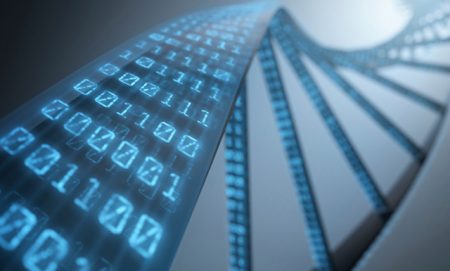
For binary data storage, a ’00’ can be encoded as A, ’01’ as G, ’10’ as C, and ’11’ as T. A Scientific American article that appeared on May 28, 2021, noted that a gram of DNA “can archive a staggering amount of information.” It can be stored in salt and remain stable for decades at room temperature. In a controlled environment such as a data centre, DNA storage would require little maintenance and would be easily copied.
How much can be stored within the double helix molecule? The Scientific American article notes that all the information we will generate in 2025, estimated to be 33 zettabytes (3.3 followed by 22 zeroes) could be stored in a volume of DNA no larger than a ping-pong ball. The entire U.S. Library of Congress, some 74 million million bytes “could be crammed into a DNA archive the size of a poppy seed” with lots of room left over to do it 5,999 more times.
According to the Wyss Institute at Harvard University, the current cost to synthesize DNA for data storage is US $3,500 per megabyte. Wyss researchers have attempted to write data directly into DNA using a method called “de novo synthesis.” Described as a low-cost approach using DNA for data storage, it deploys an electronic means of encoding data to the four nucleotide letters.
Thought to be state of the art, the work at Wyss appears to be supplanted by “epi-bit,” an even newer methodology that was recently described in an article appearing on October 23, 2024, in the journal Nature.
This research is a joint collaboration involving Peking University, North China Electric Power University, the Max Planck Institute and Arizona State University. It describes epi-bit as a method to allow the writing of arbitrary data on DNA using premade nucleic acids. “Through self-assembly guided enzymatic methylation, and epigenetic modifications,” data bits are placed into DNA using “molecular movable-type printing.” Using selective methylation, epi-bit “achieved synthesis-free writing of approximately 275,000 bits on an automated platform.”
Data-encoded DNA will lead to DNA drives that will encode error-free data using epi-bit writing kits. Vials of encrypted DNA will replace massive silicon-based data centres. Instead of warehouses, DNA drives will be housed on a shelf or uploaded to the cloud. Since DNA can last millennia without maintenance why will we need backup and archiving that takes up even more space?
Diamandis describes future space missions carrying multiple DNA storage cubes each no more than 5 cubic centimetres containing a billion gigabytes of data. It won’t take much to transport all the knowledge of humanity in a few cubes of DNA. Imagine what this will mean for future space colonies or for a permanent human presence on the Moon and Mars.
Diamandis notes, “Throughout evolution, DNA has unlocked extraordinary possibilities—from humans to bacteria. Soon hosting limitless data in almost zero space, it may one day unlock many more.”
]]>
In the age of big data, we are quickly producing far more digital information than we can possibly store. Last year, $20 billion was spent on new data centers in the U.S. alone, doubling the capital expenditure on data center infrastructure from 2016. And even with skyrocketing investment in data storage, corporations and the public sector are falling behind.
But there’s hope. With a nascent technology leveraging DNA for data storage, this may soon become a problem of the past. By encoding bits of data into tiny molecules of DNA, researchers and companies like Microsoft hope to fit entire data centers in a few flasks of DNA by the end of the decade.
Where We Have Come From
After the 20th century, we graduated from magnetic tape, floppy disks and CDs to sophisticated semiconductor memory chips capable of holding data in countless tiny transistors. In keeping with Moore’s Law, we’ve seen an exponential increase in the storage capacity of silicon chips. At the same time, however, the rate at which humanity produces new digital information is exploding (as seen in the graph below).
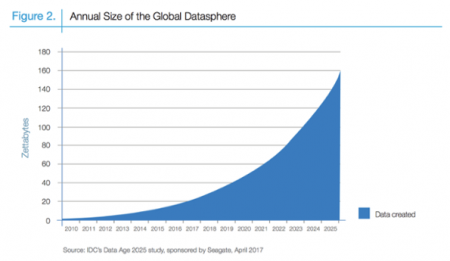
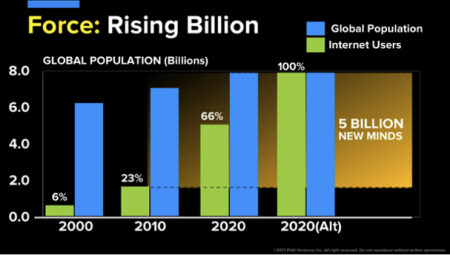
As of 2016, digital users produced over 44 billion gigabytes of data per day. By 2025, the International Data Corporation (IDC) estimates this figure will surpass 460 billion. And with private sector efforts to improve global connectivity—such as OneWeb and Google’s Project Loon—we’re about to see an influx of data from 5 billion new minds.
While companies and services are profiting enormously from this influx, it’s extremely costly to build data centers at the rate needed. At present, about $50 million worth of new data center construction is required annually just to keep up, not to mention the millions spent on furnishings, equipment, power and HVAC.
And memory-grade silicon, rarely found pure in nature, may soon run out with researchers predicting this happening as early as 2040.
DNA is the Answer
Take DNA, on the other hand. At its theoretical limit, we could fit 215 million gigabytes of data in a single gram of DNA. But how?
DNA is built from a double helix chain of four nucleotide bases—A, T, C and G. Once formed, these chains fold tightly to form extremely dense, space-saving data stores. To encode data files into these bases, we can use various algorithms that convert binary to base nucleotides—zeroes and ones become A, T, C and G. ‘00’ might be encoded as A, ‘01’ as G, ‘10’ as C, and ‘11’ as T, for instance. Once encoded, the information is then stored by synthesizing DNA with specific base patterns, and the final encoded sequences are stored in vials with an extraordinary shelf-life. To retrieve data, encoded DNA can then be read using any number of sequencing technologies, such as Oxford Nanopore’s portable MinION.
Still in its deceptive growth phase, DNA data storage—or NAM (nucleic acid memory)—is only beginning to approach the knee joint of the exponential growth curve. But while the process remains costly and slow, several players are beginning to crack its greatest challenge: retrieval. Just as you might click on a specific file and filter a search term on your desktop, random-access across large data stores has become a top priority for scientists at Microsoft Research and the University of Washington. Storing over 400 DNA-encoded megabytes of data, University of Washington’s DNA storage system now offers random access across all its data with no bit errors.
Applications of DNA Data Storage
Even before we guarantee random access for data retrieval, DNA data storage has immediate market applications. As seen in the graph below, a huge proportion of enterprise data goes straight to an archive.
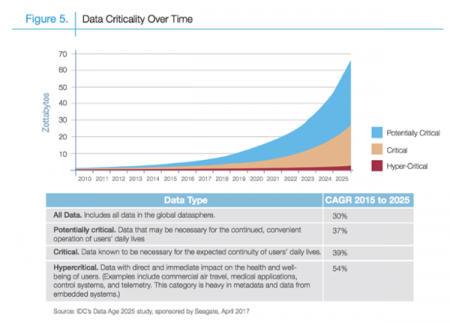
Particularly for storing past legal documents, medical records and other archive data, why waste precious computing power, infrastructure and overhead?
Data-encoded DNA can last ten thousand years—guaranteed—in cold, dark and dry conditions at a fraction of the storage cost. Now that we can easily use natural enzymes to replicate DNA, corporations and SMEs have tons to gain (literally) by using DNA as a backup system—duplicating files for later retrieval and risk mitigation. And as retrieval algorithms and biochemical technologies improve, random access across data-encoded DNA may become as easy as clicking a file on your desktop.
Researchers are already investigating the potential of molecular computing, completely devoid of silicon and electronics. Harvard University professor George Church and his research colleagues, for instance, envision capturing data directly into DNA. As Church has stated, “I’m interested in making biological cameras that don’t have any electronic or mechanical components,” whereby information “goes straight into DNA.” According to Church, DNA recorders would capture audiovisual data automatically. “You could paint it up on walls, and if anything interesting happens, just scrape a little bit off and read it—it’s not that far off.” And one day we may even be able to record biological events in the body. In pursuit of this end, Church’s lab is working to develop an in vivo DNA recorder of neural activity, skipping electrodes entirely.
Future Potential
Perhaps the most ultra-compact, long-lasting and universal storage mechanism at our fingertips, DNA offers us unprecedented applications in data storage—perhaps even computing. As DNA data storage plummets in tech costs and rises in speed, commercial user interfaces will become both critical and wildly profitable. Once corporations, startups and people alike can easily save files, images or even neural activity to DNA, opportunities for disruption abound.
Imagine uploading files to the cloud, which travel to encrypted DNA vials, as opposed to massive and inefficient silicon-enabled data centers. Corporations could have their own warehouses and local data networks could allow for heightened cybersecurity—particularly for archives. And since DNA lasts millennia without maintenance, forget the need to copy databases and power digital archives. As long as we’re human, regardless of technological advances and changes, DNA will always be relevant and readable for generations to come.
But perhaps the most exciting potential of DNA is its portability. If we were to send a single exabyte of data (one billion gigabytes) to Mars using silicon binary media, it would take 5 Falcon Heavies and cost $486 million in freight alone. With DNA, we would need 5 cubic centimeters. At scale, DNA has the true potential to dematerialize entire space colonies worth of data.
Throughout evolution, DNA has unlocked extraordinary possibilities—from humans to bacteria. Soon hosting limitless data in almost zero space, it may one day unlock many more.
]]>