Entrepreneurs Under 35
Dmitri Alperovitch – at age 32 a developer of active cybersecurity defenses that use a wide range of sources to detect traces of potential threats and act upon them. His company is CrowdStrike.
Leah Busque – at age 33, a former software engineer at IBM who has developed TaskRabbit, an alternative to Craigslist and Kijiji for those seeking or employing people in odd jobs. Designed to specifically link job seekers and providers by locality, the application currently covers 14 U.S. cities.
Anthony Goldbloom – at age 30, a former business analyst and number cruncher, a self taught programmer, he has created a website called Kaggle where scientific minds can apply themselves to solve problems posted by companies. Today the user base has surpassed 100,000.
Dmitry Grishin – at age 34, is revolutionizing personal robotics having set up Grishin Robotics, a venture firm which he has capitalized with $25 million. Grishin came to my attention back in July last year when I wrote about the company he has created which has since my first posting invested in several ventures including DoubleRobotics and RobotAppstore.
Ben Milne – at age 30, has founded Dwolla, an electronic funds transfer website that charges 25 cents per transaction on amounts greater than $10, and nothing if the amount is less. Launched in 2010 it has grown into a money exchange handling millions of dollars daily.
Bright Simons – age 31, is the developer of the mPedigree Network, a mobile network that detects whether products consumers are using are authentic or fake. His background is astrophysics but he has helped African farmers get certified as organic producers to improve their income from sales of agricultural products. The focus of mPedigree is the detection of counterfeit medicines, described as Africa’s fake-drug monster.
Balaji Srinivasan – age 33, has created Counsyl, a company that helps parents discover whether both may be carrying a recessive gene in his or her DNA that could cause a birth defect or genetically acquired disease for their offspring. The test costs $99. It uses a saliva swab to analyze 100 genes associated with recessively inherited diseases. If both parents’ DNA contains a defective copy of one of these 100 genes it means a 25% risk for the child having one of the tested diseases.
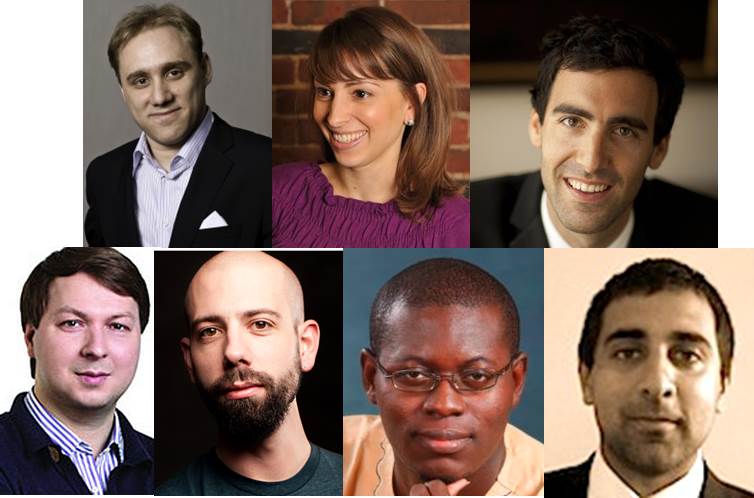
These enterprising and talented MIT honorees are seen in the picture below. From left to right in the top row we have Dmitri Alperovitch, Leah Busque and Anthony Goldbloom. In the bottom row from left to right are Dmitry Grishin, Ben Milne, Bright Simons and Balaji Srinivasan.
All these young people are developing technologies and applications of enormous impact for the 21st century. Makes you feel pretty good about the future. And speaking of the near future we will continue this series looking at others who MIT has chosen as visionaries, humanitarians and pioneers in 2013.
]]>Today’s market is divided between industrial and service robots. Industrial robotics and particularly military applications receive lots of investment from both government and the private sector. Grishin, however, intends to focus money on the under served side of the business, personal robots for everyday use.
Grishin’s founder, Dmitry Grishin, is an entrepreneur who graduated from the Faculty of Robotics and Complex Automation at Moscow State Technical University. Today he is CEO and Chairman of the Mail.Ru Group, Russia’s largest Internet company, the seventh largest in the world. Mail.Ru offers email services, an Internet portal, online games, social networking and e-commerce services.
But Grishin’s first love is robots and it his personal funds that are behind the launch of the Grishin Robotics. Grishin argues that robots are today where personal computers were in the early 1980s.
Companies like iRobot have made robotic vacuum cleaners attractive consumer items but the potential is so much greater particularly since the cost to build robots has dramatically decreased.
Where does Grishin see robots taking off? In areas that affect people’s daily lives. Here are some examples:
Grishin is looking at making investments between $1 and $2 million with a focus on small and medium-sized personal robotics companies. These are companies that are seen as too risky by venture capital firms and as a result get overlooked. The seed capital that Grishin will provide is designed to get these smaller entrepreneurial inventors to the point where they can make a mass-market impact.
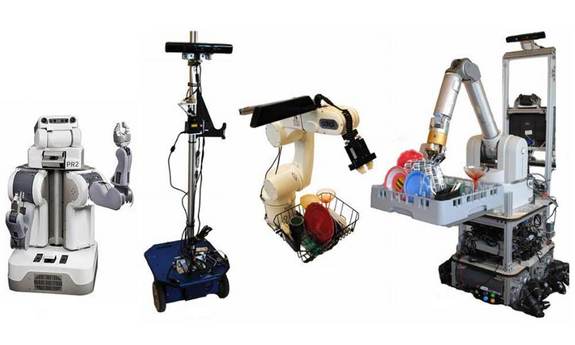
Will robots become as ubiquitous as smart phones, tablets and notebook computers? Grishin thinks so and he is putting his money on the line the same way private companies are putting money into developing space technology.
Your personal world in 2030 may be teeming with robot helpers of all kinds. I can’t help but think about the Jetsons and Rosey the Robot.
]]>