It was important to consider the biomechanics (see the illustration below) of using a wheelchair in the redesign. A rowing motion involves the large muscles in the upper body including biceps, posterior deltoids and upper/mid back muscles. A pushing motion involves triceps and anterior deltoids, smaller muscles that can more easily fatigue. In addition the redesign takes into consideration repetitive strain issues caused by the pushing motion of traditional wheelchairs which lead to damaged wrist tendons and ligaments, the cause of carpal tunnel syndrome. With a rowing motion the stress and compression of the median nerve is mitigated meaning no repetitive strain.
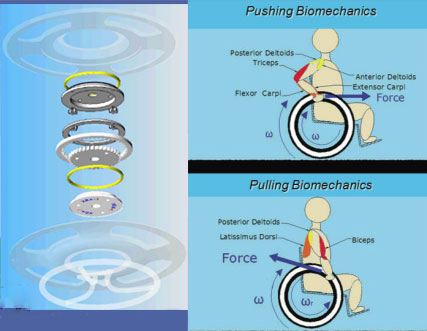
The secret sauce is in the gear system which allows the wheel to rotate counter to the rim when the user pulls backward. For the user a rowing motion is not only less stressful it is far more efficient. It takes 31% fewer strokes of the wheel to achieve the same distance. It is faster to accelerate making it attractive for wheelchair athletes. It is more stable when braking going downhill. And when going up an incline has an added hill-assist feature which the user engages on the central hub of the wheel. This protects against the wheelchair rolling back letting the user navigate at his or her own pace up an incline without slipping backwards and without getting tired during the effort.
For those currently wheelchair bound RoWheels can be used on a wide range of older model chairs using a small, unobtrusive frame adapter. Initial pricing is between $2,000 and $2,500. Production should start shortly. If the price tags seems a bit steep consider the cost of stress-related muscle injuries and carpal tunnel syndrome for those already challenged by being wheelchair bound. The investment in upgrading to RoWheels could save thousands of dollars eliminating future medical treatment for these types of injuries.

]]>
PSLT is designed to run on portable devices and translate sign language into written text. Using the camera on a smart phone, laptop, tablet or netbook, the signer can talk to anyone including those who do not understand sign language.
PSLT lets users build custom hand gestures and signs for work-related or instructional purposes using the CSL, a customizable sign language dictionary that can be expanded beyond the 8,000 prebuilt words and phrases.
The developers are also designing PSLT to allow users to issue sign commands to control devices in the home or workplace. This will be particularly valuable to those with limited mobility.
PSLT is an open source project with the developers hoping to have the application ready to launch on portable devices by mid-2013.
