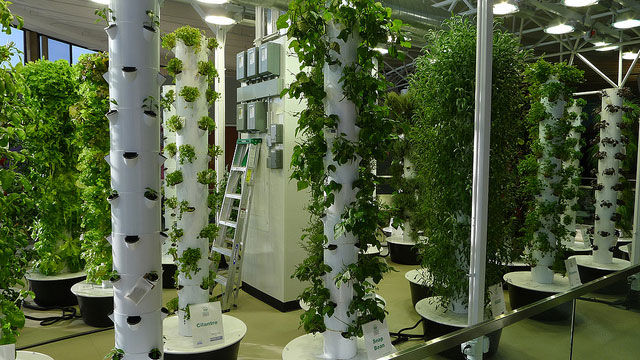
Established in 2017 by its founder James Lloyd-Jones, The Jones Food Company specializes in vertical farms using hydroponics. The company currently has built the largest vertical farm in North Lincolnshire, England, with 12 crop cycles of herbs and vegetables being grown year-round. And now it is adding a vertical farm that will be three times larger, about the size of 70 tennis courts, tended to by an army of robots.
The water being used in all its vertical farms is 100% recycled and supplemented by rainwater reserves. Hydroponics means smaller water requirements than traditional farming. And these vertical farms are low-carbon emitters. In fact, The Jones Food Company intends for its facilities to be carbon neutral in Lincolnshire by year-end, and in the Gloucestershire facility from the get-go. Solar panels on these warehouse facilities’ roofs supplemented by 100% renewable energy sources provide the power to light, heat, and operate the farms.
Why vertical farms now?
Back in 2014, I was asked to contribute a paper to an upcoming agricultural conference on urban farming. I wrote about Dickson Despommier, a professor at Columbia University, who conceived of the vertical farm. His notion was that with finite amounts of arable land and a world increasingly dominated by cities, the evolution of farming to move it closer to consumers necessitated their move into the urban fabric. The end result that Despommier envisioned was farming moving into buildings leaving more agricultural land freed up to return to a natural state as carbon sinks, and fewer emissions produced from the transporting of food from rural locales to urban consumers.
Despommier advocated for every city to produce 10% of its food needs locally and indoors. That would free up over 880,000 square kilometres (340,000 square miles) of farmland to be returned to its natural state which would be enough to reduce carbon dioxide (CO2) in Earth’s atmosphere to levels close to where they were in 1980.
The pros and cons of vertical farming were described by Kissairis Munoz in a Dr. Axe posting back in June of 2017. The pros included:
The cons included:
The production of food on this planet is a significant contributor to carbon emissions. In their book, “Climate of Hope,” authors Michael Bloomberg and Carl Pope describe our need to eat as a big deal when talking about climate change. They write “if you add up everything – growing crops, clearing and cultivating land, producing and applying fertilizers, shipping food to customers and keeping it refrigerated until it is eaten – food is responsible for about one-third of the total greenhouse emissions each year.” Agriculture produces 30% of the total methane released annually into the atmosphere. Blame cows and rice paddies. The former excreting the equivalent of 2 billion tons of carbon dioxide (CO2) annually. The latter generates 700 million tons. And those numbers are only part of the problem. Add to this nitrous oxide emissions, another potent greenhouse gas, from excessive use of fertilizers. And then top it off with the widespread use of plowing rather than no-till practices on the majority of farms, with the resulting release of carbon, normally bound in soil and root systems, into the atmosphere where it contributes to global warming.
Knowing that our need to eat is a big deal for climate change, a new start-up company, InFarm, is converting urban indoors spaces into vertical farms. The company website proudly proclaims, “we are the new farmers and the city is our farm.” Located in Berlin, the goal is to deliver on-demand farm produce within cities by introducing the technology to grocery stores. Shoppers will literally pick their food.
The InFarm vertical farming modular system can grow herbs, lettuce, other vegetables, and fruit. Its modularity makes it scalable based on available in-store floor space. A small store could handle 10 to 100 modules. A larger store 100 to 1,000. Online grocery systems could have warehouse operations filled with living plants that could be picked daily and delivered to urban consumers.
The company is partnering with supermarket chains like Metro Cash & Carry. At its stores, the modules are providing a “perpetual daily harvest” using a rotating series of growing trays. New plantings go to the back and mature plants to the front where they can be picked and purchased.
InFarm has loaded their system with sensors that monitor the health of the plants throughout their lifecycle. Machine learning anticipates potential problems with every new plant type introduced coming with its own set of algorithms that factor in all the conditions for optimal health.

]]>
In my initial research on vertical “urban” farms I discovered Dickson Despommier and his concepts which you can read about at www.verticalfarm.com. Despommier has been a frequent speaker at conferences advancing the idea of agricultural intensification and localization in a world increasingly dominated by cities. Despommier is one of a number of visionaries who equates our current agricultural model as increasingly problematic because of its net contribution to global warming and its destructive impact on soil and freshwater resources.
How is this occurring? Because clearing land on a large scale to grow crops has an enormous impact on the planet’s carbon and freshwater balances. And in places like Amazonia and The Congo the demand to plant traditional farms is depleting the rainforest, the planet’s lungs and regulator of atmospheric water vapor. Meanwhile transportation of agricultural produce to urban consumers is a significant contributor to greenhouse gas (GHG) emissions. So there are so many good reasons to seek a new paradigm for farming.
I also looked at the work being done in Manchester, UK, Kyoto, Japan, Singapore and the Netherlands. The posting http://www.21stcentech.com/agriculture-part-2-why-we-are-rethinking-the-farm/ provides links to many of these projects.
Our future with climate change producing increasing risks to the current agricultural production model suggests we need a way to mitigate and overcome what could become a cascade of catastrophic occurrences throughout this century and the next few that follow. A recent report entitled “Stranded Assets in Agriculture” highlights what farmers are facing in the near and more distant future. I invite you to read a posting I wrote back in January on the economic impact to agriculture from climate change at http://www.21stcentech.com/agriculture-update-economic-impact-farmland-climate-change/.
If we are to be an urban society which clearly is in the cards, and if we are to address climate change, the urban farm in a controlled setting represents a model worth pursuing. It may prove to be the easiest way for humanity to climate proof agricultural production and ensure that we produce food with a minimal carbon footprint. Of course, adapting agriculture to this new paradigm where most of what we consume is locally produced will require governments to be proactive in developing carrot and stick policies to promote the shift from the current model.
The end result will be far less horizontal land under agricultural production and a higher concentration of farm production within 100 kilometers of urban markets. It means land currently plowed can revert to a more natural state and the potential to create a landscape that sequesters carbon and preserves the natural water balance in the air and in aquifers.