The objective of a long-term human presence off-world, therefore, is to build structures in space from materials available in space. That means extracting resources from low-gravity bodies like asteroids. Even extracting building materials from the lunar surface for use in space would be better than launching payloads from Earth to be used to build a space infrastructure.
That’s what makes the latest NASA initiative to construct and assemble a communication satellite in space using a robotic platform so interesting. Maxar Technologies, the Colorado-based company that recently announced it was putting its robotic arm business up for sale, appears to have won a $142 million contract to assemble spacecraft from parts in low-Earth orbit.
The Space Infrastructure Dexterous Robot (SPIDER), a 4.86 meter (16-foot) robotic arm will be incorporated into a future NASA project named Restore-L. The initial build will create a 9.75 meter (32-foot) lightweight structural beam. This demonstration project will lead to the capacity for NASA to construct spacecraft in orbit. SPIDER recently completed a successful ground demonstration of the technology which will be deployed as early as 2024.
From a Canadian perspective what makes this announcement so interesting is that the SPIDER robot is the evolution of the technology that produced the Canadarm, the robotic arm first featured during the U.S. Space Shuttle program, and subsequently deployed on the International Space Station (ISS).
Restore-L plans to be more than a platform for constructing beams and spars for large satellite arrays. NASA also wants to use it to repair and refuel old satellites that would otherwise become space junk and a permanent hazard.
In its first foray into beam building, SPIDER will use MarkerSat technology developed by Tethers Unlimited, a Seattle-based company that offers in-space servicing and refueling of satellites, in-space manufacturing and assembly of components and systems, and networking for advanced space missions.
The project also includes technology developed at the West Virginia Robotic Technology Center designed to enhance the reliability of building space assemblies in orbit.
On December 30, 2019, Maxar announced it was selling the Canadian subsidiary, formerly MacDonald, Dettwiler, and Associates (MDA), to a Canadian private investment firm for $1 billion CDN ($765 million USD). Pending regulatory approval all of the Canadian business elements of Maxar, including the space robotics technology will once more be in Canadian hands.
It is not clear, therefore, just how much Maxar will be involved in the Restore-L project and the development of SPIDER built on the foundation of the Canadarm and Dextre, the latter, the robotic handyman on ISS used to install and replace exterior equipment with or without extravehicular human missions.
The current iteration of the Canadarm is Version 2, but a Canadarm 3 is planned for the future Lunar Gateway. Canadarm 3 technology will likely be incorporated on SPIDER to provide autonomy for what may become the first in-space manufacturing and assembly platform, and marking the beginning of what will become an off-world infrastructure made in space.

That’s why DARPA (the Defense Advanced Research Projects Agency) has launched a search for a partner to build a new type of robotic satellite to freely roam 35,000 kilometers (22,000 miles) above the Earth and provide repair services as needed to existing and future geosynchronous satellites.
The current generation of satellites operating at these heights have built-in multiple redundancies should something fail. That makes them heavy to launch and expensive to build. When malfunctions occur they are designed to use onboard backup systems while ground crews try to do remote diagnostics.
That’s why a roving repair robot in deeper space would be such an important asset. And once built and successfully demonstrated it would mean any future geosynchronous satellites would not have to be designed with as much redundancy, and weight, saving a considerable amount of money.
The DARPA initiative has been named the Robotic Servicing of Geosynchronous Satellites (RSGS) Program, and a proposer’s day is planned for Washington this May.
Having reviewed the DARPA documentation it is clear that what is being envisaged is a dexterous robotic system capable of operating in geosynchronous space to repair current U.S. satellites with the ultimate goal to help transform the architecture of future satellites. The initial project will require the DARPA partner to build the satellite, and both launch and operate it. DARPA would help with software and hardware development, testing, and integration of the advanced robotics payload to create an efficient form factor. DARPA would also assist in the development of key software and robotics workstations for mission operations, and assist with payload integration for launch. And finally, DARPA would develop training and mission support.
The DARPA program is a logical next step in the development of space infrastructure. When you consider the cost of two Space Shuttle missions, at $400 million each, launched to repair and upgrade the $4.7 billion Hubble Space Telescope you can see why a more economical way to handle satellite repair is needed. Hubble does not orbit at geosynchronous heights and yet the missions flown were logistically challenging and expensive. A robotic alternative would have provided a much more budget conscious way to ensure the continuity of the space telescope. Now DARPA wants to do what was done with Hubble using robots, and do it to satellites in geosynchronous orbit, a very remote and tall order.
There is already an existing repair robot in space on the International Space Station (ISS). It is Dextre, the Canadian Space Agency’s handyman which is being used for doing ISS outside repairs. Dextre requires human operators on the ISS or at ground stations to control its tasks. It is not autonomous which may be the way a future robotic repair spacecraft will operate to service malfunctioning satellites in deeper space.

When the Space Shuttle Atlantis flew to the ISS in 2011 it delivered a box containing the Robotic Refueling Mission (RRM). It joined Dextre (seen below along with the RRM), the Special Purpose Dexterous Manipulator or SPDM which has been on the ISS since 2008. Dextre has proven itself doing space-walk type assignments so astronauts and cosmonauts don’t have to do extravehicular ISS maintenance.
In March 2012 the RRM mated to Dextre went operational. What RRM does is refuel and maintain satellites in near-Earth orbit. With Dextre holding it in place it can service and refuel a wide range of satellite technologies. RRM receives its instructions from humans on Earth but it just as easily can be operated by humans on the space station, or given enough information about the satellite it is servicing, operate autonomously. RRM is a good prototype of what we will need for Deep Space fuel depots.

Our First Steps in Deep Space Involves Creating Highways with Off Ramps and Gas Stations
Gas stations in space don’t require human inhabitants. These Deep Space staging areas act as supplementary fuel depots beyond low-Earth orbit making it possible to supplement and resupply propellant for lunar and Martian missions and beyond.
In the near-term, that is the next two decades, a string of fuel depots could be placed at critical staging points in Deep Space. Each depot would consist of a fuelled upper stage rocket that would be placed in low-Earth orbit. The stage would then be towed by a robotic space tug using ion propulsion to locations beyond Earth to serve as gas stations, literally highways in space with off ramps and fuel sold here signs. To build these depots would require no new technology investment, just the harvesting of existing technology and repurposing it to create our highway in space.
NASA has been studying the idea of fuel depots for some time now and recently selected four companies to develop cryogenic propellant storage and transfer systems for beyond low-Earth orbit placement. They call the concept the Simple Depot and have tentative plans to launch a prototype as early as 2015 using a Centaur upper-stage as a long-term storage tank.

Once we have a string of gas stations we will be much better able to launch and service Deep Space missions. But to make these missions successful we need Deep Space habitats.
What Would Deep Space Habitations Look Like?
The answer to this is simple. Much of what we have constructed for the ISS will shape our first unmanned and manned Deep Space habitats. They will be built in modules. The assembly point will be in low-Earth orbit, probably the ISS itself. When completed propulsion systems would be added to push the finished habitations to their destinations in Deep Space.
NASA and Roscosmos, the latter being the Russian space agency, have been studying the requirements for surface-based and Deep Space human inhabited remote stations. Roscosmos has proposed to its space partners involved in the ISS that the space station be used as a testing facility for longer duration habitation to simulate Deep Space missions. At the same time the ISS is being looked at as a staging and construction site for beyond-Earth-orbit spacecraft.
The Deep Space Habitat or DSH is a concept for a human-crewed Deep Space 60-day mission. Shown below, it comprises a habitable module, logistics module and a docked space capsule with propulsion system.
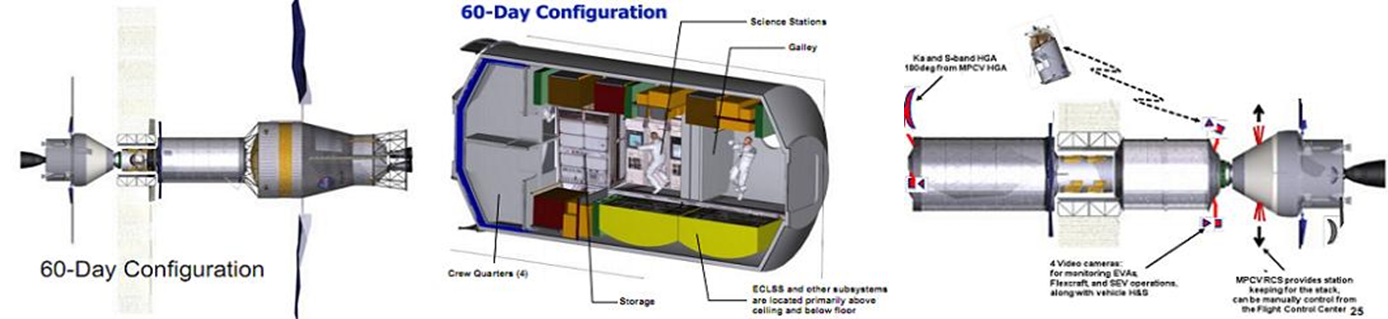
Russia has also served as a willing partner to test alternatives to the Deep Space Habitat and its modular ISS technology. In partnership with Bigelow Aerospace, who took NASA prototypes for inflatable space habitats and made them their own, Roscosmos launched Genesis-I and II, on rockets in 2006 and 2007 to test the validity of inflatable technology.

Both Genesis spacecraft remain in orbit and Bigelow plans to place a much larger inflatable called the BA 330 in orbit as early as 2015 and then people it shortly thereafter. Like the NASA concept, BA 330 modules can be connected together to create a much larger habitable space with each offering a crew capacity of up to 6. In May 2012 Bigelow and SpaceX, the developers of Dragon and the Falcon rocket, created a commercial partnership to launch, service and support a private space station in low-Earth orbit. Between the two companies we may soon see a private space station providing an alternative to the ISS.
Radiation, Space Debris and Weightlessness – Answering the Challenges
But there is much more to going into space than just developing fuel depots and suitable spacecraft. The human factor requires us to look at daunting challenges. These include the potential of exposure to lethal doses of cosmic radiation, micrometeorite impacts that could destroy a spacecraft or cause a lethal atmospheric leak, and the long-term consequences of human exposure to zero-gravity.
Dealing with Cosmic Radiation and Space Debris
The current material used to build much of the ISS is aluminum. Aluminum provides minimal shielding from cosmic radiation. So NASA engineers have added material made from multiple layers of polyethylene fabric to the inner skin of ISS modules. The fabric disperses radiation and deflects micrometeorites.
Bigelow has looked at the challenge as well and dispensed with aluminum as an exterior skin for its inflatable space habitats. Instead it uses a flexible eight layered material that is both radiation deflecting and puncture proof.
Exposure to Zero Gravity
Prolonged weightlessness in Deep Space has profound physiological implications on humans. We have adapted to Earth and our physiology and biological structure interacts with the planet’s gravitational forces. When we go into low-Earth orbit humans experience micro gravity. They are not absolutely weightless but do float freely within the walls of spacecraft or when doing extravehicular space walks. Balance is affected as our natural gyroscope, our inner ear, no longer can sense what is up and down. Micro gravity changes the way our heart distributes blood throughout the body. With no gravity to fight, blood no longer is drawn down to lower limbs. Muscles and skeletal structures deteriorate with no gravity to provide resistance. To overcome these physiological and anatomical stresses current crews on the ISS take medication and exercise frequently.
Simulating Gravity
The simplest way to simulate gravity is by creating thrust. When rocket engines ignite and push human payloads into orbit, astronauts experience g-forces. A Deep Space mission could use continuous pulse rockets to create a low gravity environment to mitigate the risk to the human body from prolonged exposure to zero gravity.
Another way to create artifical gravity in space is to build a habitation that rotates just like the double-torus wheeled station we saw in Stanley Kubrick’s, 2001- A Space Odyssey.

But there are inherent challenges in designing this kind of environment. NASA made a first attempt back in the 1960s during the Gemini space missions. On Gemini-11 they outfitted the spacecraft with a tether which was attached to an Agena Target module. By firing thrusters the crew were able to induce the two spacecraft to slowly begin to rotate creating limited observable artificial gravity as objects in the Gemini began to move toward the floor.

For Deep Space habitation creating artificial gravity will become an important design consideration. NASA has proposed a design it calls Nautilus-X, a spacecraft that would be assembled in low-Earth orbit, combining inflatable habitats like those Bigelow is building, and a cylindrical inflatable tube that would be spun to generate centrifugal force. The tube would serve as an artificial gravity living environment for the space crew. A 10-meter (approximately 33-foot) diameter ring revolving four times per minute would create a micro-gravity environment at 0.08 of Earth’s. If the revolutions were increased to ten that same ring would create a gravity environment equivalent to 0.51 of Earth’s. If we were to make the ring larger we could decrease the rate of spin to achieve more Earth-like results.
What About Expendables in Deep Space? – Oxygen, Food, Water
So we have solved the issues of gravity, space debris impacts and radiation. But what about our other basic needs?
We humans are chemical factories that require lots of inputs and provide lots of outputs. We breathe oxygen and expel carbon dioxide. When we eat our gut produces methane. When we sweat we produce ammonia. We also emit acetone, methyl alcohol, and carbon monoxide, byproducts of our metabolsim. How we manage the chemical balance of inputs and outputs in a closed system like a spacecraft will determine whether we can make a go of it for prolonged space missions.
That means a Deep Space habitat will require a regenerative life support system that reuses and recycles all of these chemicals and gases. That is not the case on the ISS which has used perchlorate candles to produce oxygen when it was being assembled and more recently uses electrolysis to split water molecules to create hydrogen and oxygen. The ISS is not a closed system. It vents hydrogen into space as a byproduct of the electrolysis. In our Deep Space habitat we wouldn’t do that. Instead we would combine the hydrogen with the carbon dioxide we expel during breathing and use the two to recreate water. In the ISS only recently has a system been put in place to recover water from urine. But in our Deep Space habitat water recycling will be critical. We will need to recapture every drop of water from all on board sources – waste water from electrolysis in fuel cells, from urination, from washing and from sweat, all of it will be recycled because we will have no other source for water unless we encounter at a destination point.
Food represents as significant a challenge as water and oxygen. Today on the ISS food is resupplied every 90 days. ISS food is either dehydrated, frozen or thermostabilized for prolonged shelf life. But crews that inhabit Deep Space will need to produce their own food on board once the supplies they bring with them become exhausted. Will Deep Space crews all be vegetarians? How will plants deal with the environmental conditions of Deep Space? Will there be enough sunlight on a flight to Mars for photosynthesis to occur? What about air circulation within the space habitat to ensure that the carbon dioxide we expel gets recirculated so the plants don’t suffocate on the oxygen they respire?
A proposed solution for Deep Space habitations involves creating self-contained regenerative habitats that would serve as the oxygen and food factories for a space crew. These green environments would also serve as water purification systems. Plants developed to grow in these environments would have to be fast growing, fully usable from root to growing tip, highly nutritious, and hardy. Current plant contenders for space greenhouses include lettuce, spinach, carrots, tomatoes, green onions, radishes, bell peppers, strawberries, cabbage and a number of herbs.
What about animal protein as a food source in Deep Space habitats? We would need to find a food source that could replicate rapidly. This could be natural occurring or artificial. Chinese researchers have been studying silkworms as a source of animal protein even including the eating of the silk cocoons for their nutritional content. Another source is in vitro or laboratory-grown meat using animal cell cultures. Attempts have been made to create meat protein this way and NASA continues to experiment growing animal protein food sources for future Deep Space missions.
]]>