We were lucky to some degree. Our daughter survived multiple bouts of pneumonia, two open-heart surgeries, and a pulmonary valve implant done by cardiac catheterization. Today she is 33 and married. Her prognosis is good but that doesn’t mean she won’t need further surgical interventions. And it doesn’t mean that she is not susceptible to respiratory infections and diseases that can compromise both heart and lung function.
She is an artifact of a time and place when the science and technology to combat congenital heart disease was still about cut and cover. But this is changing.
Enter Gene Editing Tools
The future for children like my daughter may soon be far different because of a tool called CRISPR/Cas9, a gene editing technology that I have talked about in the past at this blog site. CRISPR is the most well known of a number of gene editors capable of altering our DNA, as well as that of every animal and plant on the planet. It is helping to create disease and pest resistant crops. It is eliminating disease carrying mosquitoes. And now in humans, it holds the promise of removing unhealthy genetic information and replacing it with healthy DNA sequences. The ultimate capability of this technology is the elimination of all congenital diseases by snipping out the bad and replacing it with the good.
In the latest headlines reported in the last couple of weeks we have learned of an experiment conducted in the United States that targeted malfunctioning genetic information responsible for a congenital heart condition known as hypertrophic cardiomyopathy. This disease is very different from what my daughter had. But it has something in common. The disease is related to gene mutations that cause cells in the body to become disrupted leading to abnormal growth. My father-in-law succumbed to this disease in his 97th year. He was one of the rare ones who didn’t show signs of the condition until he was in his mid-80s. At that time he was outfitted with a cardiac pacemaker to help alleviate the worst symptoms of the condition which causes the wall between the two lower chambers of the heart to thicken to a point where it no longer is supple enough to contract. Hypertrophic cardiomyopathy normally begins to show symptoms in the population of adolescents and young adults. When it does it tends to lead to sudden cardiac death.
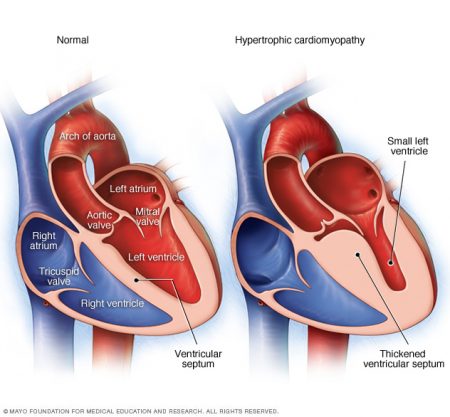
Like my daughter’s congenital heart condition, hyptertrophic cardiomyopathy (seen in the image above on the right) is associated with a range of gene mutations on one or more chromosomes. The research to date indicates 8 different gene mutations are linked to the disease. One of those genes is the MYBPC3 mutation which can be passed on to the child by either parent. It is defined as dominant inheritable trait which means only one copy is needed from a parent for the child to exhibit the mutated gene.
What does MYBPC3 do?
It provides important instructions that affect the contractions of the heart muscle. Specifically, it alters sarcomeres, the cells which make up the thin and thick filaments within the heart muscle (see image below). When the mutation is not present the sarcomeres work conjointly to create normal contractions. But when the MYBPC3 mutation is present the protein carrying instructions responsible for creating the heart produce errors in the natural configuration of these cells. And although the mutation may be asymptomatic, in 30% of cases the heart muscle will thicken to a point where symptoms occur.

The latest research from Oregon Health and Science University, Portland, that was published recently in the journal, Nature, attempted an experiment where mutated MYBPC3 genes were targeted using CRISPR/Cas9 to substitute good genetic information for bad. A total of 58 human embryos not destined for implantation were targeted. The team successfully corrected the genetic information responsible for the defect in 42 of the embryos while not causing any unwanted genetic changes in the remainder of the genome. Normal copies of the MYBPC3 gene were implanted using the Cas9 protein which serves as the knife tool within CRISPR. First Cas9, working with the embryo’s own RNA guide molecules selected the place for editing the gene. Once the defective gene was excised, it was replaced with healthy genetic information. Upon completion, the cell’s machinery carried on as if nothing had happened.
Such a technology, if replicated in treating other congenital diseases at the embryonic stage, would be revolutionary. Then parents who were known carriers of harmful genetic mutations based on DNA analysis and a comprehensive family history could have doctors intervene at the embryonic stage to correct life-harming and life-ending defects.
Of course, the dark side of speculation by journalists covering the story led to headlines that declared “designer babies” are in our future. Parents with perfectly normal medical histories and DNA exhibiting little in the way of harmful mutations could decide they wanted a child with blue eyes even though both of them had brown. Or some could request doctors to alter other genetic information that could bestow on an unborn child improved physical strength or mental acuity.
Making a human is pretty straightforward — it happens daily with no training. Tradition and evolution points to sex as the way we humans have reproduced for millions of years. But this is changing fast. Today more couples are turning to in vitro fertilization (IVF) to have babies.
IVF is an assisted reproductive technology where fertilization happens by combining an egg and sperm in a laboratory dish, and then transferring the resulting embryo to a uterus. In 2014, more than 65,000 babies were conceived with the help of IVF representing 1.6% of the 4.0 million annual births in the United States.

Over the past decade, the number of IVF procedures has skyrocketed from 113,000 in 2003 to more than 165,000 today. This trend is facilitated by decreasing costs of IVF procedures and increased successful uterine implants. In the last 10 years, IVF costs have fallen from $20,000 to approximately $10,000 per procedure while successful pregnancy rates have increased from 20% to greater than 50%. For 6.1 million women in the United States suffering from infertility issues this technology means a chance to have a baby where none existed before. And in 17,000 cases in 2015, women have used a donor egg to become pregnant.
IVF also gives couples the ability to fertilize up to 8 to 10 eggs at a time. These can be grown to a blastocyst (the first stage of development that occurs to an egg after fertilization when it begins differentiating into a multicellular organism). The healthiest blastocyst can then be selected for implantation into the mother’s womb. I believe that IVF may eventually be the “standard” and most widely accepted way to reproduce in the not too distant future.
Egg Freezing
As women continue to further their education and careers, many face deep anxiety about having children later in life since fertility rates decline by two-thirds by age 40.

The new solution to this aging challenge is the ability to freeze healthy eggs harvested from earlier in life. Egg freezing is becoming a way for women to reproduce to a timeline of their own choosing, not one dictated by a biological clock. Between 2009 and 2013, as depicted in the graph below, the number of women choosing to freeze their eggs at fertility clinics in the United States grew 700%.

Carl Djerassi, inventor of the contraceptive pill, commented on this trend, saying, “In the next 20 years, more young people will freeze their eggs and [sperm] in their 20s, and bank them for later use. They will do away with the need for contraception by being sterilized, and withdraw their eggs and sperm from the bank when they are ready to have a child via IVF.”
Designer Babies
If you had the ability to tinker with the genetics of your baby, would you? What if you could prevent a hereditary disease? Might it become “unethical” to NOT correct genetic errors? Since we discovered CRISPR/Cas9, a tool used to “edit” the human genome with incredible precision, these questions are no longer theoretical and philosophical. Just three years after its initial development, CRISPR is already widely used by biologists as a search-and-replace tool to alter DNA. And by editing the DNA of cells or an embryo (germline engineering), it becomes possible to correct diseased genes and pass genetic fixes on to future generations. Such a technology could be used to rid families of genetically transmitted diseases such as cystic fibrosis and muscular dystrophy. This could be as important to the 21st century as vaccines were to the 20th.
By some measures, U.S. public opinion is not particularly negative toward the idea of genetically modifying babies.

The Pew Research survey results depicted above found that 46% of adult Americans approved of genetic modification of babies to reduce the risk of serious diseases. The same survey also found that 83% felt genetic modification to make a baby smarter would be “taking medical advances too far.”
At least three other centers in the United States are working on germline engineering. They are joined by scientists in China, and the United Kingdom. Recently a biotechnology company, OvaScience, in Cambridge, Massachusetts, raised over $132 million to advance research into producing children free of specific genes from inheritable diseases.
Correcting the DNA in a woman’s egg, or a man’s sperm, could be used in IVF clinics to produce embryos free of genetic-caused diseases. We may even see direct editing of DNA in an early-stage IVF embryo.
Life as we know it is becoming programmable.
Reproduction and Exponential Technology
Exponential technologies over the next two decades will play a role in the way we decide to bring life into this world. There are three new technologies specifically that may be the future of reproduction:
Implications
We are moving from evolution by natural selection to evolution by intelligent direction at an accelerating pace. Some may even say from Darwin to intelligent design. From the advent of birth control in the 1960s, to CRISPR/Cas9 today, we humans are increasingly capalbe of controlling how and when we reproduce. Technologies like CRISPR/Cas9 cut to the core of what makes us who we are. And it makes us ask whether humans should be exercising that kind of power, especially with features like eye and hair color, height, intelligence, and athletic ability.
These are moral and ethical issues that technology is making us question, forever changing human development and procreation.


